
The 1 thing that terrifies an optimist
Introducing the UNO reverse card of energy
In today’s Diary:
- Abu Dhabi is quiet
- Uno reverse: energy edition
- America’s worst “own goal”
- Gas from sunshine
- The view from my window in the Middle East
Hey Rational Optimist,
Greetings from a very quiet Abu Dhabi.
In the opening days of the war Iran launched hundreds of missiles and drones every day. It’s remarkable Abu Dhabi’s air defense system swatted virtually all of them down like flies.
But it freaked out a lot of people. Roughly a third of my community has left. We’re the only family left in our little row of homes. Some went back to their home countries. Others are hiding out in places like Bali until the dust settles.
Aldar (Abu Dhabi’s largest property developer) is a good proxy for sentiment. Its stock cratered 40% since the war began. The real estate market is about to get interesting.
The rest of us are keeping calm and carrying on. I took the kids to the Warner Brothers theme park last Saturday. We walked straight onto every ride. Didn't queue once.
The only places closed are the schools. Remote learning sucks, forcing me to run an AI learning experiment with real stakes on the line. I’ll write about this soon.
Thanks again to all the ROS members who sent well wishes. The wife and kids are doing fine.
Iran did something no military had ever achieved…
It closed the Strait of Hormuz.
Roughly 20% of the world’s oil flows through a narrow passage of water between Iran and Oman. And it’s closed for business right now.
Iran threatened ships. But what stopped traffic was seven insurance clubs in London withdrawing war-risk coverage. What good is insurance if it’s canceled the moment you need it?
Oil prices rocketed past $100/barrel for the first time since 2022. Gas markets are also getting slammed.
Qatar controls the world’s largest natural gas export hub. It’s shut due to an Iranian drone strike.
With Qatari gas knocked out a bidding war broke out on the open ocean. A tanker shipping gas to Europe turned around mid-voyage and pivoted toward Asia because Asian buyers outbid the Europeans!
If there's one thing that terrifies a rational optimist…
It’s expensive energy.
Energy is the bedrock of all innovation. Energy use is our “speedometer” for civilizational progress. There is no such thing as a rich, low-energy country, and there never will be:
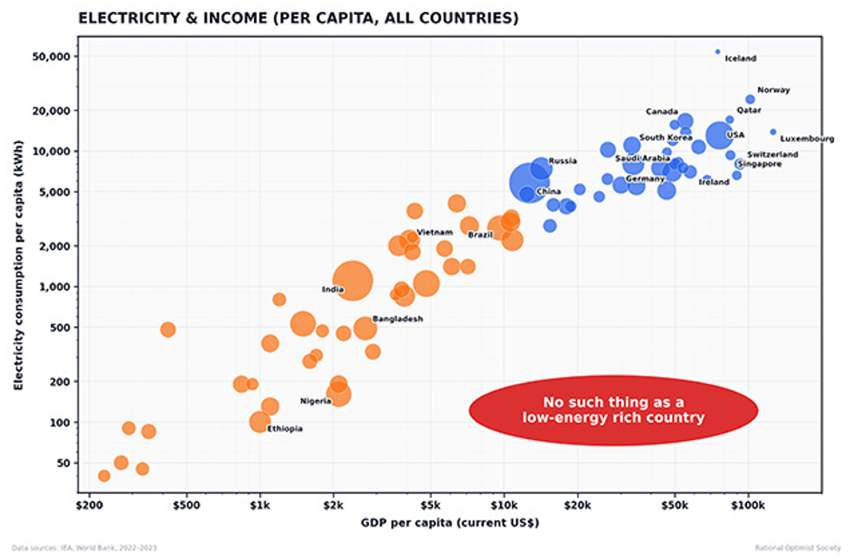
What happens when our master resource gets expensive?
We’ve seen this movie before…
In 1973 Arab members of OPEC imposed an oil embargo. Oil prices quadrupled within three months.
Americans found themselves waiting in long lines for lines. The economy plunged into recession. The 1973 oil shock ended the era of reliably cheap energy:
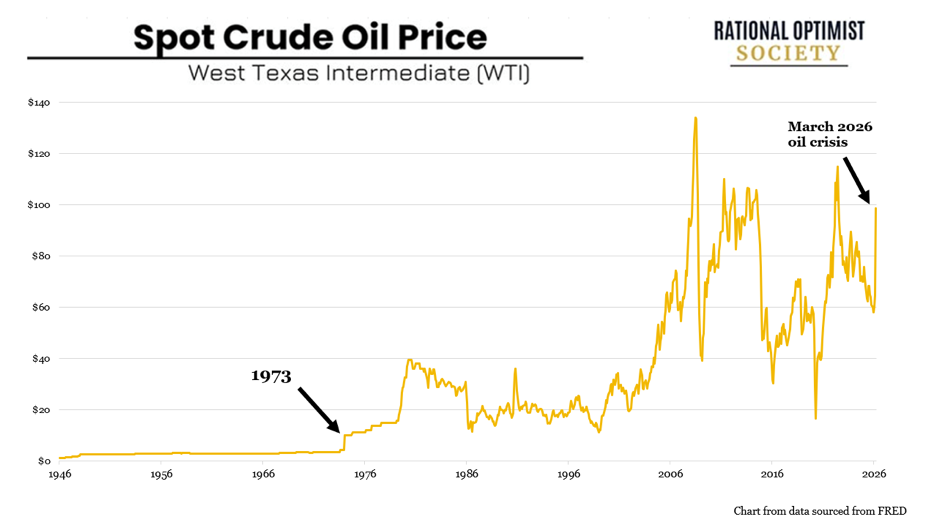
Before 1973 the physical world was galloping. Real wages had doubled since 1945.
One generation built the Interstate Highway System, the polio vaccine, the transistor, the precursor to the internet, and walked on the moon. It was the most compressed burst of innovation in physical infrastructure the world had ever seen.
That golden era of innovation didn’t end because we ran out of ideas. It ended because energy got expensive.
After the 1973 embargo American energy use per person—which had risen at roughly 2% annually for nearly two centuries—dropped for the first time. And it never fully recovered:
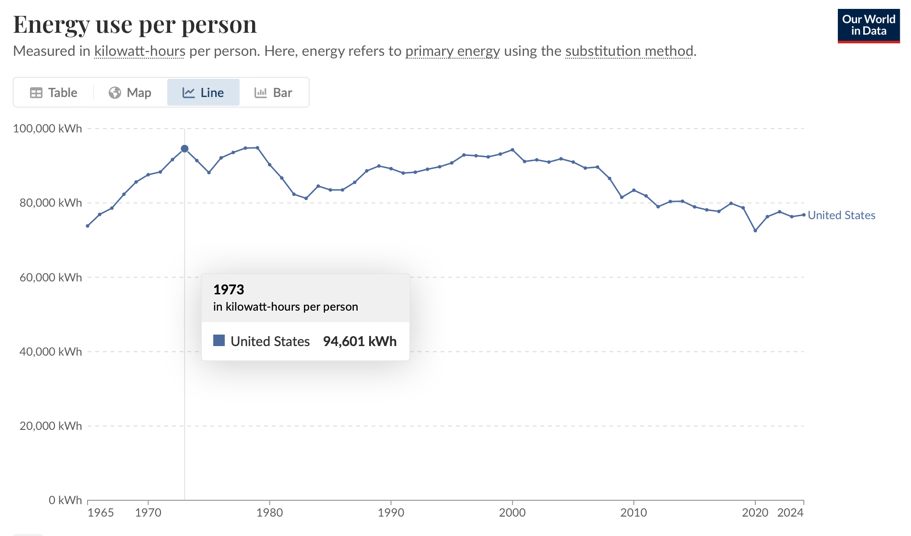
Economist William Nordhaus found America’s post-1973 slowdown was concentrated almost entirely in the most energy-intensive industries.
Expensive energy made building real things too costly and too unpredictable. The story that cheap foreign labor cracked open the US economy is a lie. It was shackled by the price of the energy it ran on, as we wrote in our multipart series WTF Happened in 2024?
This was the beginning of the innovation famine. Progress retreated into software, which didn't require cheap, reliable energy to grow.
Last time we made all the wrong choices.
In 1973 America sat on plenty of oil and chose not to pump it. But our biggest unforced error was not going all-in on nuclear power.
President Nixon responded to the Arab oil embargo with “Project Independence.” Mission: build 1,000 nuclear plants and make America energy self-sufficient.
Instead, Washington hatched a bureaucratic monster called the Nuclear Regulatory Commission that spent the next 50 years making it effectively illegal to build new reactors.
Jimmy Carter put on a sweater and asked America to turn down its thermostat. The nation that just walked on the moon decided the answer to expensive energy was to use less.
We snatched defeat from the jaws of victory. We’re not doing that again.
Now it’s time to play the Uno Reverse Card on energy:
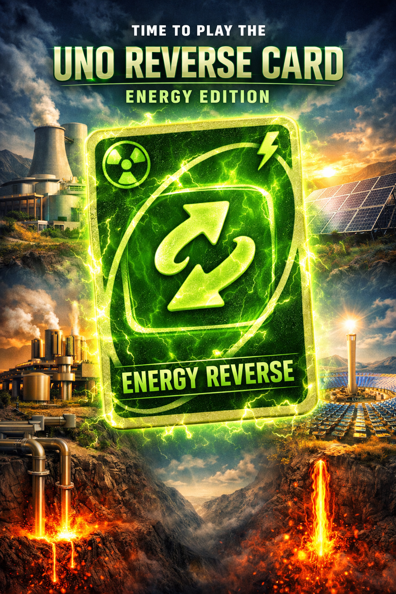
This time, the crisis becomes the catalyst for a sprint toward new energy sources.
Oil and gas aren't going anywhere. They’re being joined by what we call The Abundance Triad: nuclear, solar and geothermal energy.
1. Nuclear: Isaiah Taylor's great-grandfather helped build the bomb.
Ward Schaap was a nuclear physicist on the Manhattan Project. His great-grandson grew up hearing those stories and by the time he was in high school knew he wanted to reinvent how we make reactors.
Now Isaiah, founder of our No. 1 nuclear seed Valar Atomics, is pioneering America’s second atomic age.
Isaiah’s vision is to build “gigasites,” with 1,000+ microreactors clustered together, pumping out far more power than any existing plant.
Isaiah’s gigasite concept is regulatory arbitrage. Most of nuclear’s regulatory cost and delay isn’t from certifying new designs. It’s from licensing the site.
Since it takes the same mountain of permits to license one reactor vs. thousands on the same piece of land … why not cluster thousands there?
If Valar’s vision is realized, these gigasites could produce more energy than the hungriest AI data center can consume or the most powerful battery can store. To store the extra energy, Isaiah plans to use cheap nuclear power to make synthetic fuels.
In November Valar became the first startup in history to split the atom.
And last month three C-17 transport planes hauled Valar’s Ward 250 nuclear reactor from its California HQ to a site in Utah where it’s racing to switch on its first reactor by July 4.
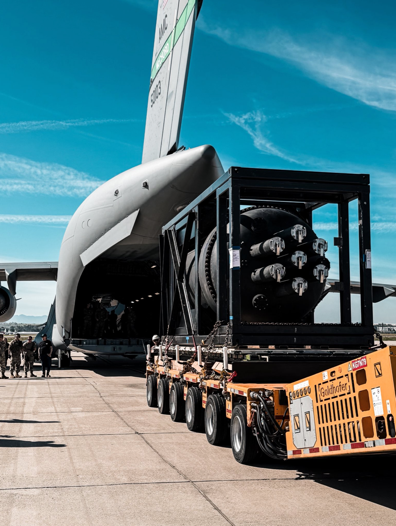
Source: Valar Atomics
This is what “0 to 100” looks like in an industry that usually moves in decades. I’m looking forward to seeing Isaiah again in El Segundo next week.
2. Natural gas: Casey Handmer is one of my favorite founders…
He talks a million miles an hour, like he knows there isn't enough time in the day to explain all the ideas ricocheting around his brain.
And his startup Terraform is building something very cool and very important: a machine that makes natural gas from sunshine, water and air.
The Terraformer in the background of this photo is essentially a portable gas plant powered by sunlight:
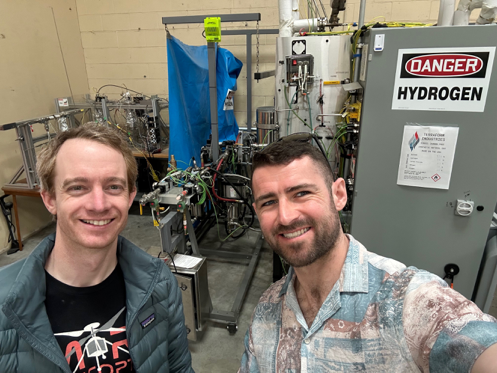
Solar panels on one side. Air goes in. A carbon capture unit strips CO2 from the atmosphere. An electrolyser splits hydrogen from water. Natural gas, just like what comes out of the ground in Qatar, comes out the other end.
The idea of making synthetic gas has been around for decades. What Casey figured out was the incredible 99% cost declines in solar energy finally made it economical.
Casey thinks at some point this decade it will be cheaper to make gas from sunlight than to pull it out of the earth.
When that happens the Qatars of the world lose their leverage. A shipping container in the Arizona desert will produce the same product at lower cost.
Terraform’s initial goal is to make jet fuel to power supersonic flight. Terraformers sitting next to Astro Mechanica jets on the runway? I’m all-in.
Congratulations to Casey, who recently welcomed his fourth child into the world. I can’t wait to buy him lunch and get an update on the business in Burbank, California, next week.
Deep beneath your feet the Earth is on fire.
Drill down 12 miles and you hit rock hot enough to melt lead. This endless furnace also contains enough heat to easily power all of humanity.
The problem is drilling deep enough. The Soviets dug the deepest hole ever in 1970, the Kola Superdeep Borehole in Siberia. They reached 7.6 miles down, and their drills kept breaking.
3. Geothermal: Quaise Energy wants to drill deeper than we’ve ever gone before.
Born in MIT’s nuclear fusion lab Quaise aims to bore 12 miles down into Earth’s crust, where rocks bake at 930°F—not with drills, but with lasers.
It’s building a machine that melts rock with high-powered millimeter waves. These microwaves vaporize granite like a blowtorch through ice:
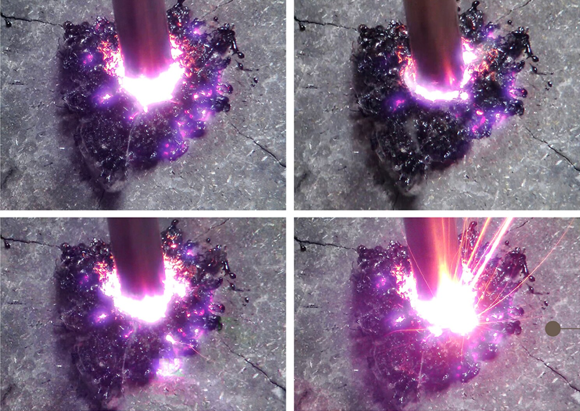
Source: Quaise
Last summer Quaise successfully tested its “energy drill” in Texas. It drilled 118 meters into solid granite, carving basketball-sized holes through solid rock. Quaise aims to drill a kilometer-deep well this year.
It’s early days. But if Quaise succeeds, one small geothermal well as narrow as a trash can could power an entire town!
The beauty of geothermal is the heat beneath the earth’s crust has been there for 4 billion years and will be there for many more, regardless of what’s happening in the Gulf.
My kids will be happy to know the floor really is lava. And a generation of engineers is now figuring out how to use it.
What makes me a Rational Optimist?
Knowing super-smart innovators are dedicating their lives to solving the thorniest problems.
This energy crisis is bad. But if this generation of builders succeeds, and I believe they will, energy gets cheaper and more abundant than at any point ever.
The other thing that gives me confidence is what I call the Great Handoff. In 1973 energy abundance depended on whether governments dared to go nuclear. (Spoiler: They didn't.)
Now the baton has been handed from politicians to builders. Big Tech companies are reopening decommissioned nuclear power plants and signing multimillion-dollar geothermal deals. They need the power.
Pay attention to founders like Isaiah and Casey building through the crisis. The Hormuz situation will eventually be a chapter in a history book. The energy infrastructure being built right now will power the next century.
I can see both ends of this story from my apartment window.
Thirty miles to the east: a burning oil terminal, hit by an Iranian drone.
Down the coast road to the west, two monuments to what comes next: the Barakah nuclear plant, the Arab world's first. And beyond it, Al Dhafra … 3.7 million solar panels stretched across the desert and powering 160,000 homes.
Both built here in the Gulf by a petro-state that looked at its own oil dependence and decided to bet on the future.
In 1973 the world faced an energy crisis and played the wrong hand.
Today we’re playing the Uno Reverse Card. And we will win.
—Stephen McBride


