
Welcome to Proto-Town
In today’s Diary:
Pink poodles & plastic astronauts
1,300 acres of controlled chaos
Robots + mud = affordable homes
Waymo for the construction site
Find your Rwanda
The first thing I noticed was the pink poodle.
She ran up to me as I walked past a giant plastic astronaut, guarding an inflatable hangar that looked like it had been airlifted from Soviet Russia.
I’d just driven 45 minutes south of Austin, down a long dirt road. So long my Uber driver looked back and joked, “Are you taking me out here to kill me?”
Now I was standing on 1,300 acres of Texan ranchland that I believe will be among the most important patches of dirt in America over the next decade.
Welcome to Proto-Town! What’s happening here is so under wraps I was sworn to secrecy on most of what I saw.
Proto-Town isn’t open to the public. I only snuck a few photos because I didn’t want to be accused of being a journalist.
If I had to describe Proto-Town in one sentence, it’s…
A commune for people building cool stuff.
Proto-Town is a private sandbox where regulators don’t harass builders. It feels like a cross between Galt’s Gulch and an early Shenzhen. Thanks to a development agreement with Caldwell County, a dozen frontier tech startups now iterate fast here without city inspectors breathing down their necks.
A research nuclear reactor is being built a quarter mile from where I was standing. Base Power is testing batteries there. Dynamo Air is developing heavy-lift drones that can carry 10,000 lb. loads.
I visited Proto-Town to meet Zach Dwiel, founder of Terran Robotics. After passing security, the guard told us to drive to the big white astronaut.
The poodle, Zul, belonged to Zach's co-founder, Danny. He moved from Indiana recently and now lives here full-time.
Nothing here is corporate.
Danny handed me a freshly brewed cup in a small kid's mug. It was the best coffee I drank in Texas.
The dozen companies on site essentially operate as a commune. The founders and crew all live in converted ranch houses and eat lunch together every day.
Proto-Town reminded me of a frontier town from a history book. It gave me the disorienting experience of traveling back in time and seeing the future of innovation in the same afternoon.
Proto-Town is one giant eccentric, regulation-skirting, “what-the-hell-is-that?” project. And if we want to revive America’s frontier spirit, we’ll need hundreds more of them.
A robot making homes out of dirt
That’s what Zach and his co-founder Danny are building at Proto-Town.
Picture an area about the size of a tennis court, with steel posts driven into the ground at each corner. Each post is linked to a single home-building robot in the middle, which looks like the claw machine at an arcade.
First the claw scoops up about ten pounds of pre-mixed earth and slaps it onto the rising wall. Then a hammer pounds the walls, compacting the earth.
I saw a wall about 12 feet tall rising out of the red Texas dirt. The robot scanned the wall in real time as it hammered away, making sure it was smooth:
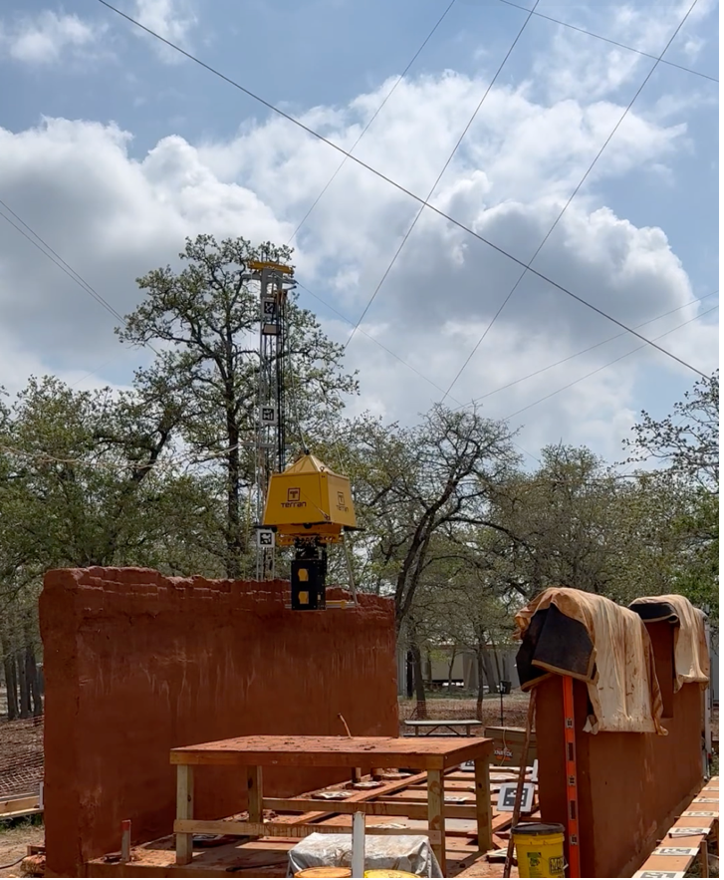
A robot building houses out of mud in hurricane country. Really, Stephen?
The material is called cob, and we’ve been using it to build homes for thousands of years.
The picturesque cottages of Devon, England, are cob. An estimated 20,000 cob homes still stand in Devon alone. Parts of the Great Wall of China are also cob.
It fell out of favor because it was extremely labor-intensive. Building a cob home by hand requires moving roughly 400,000 pounds of material.
Terran’s home-building robot, aka “The Terraformer,” solves that problem.
I touched a Terran wall and can tell you it was solid in a way the paper-thin walls of an American newbuild are not. It’s 5X to 10X thicker than a stick-frame wall. Punching it would break my hand before it would dent the wall.
A Terran home is a better home in a lot of ways. The walls hold heat for a week if the power goes. They absorb rather than reflect sound.
It also has the potential to be much cheaper. According to Zach a Terran wall will cost less than $10,000 all in. The materials cost is so low because the primary ingredient is the dirt under your feet.
Proto-Town is Terran’s first paying customer. Its biggest deal to date is with a developer in Houston to build ten affordable homes.
I asked Zach why he chose to build at Proto-Town first. “We're able to move so fast here. We wouldn't be able to do it anywhere else.”
Permitting that doesn't take a year for a wall. Hallelujah!
I walked down a long dirt road to the next startup…
On the way I passed a giant black-and-white billboard of Oppenheimer at Los Alamos. It stuck out like a patron saint of American innovation:
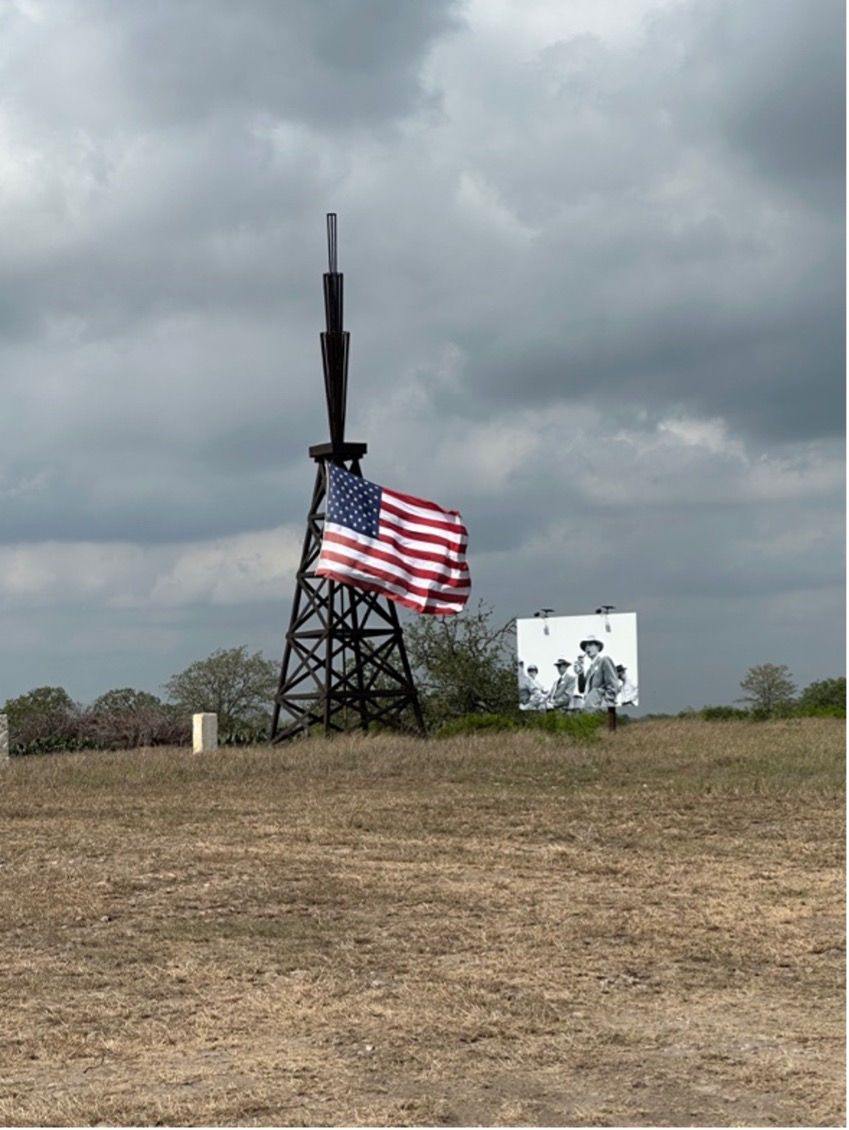
Then you come to a hangar housing giant yellow Caterpillar excavators. But these are no normal excavators. They are Bedrock Robotics’ robo-diggers.
As an ROS member you know Bedrock is doing for heavy machinery what Waymo did for cars: turning them autonomous.
Bedrock doesn’t make excavators. It builds an AI kit that’s essentially a brain transplant for heavy machinery. It installs in a few hours and turns the excavator autonomous, letting it “see” and “feel” the dirt.
Most autonomy companies, including Waymo, were built on hand-coded rules. If you see a red light, stop.
Bedrock skipped this step and went AI from day one. The AI “brain” watches and learns from humans.
Founder Boris told me a story that captures how good the AI model is getting. When a dump truck filled up and pulled away, the excavator started scooping loose earth to be ready for the next truck. Nobody told the AI to do that. It figured it out on its own.
Two Bedrock employees met me in the hangar. They handed me a hard hat and a hi-vis jacket. We piled into a pickup truck and drove to see the robo-diggers in training.
I watched the excavator smoothly dump a load of red Texas dirt into a waiting truck. The only reason I could tell a robot was doing the digging was the small blue light blinking on top of the cab, which means the machine is operating autonomously.
Then I met the top gun of the site. A young guy in his twenties whose name sat at the top of the leaderboard for most truckloads filled.
He climbed out of the excavator and showed me the screen inside the cab. The display showed what the AI sees. It looked like a video game, with the world around the bucket color-coded by depth.
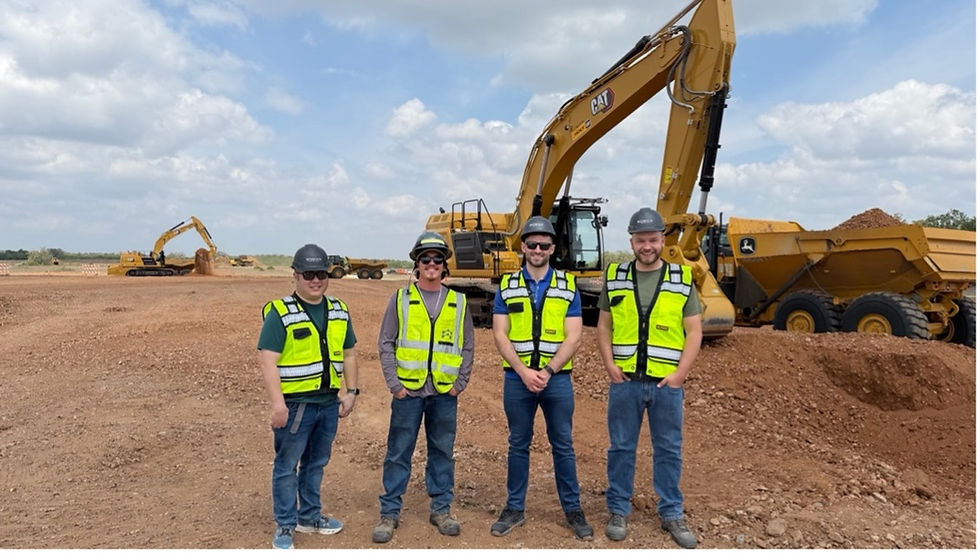
Dudes in hard hats and Carhartts, in the middle of Texas, pioneering a game-changing technology. Bedrock is a true American innovation story.
Bedrock will slash the cost of building stuff in America. And cheaper construction = more construction. We’ll get more of everything America spent the last 50 years failing to build.
If I were 20 years old and didn’t have kids…
I would have stayed in Proto-Town.
I’d trade my Louis Vuitton trainers for steel-toed boots and ask which of the dozen startups needed an extra pair of hands. It’s one of the most “alive” places I’ve ever visited.
The founders I met at Proto-Town are optimistic because they have looked hard at the problems and decided they’re solvable. We should all adopt that attitude.
Every hard tech entrepreneur should visit Proto-Town and see it for themselves.
America needs 100 more “Proto-Towns” this decade. Private sandboxes with friendly local government where you can test, iterate, and ship without city inspectors trying to shut you down.
I’ve met so many founders thwarted by dumb regulations I’ve lost count. You know the story of drone maker Zipline. The FAA wouldn’t let them fly in America. So the founders found a friendlier regulatory environment in Rwanda, which allowed their drones to deliver blood for medical emergencies. A decade later Zipline has saved tens of thousands of lives.
I often tell founders frustrated by regulations to “find your Rwanda.” That used to mean moving countries. Let’s stand up more Proto-Towns so we can build the best stuff right here.
If you’re an investor, fund the next Proto-Town. I’m serious. There are at least 100 pieces of cheap rural land where this model could be replicated.
Proto-Town also symbolizes the biggest wealth-creation opportunity of our lives. The coming decades will mint a new generation of fortunes for people who bet on hardware eating the world. The prize pools are 10X larger because energy, defense, manufacturing, housing and construction dwarf anything Silicon Valley touched so far.
And to all my fellow parents in Texas, tell your kids about Proto-Town. Tell them this is what America is about. Tell them they could build the next one. Try convincing their teachers to take a field trip there.
If you’ve happened to lose it, Proto-Town will give you back your optimism.
—Stephen McBride


