
America’s mucky hardware problem
In today’s Diary:
The space startup sewing parachutes
52 weeks to get one chip
99% cheaper overnight
A blade like an ant colony
Skills rarer than nukes
Hey Rational Optimist,
In my travels to meet America’s next generation of great founders, there’s an important story I’m hearing over and over and over again.
Exhibit A: LA startup Inversion Space. It builds maneuverable space capsules about the size of a refrigerator. Each one can park cargo in orbit for up to five years then drop it anywhere on Earth in under an hour. You can imagine the uses for this – military and otherwise.
Inversion needed specialty parachutes. The parachute companies said sure…
“That’ll be millions of dollars and 3 YEARS!”
Young companies must move fast. Waiting 3 years for a parachute is death. So Impulse bought its own sewing machines and started stitching parachutes at its LA headquarters.
Because in American hardware if you want something made fast, you have to make it yourself.
At El Segundo drone mass-producer Neros, I learned the radio they needed cost $25,000 off the shelf. Neros sells low-cost attritable drones for about $2,000, so that wasn’t going to work. Neros now builds its own radios.
At Antares, which builds nuclear microreactors in Torrance, the wait for machined metal parts was six months. So it’s making a lot of them in-house.
Boom Supersonic founder Blake Scholl told me one blade part for its jet engine cost $1 million and took six months to arrive. So Boom bought a $2 million machine and now makes the part itself!
Apex Space founder Ian Cinnamon shared a simple rule with me: “Can we get it, and enough of it? If not, insource it.” Apex’s first satellite was about 30% made in-house. Now it’s closer to 70%.
The problem: Doing it all yourself is slow, expensive and hard. It’s why so many hardware startups fail.
The source of this problem? For decades America outsourced the making of most stuff. Hardware suppliers shrank, and the ones that survived got used to serving a handful of customers in no hurry at all.
Now a new wave of startups wants thousands of parts in weeks. It’s a total mismatch.
But I have good news.
Hardware is on the cusp of its “AWS moment.”
There was a time not too long ago (2000) that, if you wanted to launch a serious website, you had to buy your own servers. And rent a locked cage in a data center to keep them safe, and hire people to babysit them. Marc Andreessen has noted that running a basic internet app this way cost about $150,000 a month.
In the early 2000s Amazon got good at running these giant data centers for its own store. And in 2006 AWS (Amazon Web Services) started renting out servers for as little as 10 cents an hour.
Jeff Bezos reckoned developers spent about 70% of their time on “muck”: the grunt work of keeping machines running instead of building their product. AWS let startups type in a credit card and get up and running in minutes instead of weeks. No big check up front. You just paid for what you used.
This changed everything for software. By 2011 Andreessen noted the same $150,000-a-month app cost 99% less thanks to AWS. The next year Facebook paid $1 billion for
Instagram, a photo app with just 13 employees that ran entirely on rented Amazon computers.
That was the starting gun for the “software as a service” boom—a whole generation of startups that no longer had to spend millions of dollars on servers just to get started.
Now AWS for atoms is coming.
Except this time it won’t be one company like Amazon underpinning the revolution. Several startups are doing for their piece of the supply chain what AWS did for software, each one cracking a mucky problem of making stuff in the real world.
Take turbines – which power not just jets, but many data center power systems.
A turbine is only as good as the metal blades spinning inside it. These blades spin in a blast of gas hotter than their own melting point. They survive because cooler air flows through tiny tunnels inside them. Slice one open, and it looks like an ant colony.
One small flaw in these tunnels and the whole blade is scrap.
That’s why more countries can build a nuclear bomb than can make turbine blades.
And every one of those blades is a casting: metal poured into a mold, a craft about 5,000 years old.
Rangeview founder Cameron Schiller is dragging casting into the 21st century.
The old way was painfully slow: you machine a steel die that costs $500,000 and takes eight months, then spend weeks dipping wax copies in ceramic goop to build the molds. Only then can you pour.
Instead, Rangeview 3D-prints molds straight from a computer file, ready to pour in about 12 days. No die or wax. And every new part is just a software update. It’s AWS for casting: no waiting and no big check up front.
This summer Rangeview won defense deals with the US Navy and with Kratos, which builds jet engines for drones and missiles.
Now Rangeview is heading into what Elon Musk calls “production hell”: the brutal jump from building a handful of something to building thousands. When we visited last month the team had cut a giant hole in the floor to fit a new melting machine the size of a kid’s bedroom.
Castings are so scarce the big blade makers are booked up for years. Cameron is already scouting Texas and other states for factory number two—one of many founders to follow the “launch in LA, scale in TX” playbook.
Hadrian makes precision metal parts for missiles, rockets and submarines…
Founder Chris Power says a part that once took 20 weeks now arrives in two.
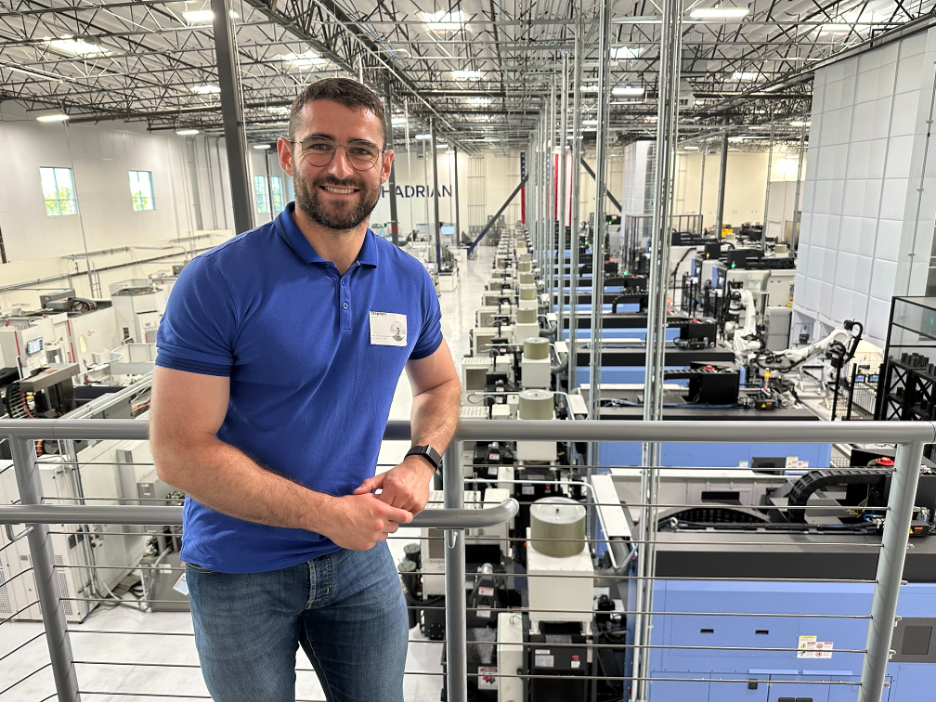
As with Rangeview, the secret is a factory that runs on software. I walked Hadrian’s LA floor and saw rows of computer-run machines the size of garden sheds whirring away. Spinning cutters inside carve parts out of solid blocks of metal.
Down the middle a giant robot arm slides along a conveyor and grabs finished parts. Two people can mind 20 machines. Here’s me on the stairs overlooking the floor:
And it’s scaling fast. Hadrian’s Arizona plant covers almost five football fields. Its new Alabama plant makes parts for Navy submarines. This month it bought a Pennsylvania foundry that’s poured metal since 1866.
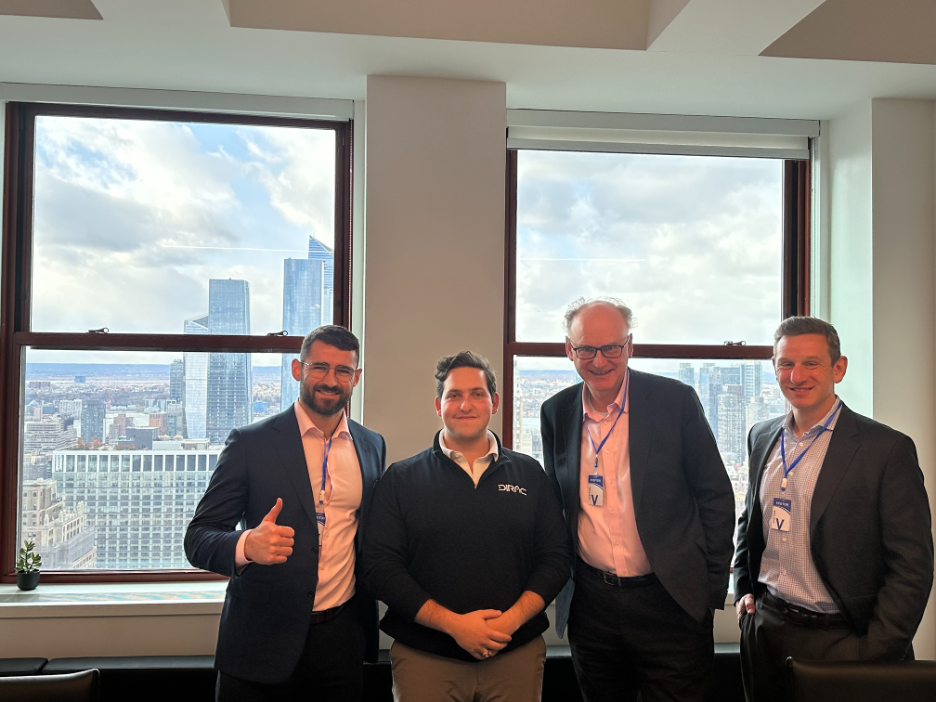
Fil Aronshtein calls his startup Dirac “the anti-software software company.”
It’s based in the Empire State Building, the skyscraper built in just over a year in 1931. Fitting for a company helping America build fast again.
Dirac turns 3D designs into step-by-step build instructions which is a job engineers usually grind out by hand.
Picture a recipe with a photo for every step, except the dish is a missile. The usual way to cobble them together is to screenshot the 3D model, paste it into PowerPoint, type out the step, and repeat for 100 pages.
With Dirac’s software you simply drop in a 3D model and out come the steps, each with an animation showing how the pieces fit together.
In January Anduril inked a multi-year deal. Writing one set of instructions fell from 12 hours to 90 minutes.
Anduril’s in-house software-tools team of about 280 people could have built this, but Anduril partnered with Dirac instead.
That’s the AWS for atoms playbook: Do a job better, faster and cheaper than your customers can. Buying from you becomes a no-brainer.
Every Falcon 9 rocket has about 1,000 bundles of cable that act as a nervous system.
Drones, missiles, fighter jets, and the car in your driveway all run on them too.
Most of these cable “harnesses” take six months or more to make and deliver. Senra Systems delivers in weeks.
Building harnesses is fiddly grunt work. It involves hundreds of wires cut, stripped and crimped, mostly by hand. Senra does it on demand. The company’s factories run on its own software. A technician photographs each crimp, and the system passes or fails it on the spot. Every inspection adds to a library of examples.
Should a cutting-edge rocket company spend scarce time and money on this? No. It should be building rockets.
We’ve now visited founder Jordan Black several times, and each time the operation was bigger. Last month we walked Senra’s new factory in Cypress, California. It’s 80,000 square feet, five times the room of its last home. Harnesses stretch along 120-foot tables.
This is what “production hell” looks like up close—and I mean that as a compliment. Senra is a startup scaling up, from about 1,000 harnesses a month toward 10,000 next year.
How do you tell the future giants from the also-rans?
First and most important: can they make the thing fast and in volume? Anyone can hand-build one beautiful prototype. Making the thousandth one just as well as the first and on time is what matters.
My second test: do they start narrow? The graveyard is full of startups that tried to do everything at once. If your first market doesn’t seem too small you’re doing it wrong.
Lastly the most underappreciated trait: does the system get smarter with every job?
Senra’s software learns from every harness. Rangeview’s foundry records every pour. This is the factory version of AI that keeps making itself better.
So who gets rich?
AWS made Amazon shareholders rich. But just as big a prize went to shareholders in the companies that made cheap computing made possible: Instagram, Netflix, Airbnb and the thousands more that ran on rented servers.
The AWS of atoms will do the same for hardware. Soon two founders in a garage could design a small jet drone on a laptop. Rangeview casts the engine blades… Hadrian machines the metal parts… Dirac writes the build instructions and Senra wires it up.
I expect the same explosion we saw in software after 2006. Thousands of new hardware startups. More shots on goal at cheaper energy, cheaper homes and more good jobs.
Imagine you knew in 2000 how AWS would lead to a Cambrian explosion of new software businesses. Maybe you’d have started a business. Maybe you’d have bought
Amazon stock or backed software startups. If you were young, maybe you’d have moved to Silicon Valley and joined a startup for early equity.
I think those opportunities will now repeat, but for atoms.
Startups solving “mucky” bottlenecks will thrive. Senra Systems (wire harnesses), Rangeview (casting) and Apex Space (space buses) are scaling fast. I know the founders and am more impressed every time I visit.
For all you young entrepreneurs out there, ask founders “what sucks” and listen closely. Every supply chain headache is a billion-dollar problem waiting to be solved.
If you’re a parent or grandparent tell the kids factories are cool again. We told two generations that working with your hands was a dead end. Talk about an unforced error. The future belongs to people who can make software and atoms work together.
Many of you forward these Diaries to family and friends and have watched them become more optimistic. Thank you and let’s keep the momentum going. You might be surprised by who’s receptive to these stories. Many people want to be optimistic – they just need a good reason.
Send them this Rational Optimist Diary!
Please hit like and restack, then share this with someone who needs a big dollop of rational optimism.
For full disclosure, the founders of Rational Optimist Society run a small fund that invests in companies we believe in. Our fund invests in Senra, Dirac and Apex.
— Stephen McBride


