
Introducing the first biology prime
In today’s Diary:
0 for 149
The medieval village method
600 boxes, 22 states, 149 false alarms
The world’s worst security guard
Shazam for the air
[Welcome to the 1,000+ new rational optimists who’ve joined us recently. You’re reading the Sunday Rational Optimist Diary, where we introduce you to ambitious innovators solving hard problems and improving the world.]
Hey Rational Optimist,
I’m standing in a warehouse in Redwood City, CA.
Pilgrim founder Jake Adler pulls what looks like a silver tobacco can out of the freezer and hands it to me.
I very carefully feel it, then hand it to Dan Steinhart, standing next to me.
Inside is anthrax.
"You wouldn’t believe how easy it is to buy this,” Jake says. “Basically they called me and said, ‘What is your experience working with anthrax, and what are you going to use it for?’ I said we worked with the government, and they checked my LinkedIn.”
The anthrax shipped in three days. (Technically it’s Anthrax Lethal factor, not live bacteria).
Many people are worried that bad guys will use AI to create a novel supervirus. But as Jake told us: "If you want to buy viruses and nerve agents and spread them, you just need to be a registered facility. That's not very hard to do."
Translation: we are surprisingly vulnerable to biological attacks.
And we’re shockingly incompetent at detecting them.
Since 2003 a government program called BioWatch has monitored the air in America.
It’s produced 149 alerts.
Every single one was a false positive!
BioWatch was useless during COVID. It could only detect six biological “agents” the government decided were threats back in 2003. Covid wasn’t one of them.
Jake, a Thiel Fellow, finds this unacceptable. He considers biodefense America’s most pressing problem.
So he’s building Pilgrim Labs into America’s first biology “prime.” Its first product is a black box called ARGUS that passively analyzes the air for bacteria, viruses, and other dangerous agents.
While we were with Jake and his head of Ops Mauricio, Jake showed us hats that read: Make Biodefense Great Again…
"Our joke," he said, "is when was it ever great?"
Meet Shazam for the air.
Remember the phone app Shazam? It listens to music and tells you which song is playing.
ARGUS “breathes” the air in a room and tells you what’s in it.
Here’s how it works: ARGUS sits passively, breathing in only a trickle, monitoring for biological material as small as half a micron across. When it detects something worth analyzing, it fires a “collection event.”
ARGUS then pulls in more air and spins it into a small cyclone, like a Dyson vacuum. It then flings the material into a thin film of water running around the inside of the chamber. A mini man-made hurricane to wash the air.
Whatever was floating in the room (pollen, bacteria, or a virus) is now sitting in a few drops of liquid. Anything alive in that liquid then gets cracked open, which releases its genetic material and the machine reads it.
The reader is a disposable cartridge. It packs a lab bench’s worth of chemistry, live enzymes and all, onto a 14-layer circuit board I could hold in my hand.
Known threats come back in under an hour. Novel threats – meaning something nobody has ever cataloged before - come back in three to four hours.
The chip that reads genetic material is not a new invention. Field biologists have been carrying pocket-sized sequencers for over a decade.
Pilgrim’s breakthrough is everything around the reader: getting enough genetic material out of thousands of liters of mostly empty air… with no lab, nobody in a bunny suit… and fitting it all into a portable box.
Pilgrim has an arrangement with the CDC to help stand up the agency's first airborne detection program. It’s on a shortlist with the Army for what may be the largest biosensing network in history, and is working with other defense and national security agencies.
The strangest thing ARGUS has detected so far?
Salmonella, in the room where Jake and Mauricio eat lunch.
When I asked Jake why he named his company Pilgrim, he said his favorite book growing up was Kurt Vonnegut's Slaughterhouse-Five. The main character is Billy Pilgrim.
The deeper meaning came when I asked whether he could’ve built Pilgrim anywhere but America. "No. There's a pilgrimage to the US for both me and Mauricio," he replied.
Jake was born in Toronto. Mauricio is Mexican.
A large share of America's most valuable companies were founded by someone who arrived on the proverbial boat. Musk came from South Africa. Jensen Huang came from Taiwan. The Collison brothers grew up in rural Ireland.
Innovators move to America because it is still the best place on Earth to have an “unreasonable” idea and be handed money for it.
In 1620 the Mayflower set sail. It landed with 102 passengers. By spring half had died, mostly from disease they couldn’t have detected.
For 400 years that has been our experience with respect to biology: you only find out once people start dying. That’s what Jake is changing.
On the company’s bathroom door is a poster that reads:
Men wanted for hazardous journey…
Small wages, bitter cold, long months of complete darkness, constant danger. Safe return doubtful. Honour and recognition in case of success.
That was Ernest Shackleton's recruitment ad for his Antarctic expedition.
Take out the cold, and you have an accurate job description for many hard-tech startups. Low pay, brutal hours, no certainty the thing works. And a shot at being part of something people talk about a century later.
A hundred years ago “founders” got on boats, crossed deserts and founded cities. The boats are gone now and the map is finished, so they start companies instead.
When I'm deciding whether to support a founder, I ask: if this person had been alive a century ago, would they have been on the boat?
I've never been so certain of a “yes” as I am about Jake Adler.
“Dedicated” doesn’t begin to describe Jake and his team. He started the company and “chewed glass” by himself for 2 ½ years before his first hire. He still lives in the office. Literally – his mattress is next to his desk. Dan asked him where he showers: “across the street at Stanford.”
Pilgrim is growing up, though. This was our 3rd visit. When we first met Pilgrim in April, the team was five people. A prior version of ARGUS was pulling air through an impeller torn out of a Dyson fan bought at a Target.
When we returned last week, it felt like watching a baby transform into a teenager. Pilgrim is moving into a new 20,000-square-foot space and entering what hardware builders call “production hell,” the jump from hand-built prototypes to real manufacturing.
Mauricio admitted that so far, they’ve made most of their progress through brute force, working like dogs. They know that doesn’t scale. They’re now building out a team.
To fund that, Pilgrim just closed its seed round, raising money from Peter Thiel, Brian Armstrong (Coinbase founder), Bryan Johnson and Dylan Field (Figma founder). We (the founders of the Rational Optimist Society) also invested in the Series A through our internal fund.
Since the round closed, Pilgrim has hired the man who oversaw biodefense for the World Cup, the former head of counter-WMD operations at the Department of Homeland Security, and the person who created the Emerging Leaders in Biosecurity fellowship
They were also able to coax Todd Ritter out of retirement. Todd spent his career building and deploying PCR machines in the Pentagon and 230 other active sites. He was at the Pentagon on 9/11.
I asked what got him out of retirement. He told me it used to take four tents, twelve tables, and a ten-man rotation to run PCR analysis. ARGUS fits it all in “a box that his fourteen-year-old granddaughter could run.” You set it up and walk away.
One reason we “get on the plane” so often is there’s no substitute for seeing a company’s progress in person. Any company can put on a nice half-hour presentation once.
But you can’t fake velocity.
In under 18 months, Jake and team iterated on 4 generations of ARGUS. The first was hacked together with off the shelf parts. Each got more capable and streamlined than the last. Here are the first 3 versions…

And the new v4:
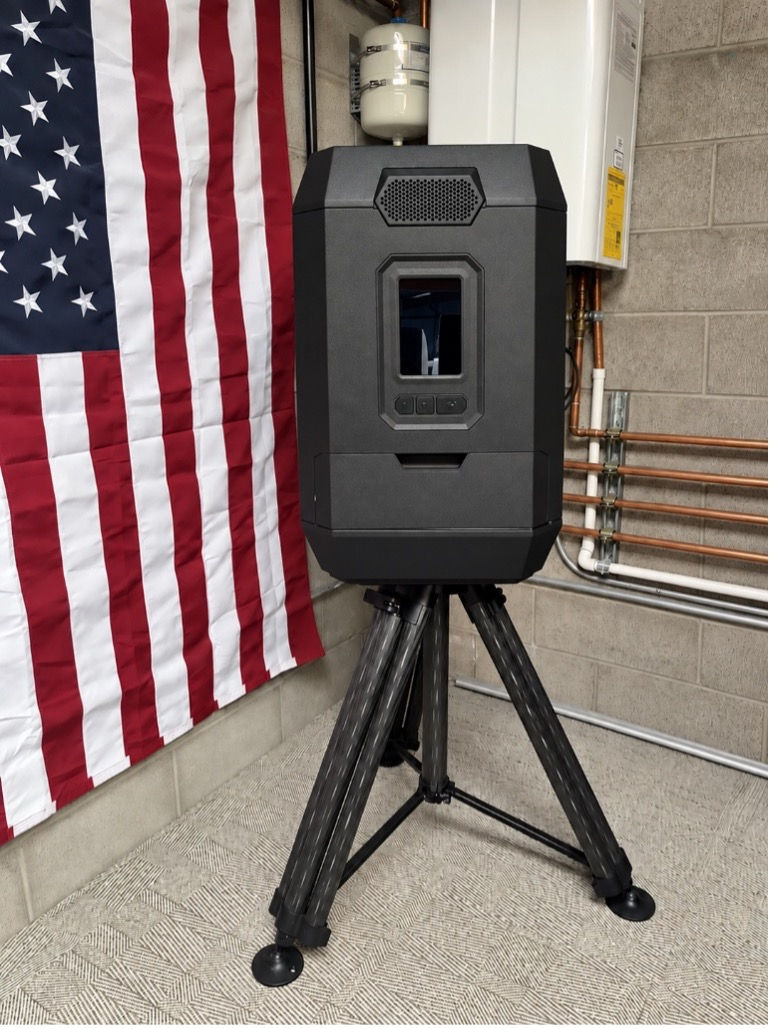
Although V4 will be first to be deployed for testing, they aren’t satisfied with it. They want to get it down to 50 lbs, make it run quieter, and tweak the design to make it look less imposing.
ARGUS is the first of many products Pilgrim plans to roll out on its way to becoming the first biology prime. Next on their priority list is Kingsfoil – a rapid blood-clotting wound dressing Jake invented and demonstrated on himself in a now viral video.
Reflecting on our visit, I realize BioWatch is a microcosm of what went wrong with America.
It’s NOT that we can’t build anymore. We can. America is still king of inventing things. The phone in your pocket and the chatbot you used this morning are both American.
The solar cell was invented at Bell Labs in New Jersey in 1954, yet China makes most of the world’s panels.
The magnet inside nearly every electric motor and guided munition was co-invented at General Motors, yet China makes most of those today.
The chemistry for separating rare earths was worked out at a government lab in Iowa in the 1940s, yet China does roughly nine-tenths of the world’s rare-earth processing today.
See the pattern? We invent but don’t deploy. My friend Eli Dourado has a chart I keep coming back to. It plots actual American productivity vs. the trend in productivity before the early 1970s. The gap is everything we invented but never deployed:

Pilgrim is filling that gap. Everything we need to read the air properly has been sitting on a shelf for years. Nobody bothered to assemble and deploy it.
“Nothing here is too novel,” Jake told us. “It’s not a science problem. It’s an engineering one.”
The threat of a bioattack is real. But doomers always leave out the part that founders are working 100-hour weeks on the solution. People like Jake and Mauricio, working to keep the good guys ahead.
Near the end of my second visit to Pilgrim, I told Jake the program he's trying to replace has been running longer than he's been alive.
"Oh, certainly," he said. "The BioWatch program was 2003… I was born in '04."
Jake has never lived in an America that could see what’s in its air. After visiting his lab, I’m convinced his generation will be the first.
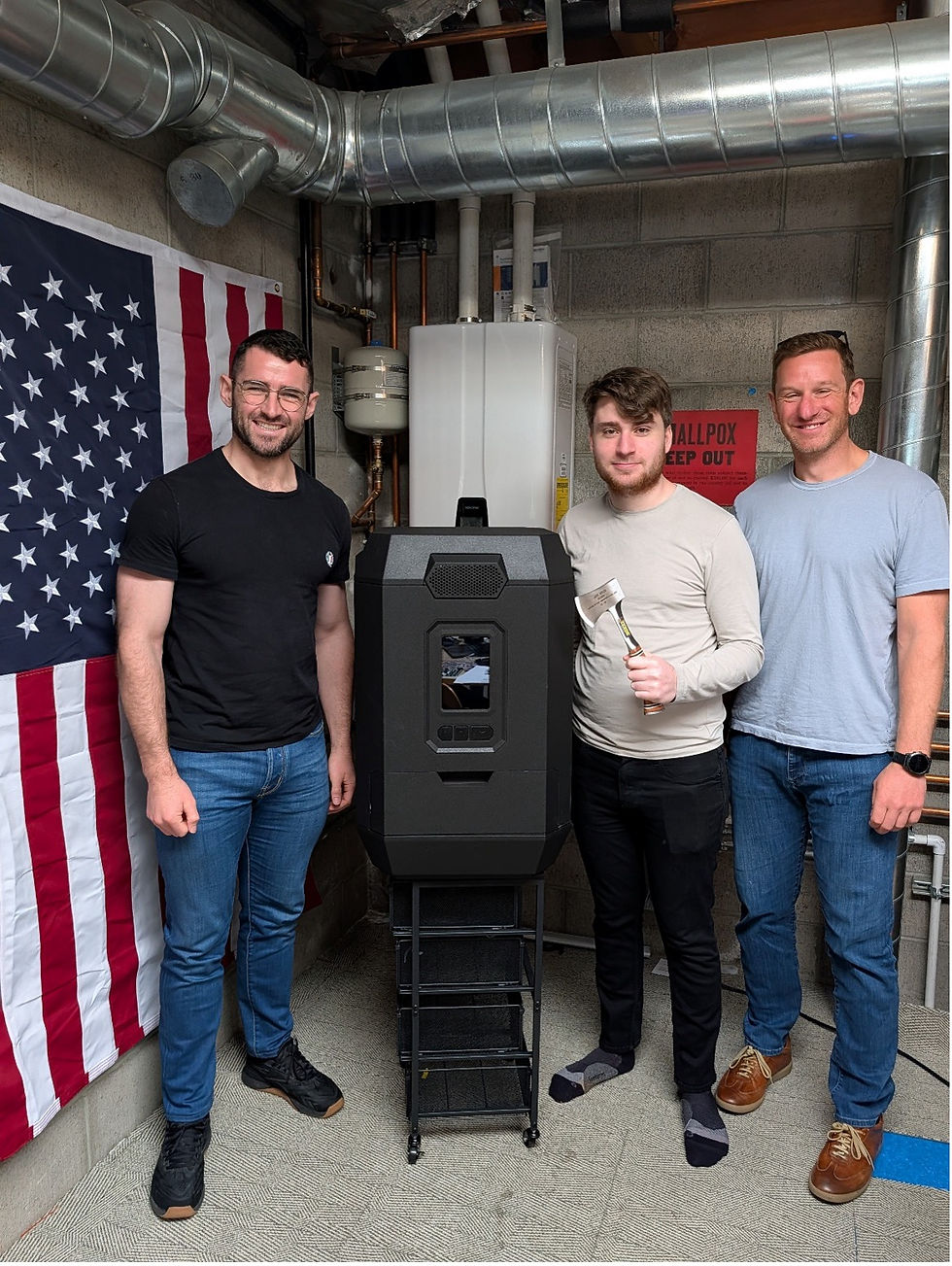
Here we are with Jake and ARGUS last week – his Innovator League axe in hand:
Pessimists fret. Rational optimists solve hard problems.
Now press re-stack and share this article with someone who’s rational optimist-curious. There are at least a million of us rational optimists out there – help us reach them!
—Stephen McBride


