
The best time ever to be 5 years old
In today’s Diary:
Hello from California
The Tesla Roadster of education
$100 for 3rd grade math
From a garage to 50 campuses
Dos and don’ts of using AI with your kids and grandkids
Hey Rational Optimist,
I’m writing from an AirBnB in Manhattan Beach, CA.
Dan and I are on a whirlwind 2 week research trip, taking 5-6 meetings a day. Yesterday we toured Neros’ massive new “Millenium One” factory that’s pumping out low-cost drones faster than anyone else in the western hemisphere.
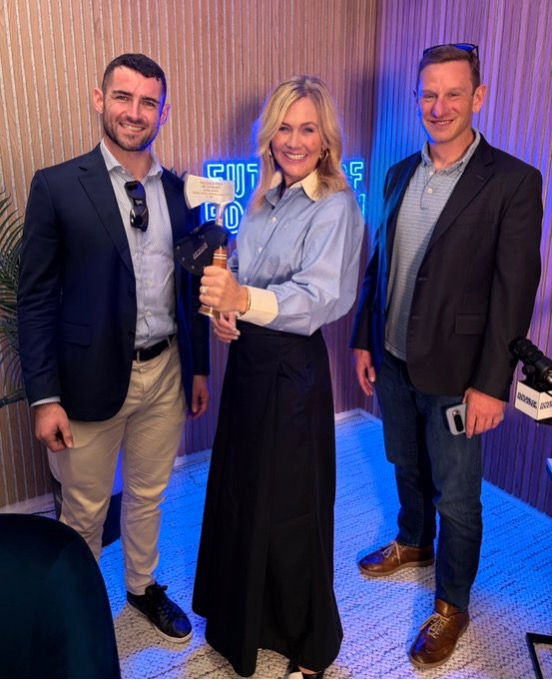
But for all the hard tech we’ve seen, I can’t stop thinking about our visit to Alpha School in Austin. Here we are with co-founder Mackenzie Price. She’s holding her well-deserved ROS Innovator’s League axe – reserved for the 30 founders doing most to improve the world.
The progress at Alpha School is amazing to see. Exactly one year ago, Matt Ridley, Dan and I spent a morning with three Alpha High seniors whose ambition, maturity and achievements blew our minds. Dan introduced you to them in his Deep Dive on the future of education.
This past May all three graduated.
Elle, the app builder, was valedictorian. This fall she starts at Stanford.
Sloane raised $500,000 for her incubator for creators.
Maddie, who created the first-ever Broadway musical written and performed entirely by teenagers, earned a plane ticket by scoring 790 on her math SAT and is off to NYC to meet with producers.
These kids are 18!
Last year 85% of Alpha parents said they saw their kid do something they thought impossible for their age. Alpha students score in the top 1% to 2% in the country for reading and math—in every grade, K-12.
How do Alpha kids achieve such incredible results?
It’s not just AI.
AI’s transformation of education is one of the most exciting things happening today.
This topic is near and dear to us. We started Rational Optimist Society to make the world more rationally optimistic for our kids. Better education will help raise millions more curious and confident kids who go on to improve the world.
Having written about AI education half a dozen times and experimented with my own kids, I’ve learned a lot about what works and what doesn’t.
Broadly, there are two ways to use AI in education.
The first way: build a brilliant AI tutor, put it in an app, and hand it to kids.
The second way: build a new kind of school around the AI.
The results are in
The school wins, hands down.
I'm growing more skeptical of AI learning apps. And more bullish on AI-native schools like Alpha.
The best evidence AI apps alone don’t cut it comes from Alpha itself. On its main campus kids learn about 2.6X faster than normal. But in Alpha's early homeschool pilot, families who got the identical software at home learned at about 1X. No improvement over regular school.
Last year a dad moved his three kids to Austin for Alpha and wrote up his family's story on the blog Astral Codex Ten. Before term started, he signed them up for IXL, the app behind most of the school's lessons. He said, "It was a fight every time” to get the kids to use it at home.
Then school started. One afternoon he took them to the park. They asked him to set up a Wi-Fi hotspot so they could do a few more lessons instead of playing.
What changed?
Incentives and teachers.
Alpha School Principal Joe Liemandt says every kid needs two things to learn:
A lesson at the right level… so the learner struggles enough, but not so much that it frustrates learning.
A reason to do it.
AI apps are brilliant at the first. They do nothing for the second.
Liemandt reckons self-directed edtech works for only 5% to 10% of kids. The other 90% need incentives and coaches.
That's why he made motivation the core of Alpha's design.
Alpha’s two biggest motivators are the same two things that get adults out of bed: getting to do something you love, and money.
In his first week Liemandt asked some fifth graders: “What would make you love school?”
"Less school."
"How much less?"
"No school."
So they made a deal. Work hard for two hours and you get the other four hours of the school day to do awesome stuff you love.
Liemandt went back to his software team and said: “We've got two hours, make them count.”
The code name for the software was Timeback, as in: give kids their time back.
In normal school the reward for finishing early is… more work. Or sit there and stare at the clock.
At Alpha focus buys you your afternoon, and slacking costs you. A "waste meter" tracks time spent skipping or scrolling and adds it back. A two-hour day can easily stretch to three.
Liemandt says time back is by far Alpha's biggest motivator.
That's why the app can't win on its own. Many school districts have asked for access to Alpha’s software, thinking it’s a magic solution to boost their student outcomes. Liemandt warns them: drop it into a normal six-hour day, and it won't work. If kids don't get their time back, they won't engage.
The second motivator makes people squirm…
Cash.
From kindergarten, Alpha kids earn Alpha Bucks for hitting their daily goals. They learn to spend it in the school store, save it in the Alpha Bank to earn interest, or invest it.
And cash is a shockingly good motivator.
Tell a 12-year-old he has to go back and redo fifth-grade math, and he's out. His parents are even less keen.
So Liemandt turned it into a game called "100 for 100." Score a perfect 100 on the state test, at any grade level, and win $100.
The kids aced the third-grade test, and each got a crisp $100 bill. Then they asked to try fourth grade. Another $100. Then fifth grade, which is where their gaps began. No 100.
So Liemandt had the AI tutor build the lessons they'd missed. They soon hit another 100.
For about $400 per kid, Alpha fills the holes and changes what kids think is doable. Liemandt says Alpha's K–6 building in Austin now gets more perfect scores on the Texas state test than a school district of 100,000 kids!
"But won't paying kids kill their love of learning?"
It depends on what you pay for. Harvard economist Roland Fryer found paying kids for big goals, like final grades, did little. Too far off, too abstract. Paying them for things they control, like reading books, worked.
MacKenzie Price explains it like this: Offer a kid $10 million to win Wimbledon, and it's useless. Offer $10 million to practice four hours a day for three years, and anyone can do it.
This resonates with me. I got kicked out of high school and landed at a school for delinquents. It paid me $38 for every day I showed up. I didn't miss a day in three years.
America spends roughly $250,000 on every public-school kid, from kindergarten to graduation. And yet high school seniors just posted the lowest reading and math scores in the history of the Nation's Report Card.
We already spend the money. Shouldn’t we start paying for what works?
When most people hear "AI school" they think
it means fewer teachers…
But walk into an Alpha campus, and you'll find about one “guide” for every five kids.
Guides have one job: showing kids their “why.”
Think back to the teacher who changed your life. It wasn't because they marked up your papers well. It's because they connected with you in some special way.
That means knowing which lever to pull for which kid.
One fourth grader loved the Denver Broncos. So his guide pulled up the class leaderboard and asked him: if this were the NFL draft, where would you go? He looked at his numbers and admitted he wouldn't get picked at all. From then on he took his work seriously.
A group of boys who were behind didn't care about Alpha Bucks. They cared about playing Fortnite. So Alpha made them a deal: hit your goals, and you unlock time to play together at school. The kids started doing extra math at night to earn more time playing with their friends. Some jumped multiple grade levels in four months.
Alpha has since rebuilt its home program around what works so well on campus. It starts with the two things AI alone can’t provide: specific motivation to reach goals and a guide for every kid.
Alpha’s home kids now learn about 2X faster than average. The home version started working when it stopped being just an app.
Every kid is great at something. In today’s “blob,” a kid who shines at soccer or drama but is average at math spends all day feeling average. Give that kid their own afternoon, and they spend half the day being great. And a kid who feels great at one thing starts to believe they can be great at other things too.
The mistake I made trying to leverage AI for my kids
I've seen the future of school, yet I still send my kids to a “normal” school in Abu Dhabi. Unfortunately there's no Alpha here yet. My wife and I won't homeschool either. We think the social side matters too much.
I did try to enhance my kids’ education though. I used to think a driven parent, especially an AI maniac like me, could build an AI tutor at home and accelerate their kids' education. I still think it's possible. But it’s not easy.
I had ChatGPT and Claude design a full homeschool program for my daughter and son. It didn’t survive contact with reality. ChatGPT's voice mode couldn't understand a five-year-old.
Next I tried Synthesis, the math tutor born out of Elon Musk's school at SpaceX. It's good, but limited. After a few days the kids got bored.
In other words, the AI is great. But kids still need a guide to motivate them, and I have a day job.
My biggest lesson: piling apps on top of school does more harm than good. My kids are at school seven hours a day and asleep for another 11. That leaves a few hours for dinner, exercise and just being kids. If I greet them after a long day with "here's an AI app, let's learn fractions," it's overkill.
Here's my advice to “AI curious” parents and grandparents:
Use AI to achieve specific tasks. In first grade, Dan's son Jack was behind in reading. He started reading aloud 15 minutes a day with the app Ello, and quickly caught up.
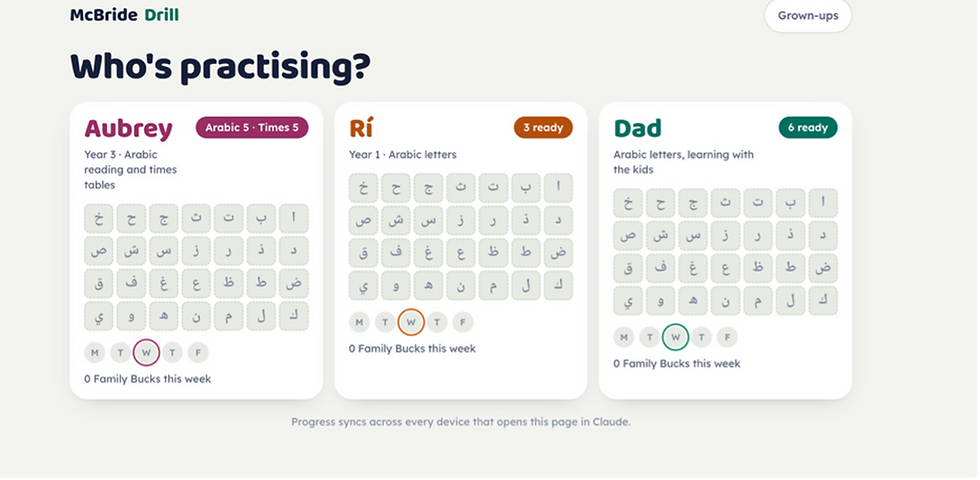
This week I had Claude build my kids a drill app for their Arabic letters. They earn Family Bucks and keep streaks. Every letter they learn gets a shiny glaze on their letter wall.
Look for an Alpha-style school. Alpha is opening in 27 new communities this fall. If you're in Texas, the new school-choice program pays about $10,000 per child. It funded more than 109,000 students this year alone. MacKenzie says more than 20 families moved to Austin to enroll from as far away as Switzerland.
If there isn't one, ask for one. That's how Puerto Rico got its campus. Local parents emailed Alpha and now Alpha Dorado is open. Alpha has a form on its website for bringing a campus to your city.
Talk to your principal. Most will say no. One in 100 will listen, and that could be enough to change your kid's life. Houston's public school district is trying Alpha's software in two elementary schools this year.
Most schools will be slow. Incumbents always are, especially when unions are involved. That's where you come in.
We started the Rational Optimist Society to close the gap between what’s possible and what people know about. No gap matters more than chasm opening up in education between proactive parents and everyone else.
It’s the best time ever to be five years old
Alpha started in 2014 with 16 kids in a garage in Austin.
This year it's growing from about a dozen campuses to around 50.
Yes, it's expensive. Tuition runs roughly $40,000 to $75,000 a year. But that's how every great innovation starts. Tesla's first car, the Roadster, cost about $100,000. Today you can buy a Model 3 for about $37,000.
School has always meant learning the same thing on the same page at the same pace. My kids' generation can be the first that doesn't have to.
My middle son is five. He'll finish school in 2039. By then I bet (and hope) school for a lot of kids will look like two focused hours in the morning and afternoons on whatever they love. (For my son, that's jiu-jitsu.) And evenings at home with the family, no homework.
As a dad, the Alpha School model has another appeal. Author Tim Urban did the math:
You’ll spend 93% of your in-person time with your kids
before they graduate high school.
Two-hour school gives us back the afternoons and evenings. Timeback is as much for parents as for kids.
I've been lucky enough to visit Alpha several times now. Every time I leave, I find it harder to send my kids to a regular school.
MacKenzie, Joe: please make Abu Dhabi your first campus outside America.
—Stephen McBride


