
The world capital of atoms
In today’s Diary:
Coffee with Elon
Drones meet meat fridge
Rockets by the beach
A Bat-Signal for lunatic builders
The real American Shenzhen
Hey Rational Optimist,
I just spent 41 hours on planes over two weeks. Almost two days of breathing recycled air, squeezing into sticky bathrooms and folding myself into economy seats.
It was disgusting. But man, was it worth it.
Why do I subject myself to this? Well, in 2002 you could have walked into a warehouse in El Segundo and met a 30-year-old internet millionaire named Elon Musk, just getting his startup called Space Exploration Technologies off the ground.
Now SpaceX is worth almost $2 trillion, and your odds of grabbing coffee with Elon are zero.
But the next Elons are working in warehouses around LA right now. And they’ll still answer your email.
So Dan Steinhart and I spent 12 days zigzagging across America, meeting more than 50 founders and investors—plus several ROS members.
It’s easy to become a pessimist from your couch. It’s hard not to be an optimist when you walk factory floors with founders grinding out 100-hour weeks on some of the world’s hardest problems.
There’s just no substitute for seeing things with your own eyes, and talking to the people building the future.
I’m more certain than ever that LA is the most important city on Earth for the next 20 years.
In four days Dan and I met with 18 companies around El Segundo, Torrance and Hawthorne.
We rented a car this time after racking up a $2,000+ Uber bill last time. LA is the only place where you can stumble upon multi-billion-dollar hard-tech startups. Driving around, we’d say, “Hey, there’s Hadrian. Look, it’s K2 Space.”
People say you can’t build anything in California anymore. That’s not what we saw.
For example, Neros – now America’s largest drone producer.
The best thing about visiting a founder multiple times is you see who’s really moving fast. When we first visited Neros last November it was in a small building in El Segundo, making about 1,000 drones a month.
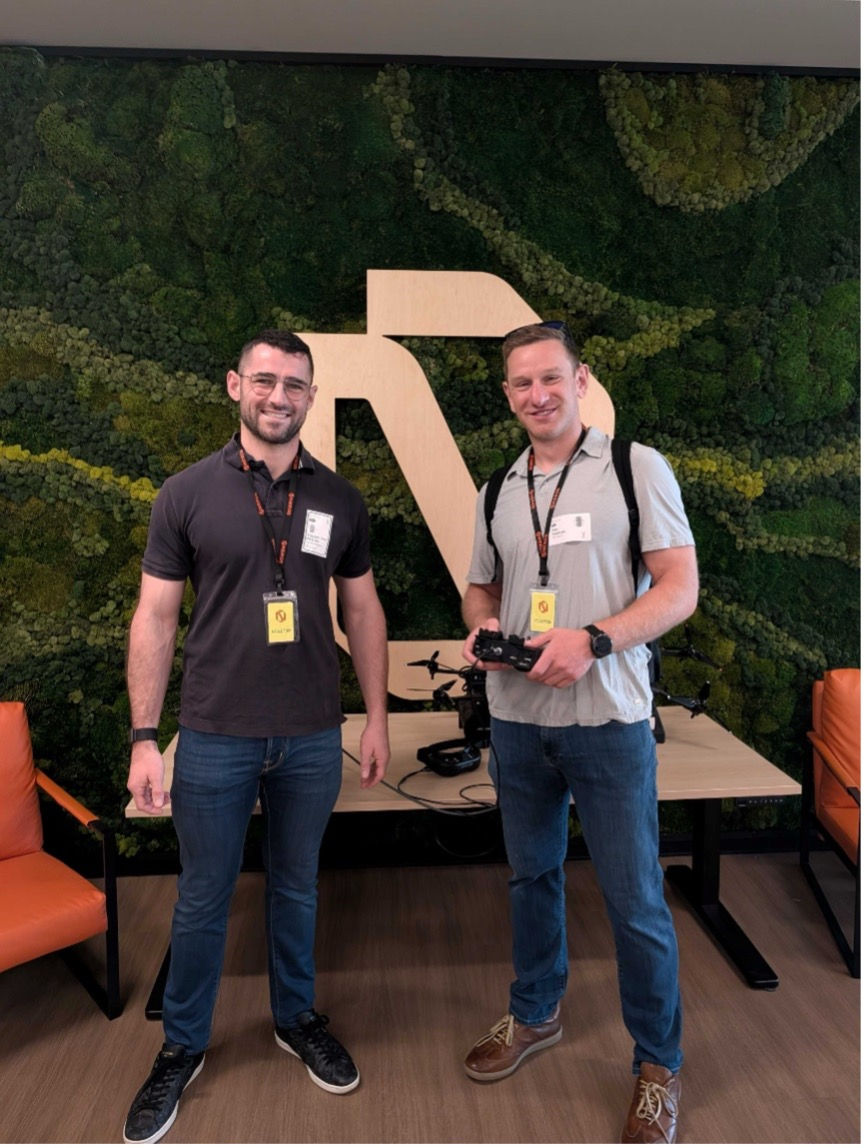
Now it makes more than that every week from its new 250,000 sq ft factory in Torrance, bigger than four football fields. Here we are with some of the equipment:
If one idea sums up LA’s bold ambition…
It’s Varda making drugs in space!
On Earth, gravity makes drug crystals sink and clump as they grow. In space everything floats, so medicine crystals grow more evenly, often in shapes you can’t make on Earth.
A small robot spacecraft rides a SpaceX rocket to orbit. Then a capsule three feet across brings them home, plunging through the atmosphere at 25 times the speed of sound.
The Pentagon pays to use each fiery fall as a test for hypersonic flight. And drug companies are coming aboard too: United Therapeutics signed a deal in May.
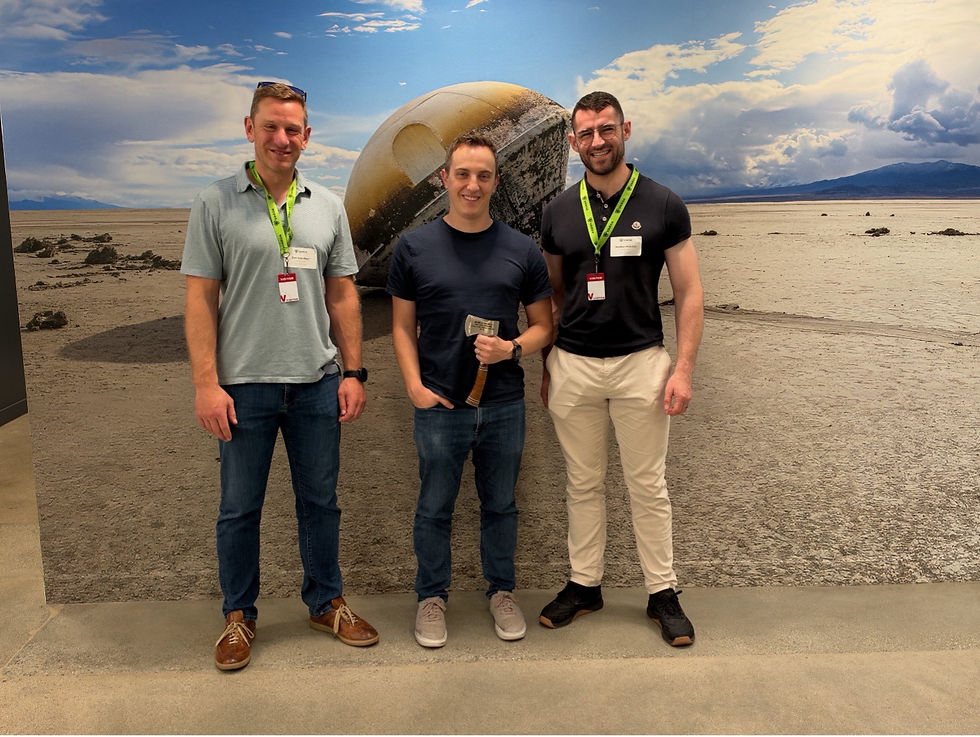
Here’s us with Varda CTO Nick Cialdella and the engraved axe we sent every company on our Innovators League 30.
Last November Rainmaker was testing drones in an old meat fridge.
Now its drones fly into winter storms from Oregon to Utah. This year it’s aiming to produce more water than all of California’s desalination plants combined.
Rainmaker’s drones release tiny particles that act like ice. Droplets freeze onto them and fall as snow, which melts into rivers in the spring. Heaters keep the drones flying inside icy clouds where a single frozen drop can snap a propeller.
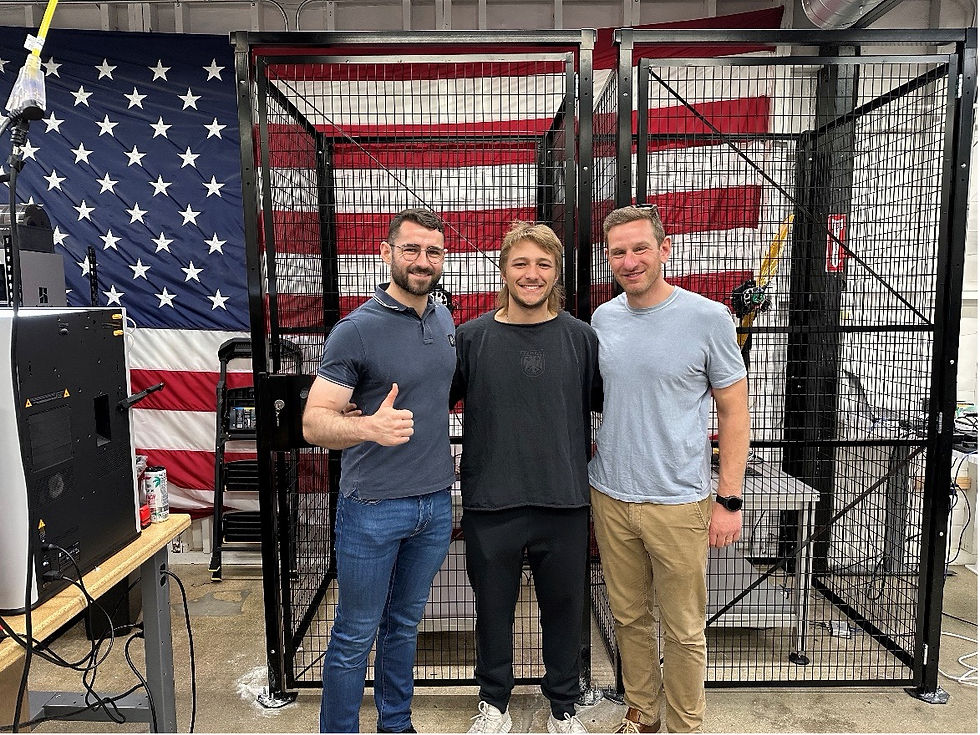
Augustus Doricko is an A+ founder, building the world’s #1 weather-modification company. Rainmaker is testing new seeding materials too. We got a sneak peek. More when they’re ready to share.
Picture a box the size of a small cooler…
Drop a hose into the ocean, press a button, and about six gallons an hour of fresh drinking water comes out the other end.
That’s Access, from Vital Lyfe. It weighs 25 pounds, runs on a battery or solar and costs $749.
Jon Criss and Andrew Harner started Vital Lyfe after 22 years at SpaceX between them. At their Torrance factory Andrew walked me down the production line and showed me how they’ve shaved seconds off every step.
It’s pure SpaceX: delete every part you can, then automate what’s left. What impressed me most is how simple the whole thing is. You press a button and it just… works.
The first buyers are boat owners, preppers and disaster-relief teams.
Andrew told us about a “prepper” at a conference who asked when she could get one. When Andrew said it would be a few months, she replied, “Oh, that’s too late.” As in, the world will have ended by then. We need to get her reading ROS!
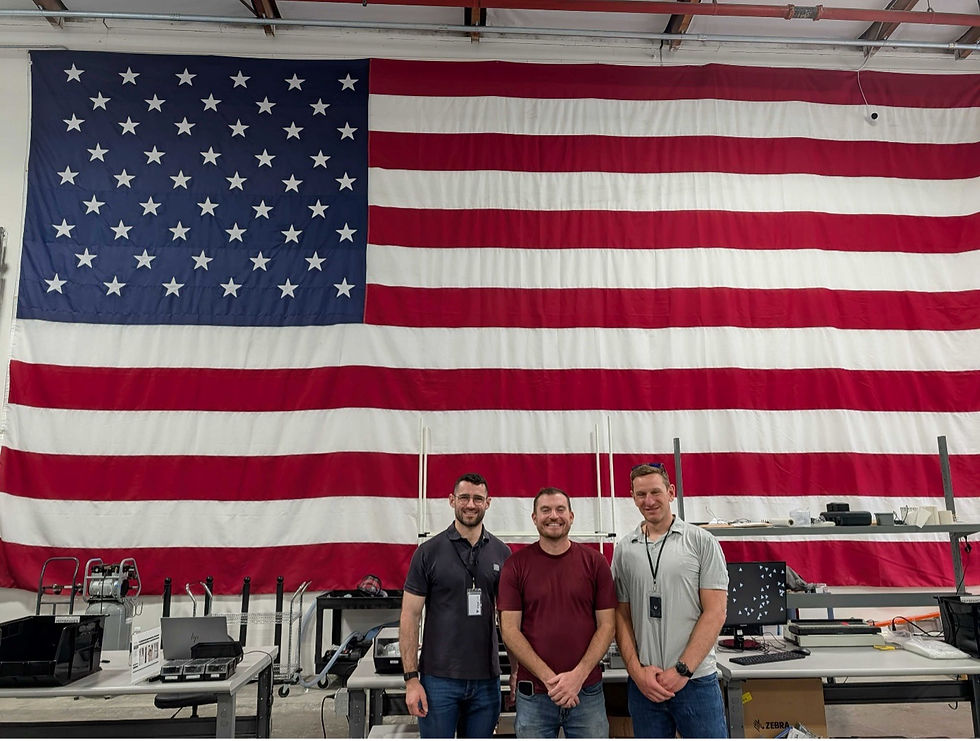
Plenty of you asked how to get your hands on Access after we showed it off in September. Now’s your chance. Units start shipping this week.
Drones… drugs in space… cloud seeding… seawater you can drink… all in one corner of Southern California.
Physical innovation is back, baby!
Picture someone born in 1920. By their 50th birthday they’d seen electricity and running water reach almost every home. The fridge replaced the icebox. Cars replaced horses. Then came antibiotics, TV, jet airliners and men walking on the Moon.
Now picture someone born in 1970. By their 50th birthday they’d seen the internet and smartphones. But they drove the same car… flew in the same planes at the same speeds… and lived in the same kind of house, which took longer to build.
Everything on a screen got faster, cheaper and better. Everything you can touch got slower, pricier and harder to build.
I rode the subway in New York last week, looking at a supercomputer in my hand while rattling through tunnels dug 100 years ago.
The whole digital world adds up to roughly 10% of America’s economy. The other 90% is made of atoms: energy, factories, transport, defense.
San Francisco was the most important city on Earth for the past 30 years because progress lived in bits.
LA is the capital of atoms.
The next trillion-dollar companies will build things you can touch. They’ll make things, launch things, fly things, mine things and power things.
Could you imagine anyone getting excited about visiting a factory 10 years ago? Now I’m disappointed if a founder doesn’t walk me across the factory floor to show off some cool hardware.
Factories are sexy again. And we have Elon Musk to thank.
“Want to come build rockets a mile from the beach?”
That was Elon’s pitch to young engineers when he started SpaceX.
He picked LA because it had been the capital of aerospace and motorsport for decades. Those industries knew how to build strong, light things cheaply. All 11 engines on the Saturn V rocket that carried Apollo 11 to the Moon were built there.
But for decades LA’s best engineers were stuck inside what my friend Nathan Mintz, founder of Epirus and CX2, calls “the big Soviet tractor factories”: Raytheon, Boeing and Northrop.
When SpaceX came along it was like a Bat-Signal for all the cracked engineers inside those companies. Finally, a place where they could move fast.
People can hate Elon’s politics. But he single-handedly kick-started the movement that’s rebuilding America. He also understood something important: build beautiful, inspiring things and you can lure smart kids raised on software back into the real world.
My favorite question for founders who used to work at SpaceX is: what’s the most important thing you learned there? The most common answer is some version of:
“You can do anything. Everything is possible.”
Now all these high-agency founders are graduating from SpaceX and reinventing everything from nuclear energy to manufacturing to defense. Forbes counted 140+ companies started by SpaceX alumni. Together they’d raised $11 billion and created more than 7,000 jobs.
Silicon Valley had the PayPal Mafia: early PayPal employees who went on to start YouTube, LinkedIn, Palantir and, yes, SpaceX. Now LA has the SpaceX Mafia and it’s already minting fortunes.
Take a short drive around SpaceX’s Hawthorne factory, and you’ll pass Reflect Orbital, which is putting giant mirrors in space to bounce sunlight onto solar farms.
You’ll stumble upon Astrolab working on a rover to haul cargo and astronauts across the Moon. And you’ll find Critical Energy creating geothermal power plants that ship in containers.
Every one of them was started by SpaceX alumni.
It’s a flywheel. SpaceX trains world-class engineers. The best of them leave to start companies down the street. Those companies train the next wave.
Draw a 10-mile circle around LAX and you’ll find 72 of the frontier-tech companies we track. That’s more than the UK and France combined! LA’s 16 most valuable hard-tech companies are worth a combined $2 trillion:
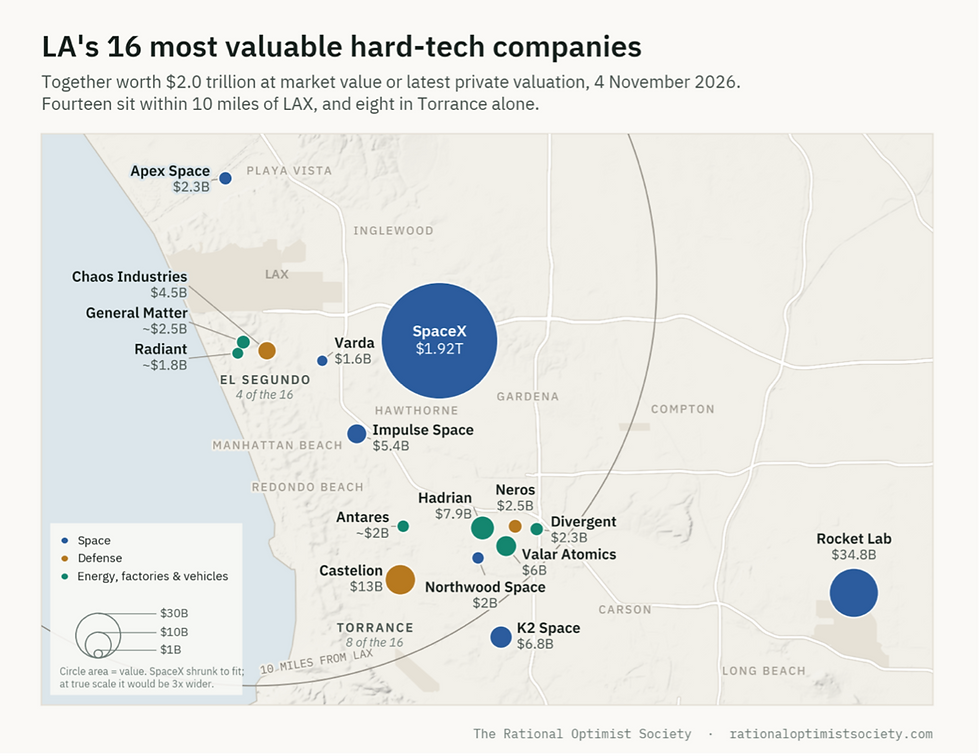
SpaceX accounts for $1.9 trillion of that. But keep your eye on the other 15. Together they’re worth about $90 billion and 13 of them didn’t exist 10 years ago.
American Shenzhen
Shenzhen, China, is the hardware capital of the East. Walk into its giant electronics market and you can buy almost any part you need. Need a custom circuit board? A shop down the street can make it by tomorrow. It’s where the world’s biggest drone maker, DJI, grew up.
LA is the only place an American version can happen.
Within 10 miles of LAX, you’ll find world experts in rocket engines, satellites, radar, nuclear fuel and metal 3D printing.
When Isaiah Taylor was building Valar’s first reactor, a batch of parts arrived from Texas, faulty. He posted about it on X. Within two days a local shop had made exactly what he needed. I can’t think of anywhere else in America where that’s possible.
“Why are these bright young entrepreneurs building their companies in California?”
That’s a question I get asked a lot, a question that appears in the comments of many ROS articles.
It’s true California’s bureaucracy is awful.
But most founders say the same thing: the bottleneck holding them back isn’t bureaucracy or capital.
It’s TALENT.
When it comes to building real things, nowhere matches LA’s density of talent.
Only a small number of people know how to build rockets, nuclear reactors or radar that aims weapons. And they’re clustered around the South Bay.
In investing terms, LA’s talent is the ultimate MOAT.
Now will these companies scale in LA? Probably not. I’d estimate 75% of them are using the “launch in California, scale in Texas” playbook.
By the way, I saw more American flags in LA than in Austin. Patriots should thank California. LA is the beating heart of America’s defense and industrial future… and it might just be America’s savior!
The best of these companies are still private.
Four “new nuclear” companies went critical this year. All four were private. Two of them, Antares and Valar, are from LA. Not one of the publicly traded reactor companies made the deadline.
Valar was founded on July 4, 2023. In August it raised money at a $6 billion valuation. That’s more than Oklo, the best-known reactor company on the stock market, which is worth around $4 billion today.
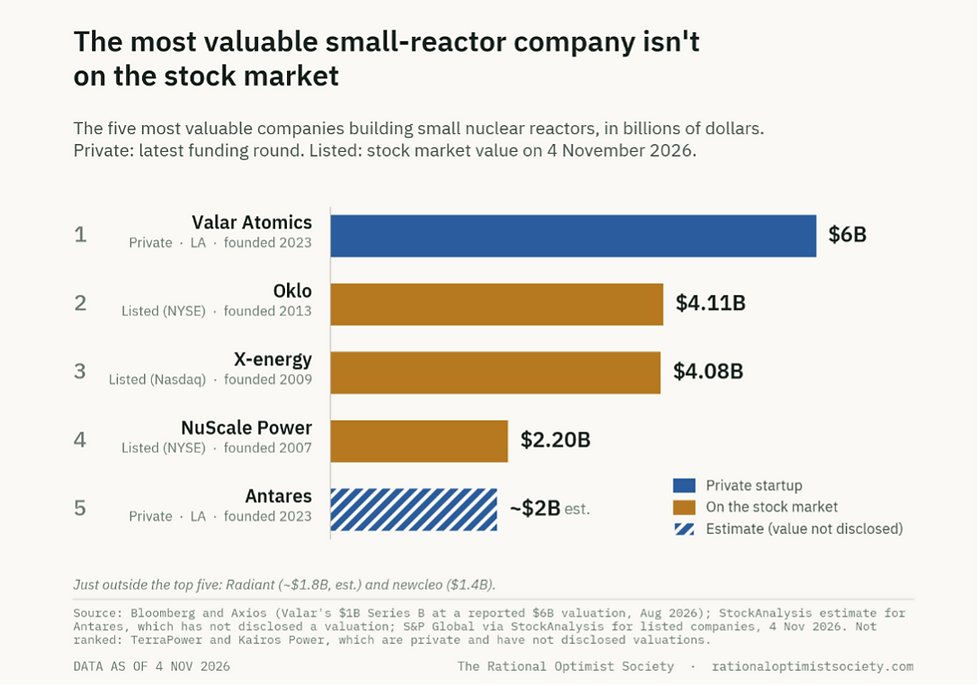
A stat that stopped me cold: 81% of American companies with over $100 million in sales are private. If you only follow the stock market you’re only seeing the tip of the iceberg.
One day people will talk about LA’s hard-tech boom the way they talk about Silicon Valley’s dot-com boom.
This is the most interesting and important trend I’ve seen in my career. And 95% of people have no clue it’s happening.
Fellow rational optimist, help us change that. We know the future can be bright because we know the hundreds of founders who are working to make it bright.
Spread the knowledge. Like and restack this article. If everyone reading simply clicks restack, we’ll be at 100,000 members of the Rational Optimist Society in no time.
—Stephen McBride


