
Yep, the singularity has begun
8 charts going vertical
In today’s Diary:
$76 billion in lizard spit
Four arms, no face, no backflips
The Henry Ford of space
An army of one + $20
The summer Texas didn’t sweat
Hey Rational Optimist,
In May I wrote a Diary titled Has the Singularity Begun?
Four months later, as progress continues to accelerate, I’m convinced it has.
More and more smart people are saying so.
Last month Stripe founder Patrick Collison said he “decided that January 1st marked the beginning of the singularity.”
DeepMind founder Demis Hassabis said: “Ten years from now, I think we’ll realize that we were standing in the foothills of the singularity now.”
Ray Kurzweil coined the idea of the “Singularity” in the early 1990s, predicting superhuman intelligence would tip progress into a vertical climb.
Many important charts are now exhibiting this vertical climb. Let’s look at 8 of them. I study and invest in innovation for a living and I can barely keep up.
New AI models used to come out once a year.
Now it’s every few weeks.
More than 80% of the code Anthropic ships is now written by its own AI. Last year that number was in the low single digits.
AI labs are using the best models to build even better models. A better solar panel doesn’t help you design the next solar panel. But AI is improving itself… which is why the models are rapidly improving… and why we’re burning quadrillions of AI tokens.
Tokens are the unit AI is measured in, the way electricity is measured in kilowatt-hours. One token is roughly three-quarters of a word.
In April 2024 Google processed 9.7 trillion tokens in a month. By May 2026 it jumped to 3.2 quadrillion. A 330X surge in two years!
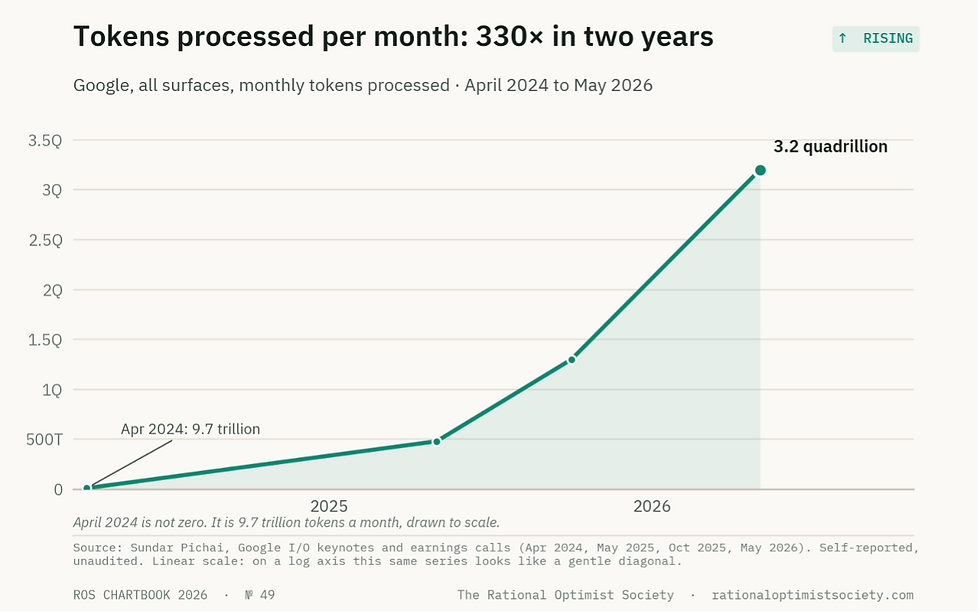
What this means for you. People are using a lot of AI. And even the best models from a year ago don’t compare to today’s frontier. You must pay for the top tier of Claude or ChatGPT. The most powerful productivity tools in history are only a click away.
There is no future scenario in which token consumption doesn’t soar.
In the 1990s a doctor named John Eng got curious about lizard venom.
The Gila monster only eats a few times a year. Eng wanted to know how it managed to stay alive. So he ordered dried venom from a catalog in Utah and got to work.
He found the lizard’s spit had a copy of a hormone you already make called GLP-1. It tells your brain you’ve had enough. But it only lasts about two minutes in your body. The Gila monster’s version lasts for hours.
Eng spent the next three years knocking on doors at the big drug companies. They all passed. Eventually a small outfit said yes. And in 2005 the first GLP-1 drug hit the market.
It stayed a niche diabetes treatment for over a decade. Then in 2017 Novo Nordisk engineered a version called “Ozempic,” which you only had to inject once a week.
In 2005 the market for GLP-1s was $75 million. In 2025 it was $76 billion, a 1,000X surge in 20 years.
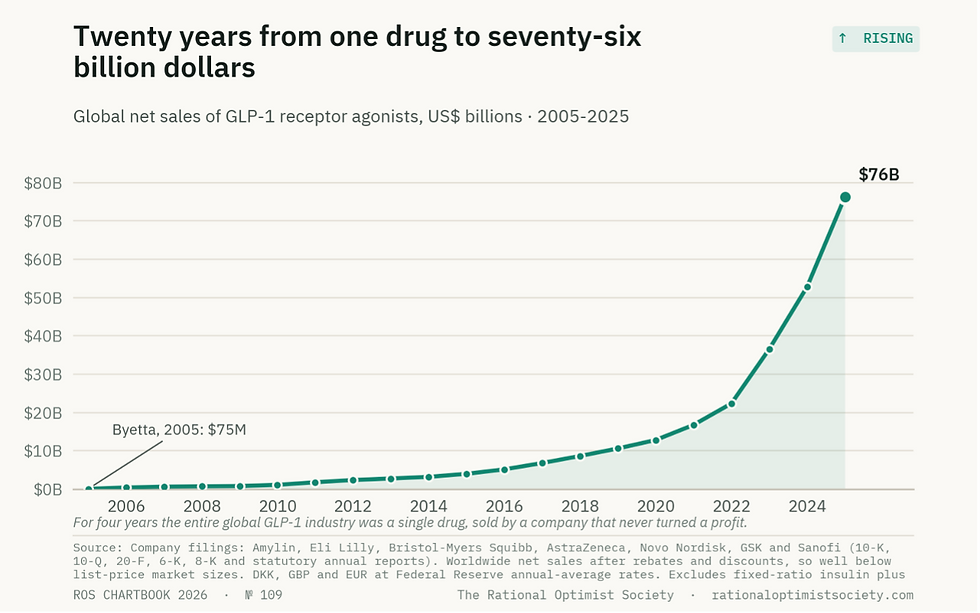
Americans got fatter every year for six decades. Now that trend is swinging the other way. Imagine what America would look like if it were thinner and less diabetic. How might communities change if addiction could be solved with a weekly injection? We’re about to find out.
I know people who did everything right but couldn’t shift the weight. They started taking Ozempic, and now they’re healthier, happier, and in better marriages. Huge life upgrade.
What this means for you. Can you believe this wonder drug was sitting on the shelf for over a decade? This is where AI hits medicine first: finding new cures in old drugs.
A 37-year-old man named Joseph Coates was in hospice with a rare blood disorder when an AI found a drug never tried for his illness. Now he’s in remission. The Singularity hitting medicine will save and improve many millions of lives.
A surgeon sits at a screen a few feet from the patient…
His hands are in two controllers, his face pressed to an eyepiece. Four robotic arms reach into the patient through incisions the width of a pencil.
The machine is called da Vinci. It’s a set of ultra-precise robot arms that never shake and can bend in ways wrists can’t. The camera gives the doctor a magnified, 3D view without cutting the patient open.
In 2007 surgeons performed 85,000 operations this way. By 2025 that jumped to 3.1 million. That’s one operation every 10 seconds, around the clock, all year:

What this means for you. Everyone is drooling over humanoid robots. But the real life-saving robots are already here.
Around 20,000 humanoid robots shipped worldwide in the first half of 2026, about 97% of them Chinese. That number will probably 10X in a few years. But I think they are a solution looking for a problem. Long specialized robotics, short humanoids.
In 2022 Ukraine built just a few thousand small attack drones…
In the first seven months of 2026 alone it pumped out 10 million quadcopters!
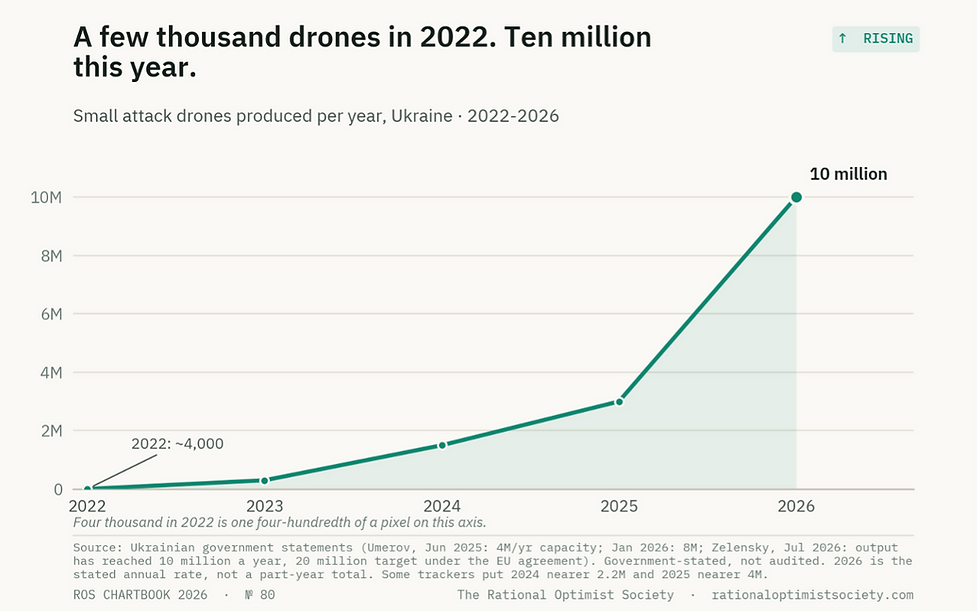
In June 2025 Ukraine ran an operation that will be taught in war colleges for decades to come.
It smuggled drones deep into Russia, hidden on the backs of ordinary trucks. The trucks were parked near Russian strategic bomber bases more than 1,000 km from Ukraine.
Then one day the roofs opened, and 100+ drones flew out. Over $1 billion worth of Russia’s strategic bomber fleet was destroyed by less than $1 million of drones.
What this means for you. For decades Western defense has been built on the exquisite weapon. One Patriot interceptor costs about $4 million.
Then Ukraine worked out that a few hundred dollars’ worth of plastic, a battery, a chip and some code can destroy a $5 million tank. Cheap things now destroy expensive things.
The good news is America is waking up. I know the founders of many of the leading defense tech startups flipping that math in our favor, and they are among the highest-quality, highest-integrity people I’ve met.
Three worth knowing:
Neros: Soren Monroe-Anderson and Olaf Hichwa are shipping thousands of small, very fast FPV attack drones a month, with a factory designed to make up to a million a year.
CX2: Nathan Mintz is building a suite of products to jam, spoof and knock out drones. Nathan shared his “hunt the archer, not the arrow” philosophy on this recent episode of Optimists Make Money.
Picogrid: Zane Mountcastle developed the connective tissue that lets every sensor, camera and weapon plug in and fight as one system.
One company now owns twice as much in space as the rest of civilization.
SpaceX has 11,093 Starlink satellites in orbit.
Every other government, military, weather agency and company on Earth has 5,538, combined.

I had my first Starlink experience flying from Dublin to LA. To quote Arthur C. Clarke, it was “indistinguishable from magic.” Eleven hours over the Atlantic, and the internet worked better than it does in most hotels.
Starlink now has 12 million paying customers. It just launched here in Abu Dhabi, and I’m considering ordering a dish.
What this means for you. SpaceX cut the cost of reaching orbit by around 95%, which is the only reason Starlink exists. The biggest opportunities will be in what cheap launch unlocks. Three private companies to watch:
Apex Space: Every satellite needs a “bus” (the frame carrying power, propulsion, computing and comms) onto which you bolt your payload. Founder Ian Cinnamon is the “Henry Ford” of space.
Varda: In microgravity crystals grow purer than anything achievable on Earth. Varda makes drugs in space and parachutes the capsule home.
Fortastra: Building “bodyguard satellites” that can approach, inspect, shadow and physically defend another spacecraft in orbit.
All three startups made our handpicked Innovators League 30 list. I’ve interviewed a handful of founders from the new space race on the Optimists Make Money show. None of them exist without SpaceX making launch cheap.
In 2010 the battery in an electric car cost $89,000…
Today it costs about $8,000. A 91% drop!
From 2010 to 2020 America built 3 gigawatt-hours of grid batteries, total. In 2025 it built 15X that… in a single year.
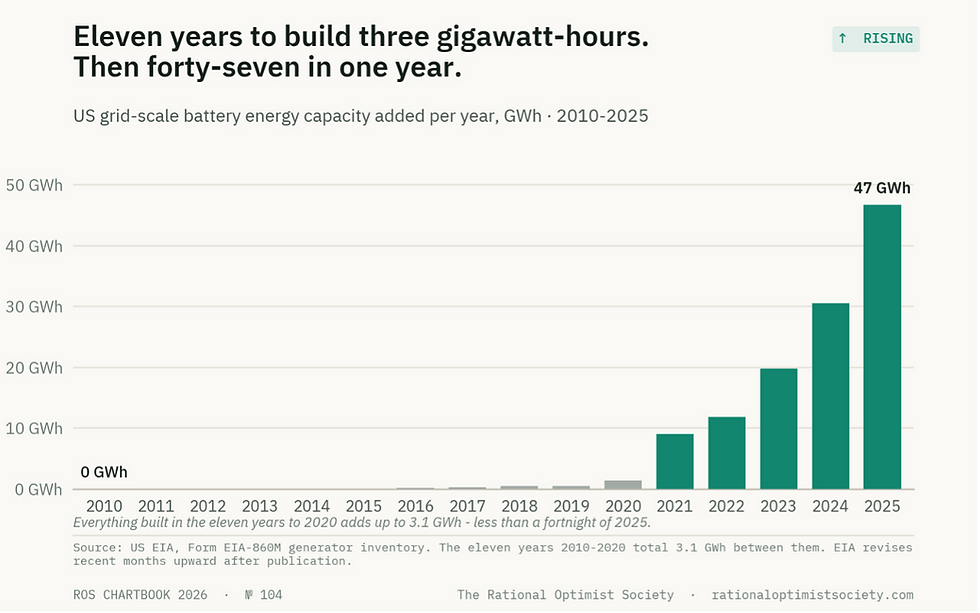
Solar and storage together made up 91% of all new capacity added to the American grid in the first half of 2026.
Panels make most of their power at noon. Households use the most power in the evening when everyone gets home, turns on the AC and starts cooking.
For 20 years that mismatch was the unanswerable objection to renewables: great, but what happens at dinner time? Batteries are the answer. They suck power at noon and give it to you in the evening. They move energy through time.
In the summer of 2023 Texas issued 11 alerts asking everyone to push the thermostat up because the system might black out. In the summer of 2024 it issued zero… because it installed enough batteries to offset the demand spike.
What this means for you. Update your priors. Batteries used to be a green dream. No longer. Their usage is skyrocketing in Texas of all places.
6,187,069.
That’s how many businesses were started in America in the last 12 months. It’s the highest ever recorded.

“Startup nation” kicked off during the pandemic when millions of people were sent home and decided to have a go at something.
The latest whoosh higher is all AI.
Before AI, starting a business involved hiring someone to build a website… design the logo… do the books… and answer the emails. Now an army of one with a $20 ChatGPT subscription can do most of it in an afternoon.
What this means for you. There’s never been a better time to go it alone. You can be the world’s best florist and hand every part of the job that isn’t flowers to the AI.
Also notice how this runs counter to the story you’re being told that AI will “take all the jobs.” No, AI is the great enabler of entrepreneurship.
AI coding tool Cursor hit $100 million in revenue faster than any company ever…
And with fewer than 20 people on the payroll.
It then hit $1 billion last November… $2 billion by February… and $3 billion by May of this year.
Last month SpaceX snapped up the four-year-old startup for $60 billion, the largest acquisition of a venture-backed company ever.
The five fastest revenue climbs from $100 million to $1 billion are all AI companies. All five happened in the last 18 months:

What this means for you. A startup reaching $100 million in sales with fewer than 20 people and then selling for $60 billion before its 5th birthday is unprecedented. AI is the driving force behind the Singularity.
Four of the five fastest-growing companies were private for the entire climb. This wealth creation is happening out of reach of public-market investors.
Today 87% of US companies with revenue above $100 million are private. Meanwhile the number of US public companies has roughly halved since 1996. The stock market is now merely the tip of the iceberg of investing opportunities.
Imagine standing on a street corner in Boston in 1869
The lamps above your head burn gas, and a man with a long pole lights them. The street reeks of horse manure. If you want to reach your brother in Ireland you write a letter and wait a month for it to arrive.
Now you’re teleported 45 years into the future.
There’s a telephone on the wall and a car parked at the curb. Airplanes fly overhead. The message to your brother arrives before lunch.
I’m convinced we’re entering another one of those stretches. This transformation will be compressed into less time. The world of 2036 will look nothing like the one we’re living in now.
There will be mind-boggling inventions we can’t foresee. These new things will affect our lives, businesses and portfolios in ways we can’t yet imagine.
The key is staying on the frontier, trying new things and taking advantage of them. That’s why I make a point of flying tens of thousands of miles each year to meet the actual people building world-changing technologies.
Please send today’s Diary to your friends and family to help more people see the future!
—Stephen McBride
P.S. Thanks for all your support last week in pre-ordering my new book, Disruption Investing. It hit #1 bestseller status in three separate categories, even supplanting Ben Graham’s The Intelligent Investor for a brief while.
The book is not affiliated with Rational Optimist Society. But if you’re into investing and innovation, you’ll like it. For now we’ve priced it at just $3 to encourage pre-orders so it can hopefully debut at #1 next week. You can pre-order a copy here, or click the image below.


