
What I’m telling my kids about AI
I believe what’s happening in AI today is bigger than ChatGPT’s debut in late 2022. We’ve hit a tipping point.
Last week we talked about how Claude Code is not just a chatbot. It’s an agentic tool which can access your computer to build stuff for you.
Having never written a line of code in my life, I used it to build the ROS database, a powerful tool linking together all the research notes and networking we’ve done in building ROS.
This week, I fed Claude Code my raw DNA file from 23andMe. I then gave it access to 16 months of biometric data from my WHOOP fitness tracker, including sleep performance, resting heart rate, workout strain, and recovery trends.
Among other things it told me:
I carry the APOE ε4 variant which increases my risk of Alzheimer’s by 2-3X. The good news? Claude said aerobic exercise is the ultimate shield for this specific gene. It suggested a hard cap on my diet: saturated fat must stay under 15g per day to protect my brain.
I used to think melatonin was a safe sleep aid. But because of my MTNR1B variants, taking melatonin hurts my ability to process glucose. I was spiking my blood sugar while trying to sleep!
Many of you read last week’s Diary and thought, “What now?” What do we do in a world where anyone with no coding knowledge can create almost anything they can dream up on a computer?
As someone with three young kids I’ve been thinking a lot about this question too.
This week’s Diary will give you what I think are the answers. It’s a letter to my children—and all rational optimists—on how to thrive in the years ahead.
Because five years from now, maybe even one or two years from now, work and life will be radically different.
“Any schmuck can do the numbers.”
That’s what ROS co-founder Dan Steinhart told me about his days at a Big 4 accounting firm.
While the staff worked 80-hour weeks crunching spreadsheets, the partners were on the golf course—building bonds with clients and closing deals and taking home millions.
AI unleashes this dynamic in every industry.
We’re entering the Industrial Revolution for knowledge work
With Claude Code any schmuck can now write code, including me.
Is this good? Bad?
For a coder making $200k tapping away at the keyboard, who’s unwilling to go outside his comfort zone and learn new skills, definitely bad.
But if you’re a go-getter? Or have go-getter kids?
There’s never been a better time to be alive.
I’m radically optimistic. Right now everything is up for grabs.
The question is: How do you position yourself—and your kids—to win?
Syllabus for the Future.
I believe if you act on the following five principles, you will flourish in the new world.
I’m figuring this out in real-time, just like you.
But one thing I’m certain of: you don’t want to be a “schmuck” competing with AI agents.
Principle No. 1: Be more human.
Authentic humanity is the one job AI can never replace. Those quirky, messy, soulful traits that machines can’t replicate are your new superpower. Here’s what this means in practice:
Build personal relationships. AI can’t share a genuine laugh over coffee, de-escalate an enraged client or negotiate a delicate partnership. The ability to connect with other humans is rocket fuel in the AI age. “Networking” goes from a LinkedIn buzzword to the No. 1 thing you need to succeed.
Use your imagination. AI can remix existing ideas impressively. But it can’t feel the burning need to create something that doesn’t exist yet. ChatGPT doesn’t have urges, dreams, or spontaneous creativity. It doesn’t wake up at 3 am with a breakthrough idea.
The future belongs to those who can imagine what doesn’t yet exist and then use AI to help bring that vision to life.
Be charismatic. AI can already write flawless code, diagnose diseases, and design a logo in seconds. But it can’t look someone in the eye and inspire them.
Be someone people want to be around. Learn to inspire, learn to dance, learn to cook, learn to make people laugh.
Parent Plan: Charisma over credentials.
The value of “soft” skills is skyrocketing. The things you can’t learn from a textbook are more important than ever. Find ways to cultivate these in your child.
This changes how I view formal education. The ability to be persuasive and charismatic is now better preparation for the real world than a degree.
I’d rather my kids take drama class or knock on doors selling cookies than stress over getting straight A’s. Getting a door slammed in your face and learning to keep smiling is a skill AI can't replicate. If you can hold an audience and change people’s minds, you will always have a role.
If you were stuck in a third-world prison and were allowed to call one person to bust you out, who would you call?
That’s author George Mack’s brilliant test for identifying high-agency people.
You don’t pick the person with the most degrees. You pick the person who can get the job done.
Principle No. 2: Build agency.
Blake Scholl was designing internet coupons for Groupon before he founded Boom to bring supersonic travel back to America. Palmer Luckey was creating virtual reality headsets before he founded Anduril and made defense tech “sexy.”
Neither asked for permission. They just did it.
Agency is the belief that you can steer your own path. This means teaching kids how to start things, not just follow rules. I didn’t even know what an entrepreneur was until I was in college. Start a business? You can just do that?!
Drill the “just do it, don’t wait for permission” mindset into your kids.
It starts with you. Most parents will wait for some school district-approved “AI literacy plan.” You, Rational Optimist, must take the lead.
“I don’t know how to code” or “I’m not a designer” are no longer valid excuses in the era of AI agents. I am a total schmuck when it comes to writing code, but I built the ROS database, which I’ll share with you in the coming weeks.
There’s a new breed of startups where a handful of people leverage AI to do the work of hundreds. AI code editor Cursor rakes in $100 million in sales with a 20-person staff.
AI is already transforming law, medicine, education and investing. Future winners won't necessarily be those with the fanciest degrees. They’ll be high-agency individuals.
I guarantee many people will build life-changing wealth by leveraging these tools. Be one of them.
Parent Plan: Create real, tangible outputs.
Last week my daughter wrote a book titled “The Girl Who Moved Away” about moving from Ireland to Abu Dhabi.
I told her I’d type it out and put it on Amazon. I could see the lightbulb go off in her head: “You can just write books!”
Teach your kids anything can now be learned. Show them AI can help them code, write stories, explore the past and endless other tasks.
AI slashes the cost of curiosity.
On our recent tour across America with Matt Ridley we had dinner with Andrew Mayne. Andrew is a professional magician and a prolific thriller novelist. He was the original “prompt engineer” for OpenAI. And a few years back he built underwater stealth suits to swim with Great White Sharks.
He’s the ultimate high-agency generalist. He doesn't have a “lane.” He can jump into any wave he sees coming.
Principle No. 3: Specialists are fragile. Generalists are anti-fragile.
Most people fear change. But change empowers generalists. You can acquire any skill or any knowledge to achieve the life you want. And even if you get replaced, it doesn’t matter, because you can quickly adapt.
What once demanded thousands of dollars and months of development can now be achieved with $100 and a single weekend. This shift gives our kids the freedom to fail. They can test a dozen ideas, discard what doesn't work, and iterate toward success
Parent Plan: Don’t let your kids pigeonhole themselves.
Show them the single-track careers they see on TV—doctors, lawyers and accountants—aren’t the only paths to success. Again, this is likely the opposite of what they’ll learn in school. So it’s up to you.
I tell my children about my job as an independent investor and writer who can work from anywhere. If you have a job where people ask, “Wait, what do you do exactly?” … you’re on the right track.
The No. 1 predictor of early death is...
Social isolation. Seriously. A recent study found it’s worse than smoking!
As one of my favorite venture capitalists, Josh Wolfe, likes to say, “what’s scarce is valuable.” In a world dominated by bots, handshakes, live events and dinners become scarce resources. These real-world connections are the only things that can’t be copied.
Principle No. 4: Find your tribe.
I believe the biggest wealth creation opportunity of the next decade is building a micro community around your “thing.” There are already millions of tiny niches, be it paddleboarding, coffee or CrossFit.
Each one will have its own “MrBeast,” and they will make so much money. “Influencer” will be a common job.
Building a community around some niche certainly doesn’t sound as stable as “go to law school.” But it’ll create a far more fun world. The kid who would’ve become just another lawyer will now create a community around their passion.
AI can diagnose a patient, but it cannot lead a tribe. It cannot give you a sense of belonging or your unique perspective on the world. And that’s something people will pay a lot of money for.
Parent Plan. Help your child build a circle around niches they gravitate toward.
If they love gymnastics, help them start a YouTube channel showing off routines. If they love Labubu dolls, help them start a school club for trading them.
The goal here is to create something, anything. Just start and see where it goes.
Principle No. 5: Weird wins in the AI era. AI can produce competent, standardized work on command. That means generic thinking, writing and creating are now worthless.
Your unique perspective and unusual combinations of knowledge are now your edge.
Parent Plan. Help your kids make unusual and unique connections.
Ask: What do you like that none of your classmates do? What do you disagree with them on?
Expose them to less popular activities. Instead of football, try fencing.
Alex Honnold, the American rock climber who recently scaled a 101-story skyscraper in Taiwan, is a good example of what’s possible when you expose kids to niche hobbies early on. Alex started climbing when he was 5.
Every rule in our “syllabus of the future” falls on one side of this barbell:
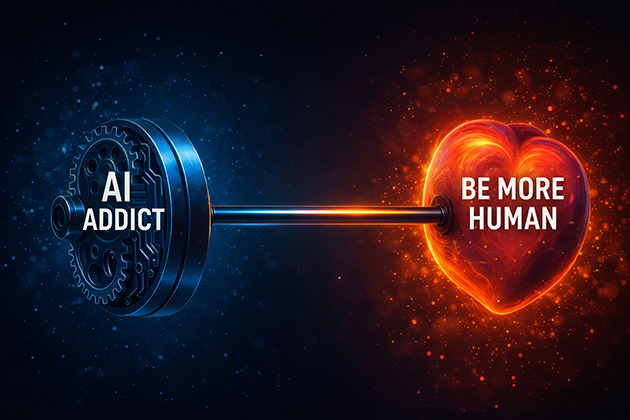
On one end: Become an AI hyper-user. Adopt every new tool. Use them until you hit your limits and melt all the GPUs. Learn to code without coding.
On the other end: Be more human. Double down on the things AI can’t do. Tell stories. Build trust over a handshake. Dance. Cook. Make someone laugh so hard they spit out their coffee.
The “barbell strategy” is how we conquer the AI age.
—Stephen McBride


