
Shady stuff is happening underwater
My friend and economist Tyler Cowen likes to frame the world in terms of what’s “overrated” and “underrated.”
I love looking at innovation and technology through this lens. It helps you identify hidden edges you can take advantage of in markets, business and life.
One criminally underrated frontier today is… the ocean.
You’re reading this essay thanks to the ocean. The “cloud” is actually underwater. Over 95% of internet data… your emails, bank transfers and ChatGPT queries… travel through a network of roughly 400 fiber-optic cables resting on the seabed.
Over 90% of everything you own, from the phone in your pocket to the shoes on your feet to the fuel in your car, arrived by sea.
Yet the ocean remains a blind spot. Did you know we’ve mapped more of Mars than our own seabed?
Over the past year some shady things have happened beneath the waves that are going to force us all to pay attention.
Invisible hunters that sink battleships without warning…
That was Nazi U-boats during WWII. These silent killers turned the Atlantic into a graveyard.
The latest “U-boats” are robots.
Last December Ukraine launched an underwater drone named the “Sub Sea Baby,” which sank a $400 million Russian submarine.
A piece of hardware that cost less than a nice car destroyed a strategic asset worth nearly half a billion dollars.
That’s how a country with effectively no navy (Ukraine) has forced the world’s third-largest Navy (Russia) to retreat from its own home base in the Black Sea.
Ukraine “hacked” a robot navy together, taking what were essentially jet skis and packing them with explosives. Swarms of these $20,000 drones hunt in packs, disabling billion-dollar warships and even shooting down fighter jets.
ROS members know aerial drones have transformed land warfare.
Few realize the same revolution is playing out at sea with none of the hype.
Any future conflict between the US and China (which I think is unlikely) won’t be decided by aerial drones. It won't even be decided by advanced fighter jets, which have a short leash of around 600 miles.
Ocean drones have no boundaries. Satellite internet turns the middle of the ocean from a communications dead zone into a high-speed network.
Imagine trying to buy coffee, but the card machine goes dark…
You try to call family to see what’s going on, and the line is dead.
This nightmare scenario happened to 14,000 people on the Matsu Islands near Taiwan. Chinese vessels cut their subsea cables, plunging the island into a digital blackout for a week.
The global web of underwater internet cables is long enough to stretch to the moon and back twice.
They are vulnerable. Taiwan had its internet cables cut nearly 30 times in recent years. Data pipelines in the Baltic Sea have been severed too. This is 21st-century sabotage.
America’s Big Tech giants, Meta, Google, Microsoft, and Amazon, now account for more than 70% of new underwater data cables. Meta is currently building the world’s longest submarine cable. Project Waterworth will span 31,000 miles and will cost $10 billion.
If you’re going to spend billions to build the underwater backbone of the AI economy…
You’re also going to spend to protect it.
5 underrated innovators protecting the oceans
Saronic
The Swarm King
Last year America made just five ships. China built 1,794. One Chinese shipyard now has more output than the entire US maritime industry combined.
That’s why Saronic is one of the most critical defense tech companies in America right now.
Founded by former Navy SEAL Dino Mavrookas, Saronic is building fleets of fully autonomous surface boats.
Saronic’s approach reminds me of SpaceX. Before Elon Musk launched skyscraper-sized rockets, he built Starhopper, a tiny capsule that proved reusability.
Saronic’s Spyglass is the Starhopper of the sea. It’s a 6-foot stealthy reconnaissance drone. Next it built Corsair, a 24-foot “gunboat” that can travel 1,000 nautical miles without human captains.
The big daddy (which I can’t wait to see) is Marauder. It’s a 180-foot, 40-ton AI-powered autonomous beast that can travel for more than a month without a human soul on board.
Marauder is a true autonomous warship and is being made at a shipyard in Louisiana right now.
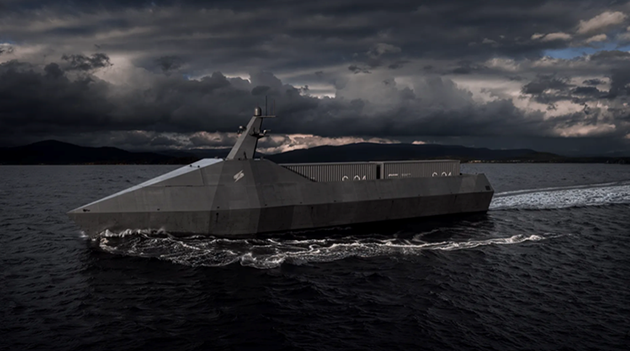
As effective as Ukraine’s “robo-navy” has been, it’s remote-controlled. A human operator sits in a bunker steering the boat via satellite. It works… until the enemy jams the signal.
Saronic is going a level beyond with its autonomous boats. Using onboard computers they can spot threats, navigate choppy seas, and coordinate swarms entirely on their own.
Even if its connection is cut, a Saronic boat keeps hunting.
Anduril
The Predator
Picture a 19-year-old kid living in a camper van, parked in his parents’ driveway. He survives on frozen burritos.
That was Palmer Luckey. Night after night, he tinkered until he created the Oculus Rift, the first “good enough” VR headset. Facebook acquired his company for $2 billion.
These days Palmer is building more important stuff at his company Anduril.
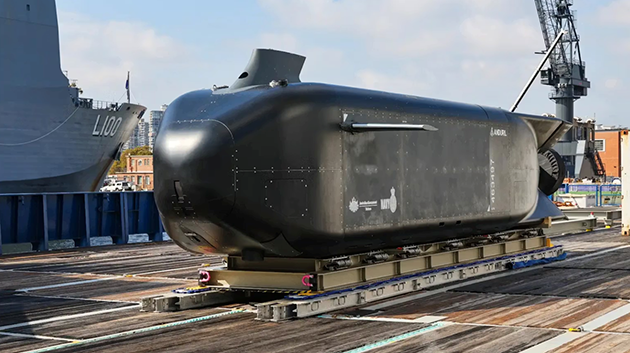
Meet Ghost Shark.
Roughly the size of a school bus, it’s an autonomous submarine that looks like a sleek spacecraft for the underwater abyss. It can loiter for weeks at immense depths, mapping minefields and hunting enemy subs.
Ghost Shark is a “sexy” piece of hardware if ever I saw one:
Anduril’s ocean strategy is like a Russian doll. It has layers of lethality.
Imagine an autonomous ship launching an aerial drone to see over the horizon. That drone spots a target and signals a submarine lurking deep below. The sub then fires a torpedo that destroys the target.
Anduril already has the drone, the sub and the torpedo. I bet it’ll build America’s first “Drone Carrier” to carry them all.
Anduril’s real secret weapon is putting “brains on boats.” Its Lattice software allows a human operator to control it all from a laptop.
Ulysses
The Gardener
The Colombian Navy recently seized a fully unmanned “narco-sub.” It was fitted with a Starlink dish and designed to carry 1.5 tons of cocaine over 800 miles.
I’d imagine for every drug boat captured, at least 10 slip through. There’s simply no way to police the vast ocean with human crews.
That’s one problem Ulysses wants to solve. I met Ulysses founder, my fellow Irishman Will O’Brien, at their warehouse in downtown San Francisco:
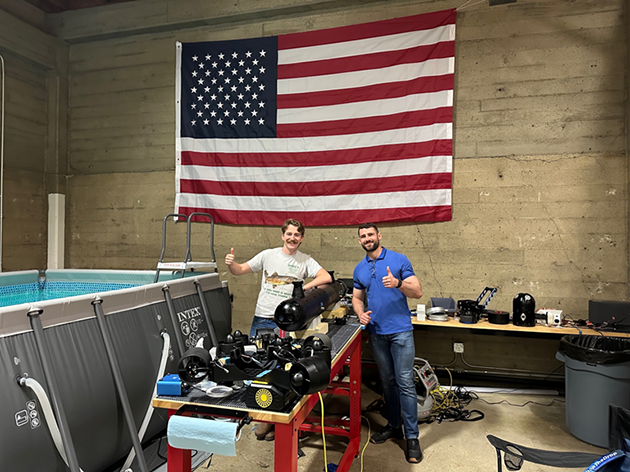
The vibe is pure hard tech startup. Tools everywhere, parts scattered on benches. At one point Will tried to light a bottle of hand gel on fire with a lighter. I love that energy.
Ulysses is building a customizable underwater drone designed to go anywhere and do anything. You can swap out batteries, add arms, or change sensors like LEGO bricks.
How it works: A surface "Mothership" carries four smaller “Daughter” drones. The droids descend, do their work, and then dock back with the mother to recharge.
A comparable system from defense giants costs millions of dollars. Without giving away specific numbers, Ulysses drones cost at least 10X less.
Its goal is to have millions of these drones in the water, available for anyone to “rent” via an app.
Ulysses’s first mission is healing the ocean.
Ulysses’s drones currently plant seagrass, a miracle crop that absorbs carbon 35 times more efficiently than a rainforest. In a recent project in Australia it cut restoration costs by 90% compared to human divers and did it 10X faster.
“Underwater work is too dangerous, costly, and difficult to do manually,” Will told me. “So much of it doesn’t get done today.” Subsea robots unlock the final frontier.
Poseidon
The Ghost
I met the founders of Poseidon in their sprawling warehouse in San Francisco’s Dogpatch with the biggest American flag I’d ever seen:
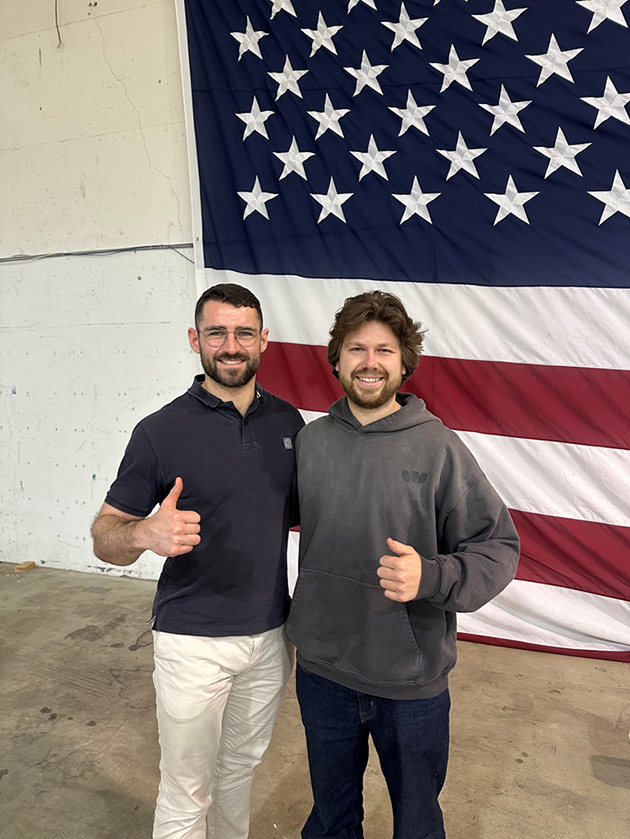
Poseidon is reviving one of the most exotic technologies of the Cold War: the ekranoplan.
In the 1960s the Soviets built massive “Sea Monster” vehicles that looked like ship-plane hybrids. These sea skimmers ride a cushion of air just above the water, taking advantage of a phenomenon called ground effect. Flying close to the surface reduces drag and boosts lift—the ultimate efficiency multiplier.
The result is something that moves like a fighter jet but skims like a speedboat. Because it flies so low, it avoids radar detection.
Poseidon is transforming the ekranoplan from a Cold War relic into a high-speed workhorse using modern materials and automation.
Last time I visited founder David Zagaynov, Poseidon just launched its first product, Seagull, a sleek 13-foot craft with a 120-mile range.
Seagull is a logistics ghost. It can move cargo faster than a ship and cheaper than a plane. And it doesn't need runways or ports. It can land on a beach in Greece or an island in the Pacific.
When I returned to Poseidon’s HQ I saw early mockups of Heron, its new 50-foot wingspan seaplane, capable of carrying two tons over 1,500 miles.
David told me Heron will be able to carry 8X more load for 60% cheaper than regional cargo. “The goal is to put all the regional cargo airliners out of business.”
Amidon Heavy Industries
The Watchman
Inspecting a subsea pipeline or cable today involves hiring a huge, manned ship that costs $200,000 per day. No wonder “stuff” in the ocean is only checked once every year or two.
Amidon Heavy Industries is building a security camera for the ocean floor. Recently I met founder Chris Amidon at his warehouse in El Segundo, America’s “hard tech” capital:
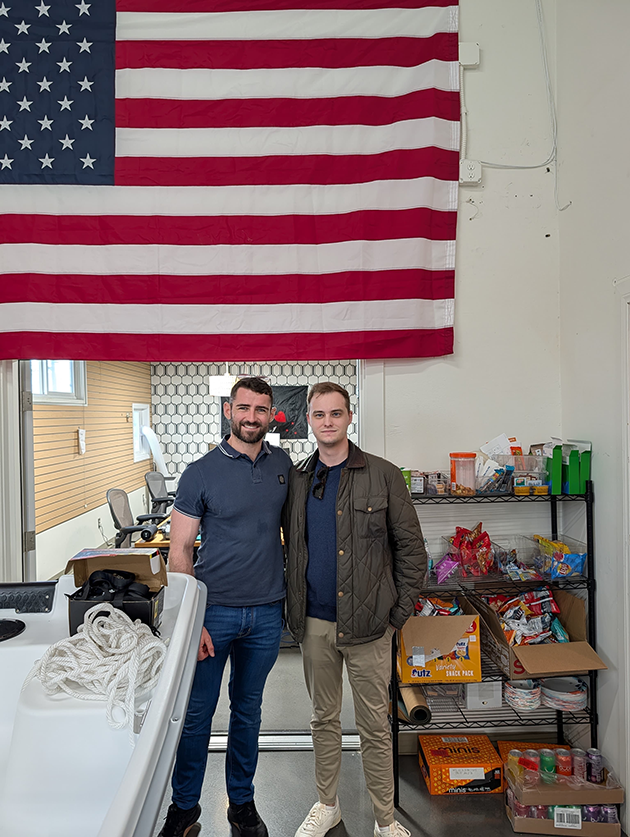
Amidon’s robo-boats are built to inspect cables, pipelines and oil rigs.
Its first boat will be an 18-foot autonomous vessel that carries a tethered drone and can stay at sea for a week at a time.
Scout-18 will sail out to a Google internet cable or a Chevron pipeline. It then deploys the droid on a cable to dive down 1,000 feet. It takes crystal-clear 4K video and sonar readings, and the surface boat beams the data back to customers.
And a droid that can inspect an offshore wind farm can also hunt for saboteurs.
Amidon is currently building its prototype (Scout-X) and is moving fast. Chris strikes me as a quality founder who avoids the hype. He’s a dark horse to watch.
A trillion-dollar economy waiting to be unlocked by robots.
That’s where the ocean is today.
The high seas have been our largest blind spot. And to rational optimists like us, blind spots are opportunities.
For my whole life the narrative around American maritime power has been one of decline. We looked at the rusting shipyards and assumed the game was lost.
But America’s greatest strength is its ability to reinvent the game.
Let’s go!
Which use for underwater drones are you most excited about?
—Stephen McBride


