
The American Dream needs a factory reset
Housing’s “iPhone moment”
I have a friend back in Ireland named Zach.
Zach is a mechanic with his own business. He grinds and does everything right. Yet every night he walks past the main house and goes to sleep in a log cabin in his girlfriend's parents' backyard.
Now his girlfriend is pregnant with their first child. They’re about to bring a new life into the world, and they don’t have a place to put the crib.
I have another friend in New York City, the founder of a promising, high-growth startup. He’s crushing it but lives in a Manhattan one-bedroom apartment with his wife and daughter. They want another baby but can’t afford the extra bedroom.
Studies show rising housing costs explain roughly half of the fertility decline in America between 2000 and 2020.
That’s millions of kids who were never born because the rent was too high.
Having kids is a vote of confidence in the future. It’s the ultimate act of optimism. We’re pricing people out of that optimism.
We know the solution: Build. More. Housing. Yet we’re building homes today slower than we did in 1971.
Over the last decade venture capitalists incinerated billions of dollars betting on startups that promised to fix housing. They all failed.
But I think I’ve finally found…
The Henry Ford of housing.
Before we meet this company, let’s visit the graveyard of failed housing startups. There are many headstones.
A few years ago housing disruptor Katerra raised $2 billion to build “gigafactories” for homes. It wanted to mass-produce homes on an assembly line like iPhones, ship them nationwide, and snap them together on-site.
We build cars in factories, so why not houses? It sounded inevitable.
Katerra went bust in 2021. It stepped on two booby traps which killed almost every would-be housing disruptor.
Booby trap No. 1: shipping air.
When you build finished rooms in a factory and ship them, you’re shipping floors, walls, and ceilings. You’re essentially paying to ship empty boxes of air.
This eats up every penny saved by the factory efficiency.
Booby trap No. 2: cash incinerator.
Giant factories cost a lot of money to build. To make the math work they must run at near-full capacity.
But housing is boom-and-bust. When the market dips (it always does), the factory doesn't stop costing money and turns into a cash incinerator. Katerra built cathedrals of manufacturing requiring perfect economic weather to survive. When it started raining, it drowned.
Then there’s the deadliest booby trap of all.
The US government tried to build houses in factories…
1969 was a great year for the optimists. America put a man on the moon and Concorde flew its first supersonic voyage.
It was also the year of Operation Breakthrough, the US government’s experiment to industrialize housing. The goal was to fund mass-producible building systems and construct 25,000 modern homes.
It was a total disaster. They built fewer than 3,000 units before shutting down.
Uncle Sam failed to account for local governments.
Factories work when they build the exact same thing, over and over. You can’t do that with homes because there are 26,000 towns and cities with different building codes.
It’s like trying to mass-produce a car, but every town has its own rules about where the brake pedal and steering wheel should go.
We’ve been trying to build houses like cars for a century. But houses aren’t cars. They’re legal projects, financial products, and custom assemblies rolled into one.
Malcom’s box
Malcom McLean was a North Carolina truck driver with an idea.
Create steel containers that could neatly and quickly stack on ships, trains, and trucks. The shipping container was born!
On a spring morning in 1956, McLean’s refitted oil tanker left Newark carrying 58 identical steel boxes. That was the day global trade got rewired.
The cost of shipping fell by more than 90% over the following years. Those steel boxes became the universal language of trade, easily swappable across ships, trains, and trucks. Every global brand you know—Nike, Walmart, Apple—owes its business model to McLean’s steel box enabling global trade.
What McLean did for shipping, Cuby Technologies is doing for housing.
“What’s in the box?”
If you’re a Dune superfan like me, you know the scene.

Ask that question to Cuby co-founder Aleks Gampel and he won’t respond “pain.” He’ll say, “Everything you need to build a new home in just 30 days.”
Cuby doesn’t build houses. It builds the factories that build houses.
It took an entire automotive-grade production line—robotics, CNC machines, welding stations—and packed it into approximately 122 shipping containers.
Cuby’s product is the Mobile Micro-Factory (MMFTM). It’s a standardized, portable factory that turns homebuilding into a predictable manufacturing process.
When Tesla hit “production hell” in Fremont, it couldn't get permission to build a new facility fast enough. So Elon put up a massive tent in the parking lot. Because it was a “temporary structure,” he bypassed the zoning nightmare and saved the company.
Cuby takes Tesla’s tent hack to the next level:

If you build a factory, you need permits and years of approvals. Cuby figured out how to snap 122 shipping containers together and be classified as one giant “machine.”
This hack allows Cuby to stand up an MMF, capable of pumping out 200 homes per year, in just 30 days.
MMFs are compact enough to slot into a mall parking lot. You inflate a massive, pressurized dome. Inside the dome the shipping containers open up to become a fully functioning housing factory:
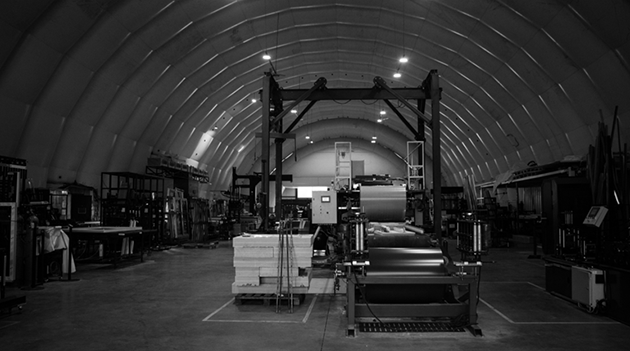
Cuby’s other co-founder, Aleh Kandrashou, walked me (virtually) through its test facility in Eastern Europe to see how an MMF works.
Cuby broke the construction process down into 35 different departments. Walk past one container and inside is a dedicated welding robot fusing steel foundations. Move to the next container, and it’s a specialized paint booth coating the exterior panels.
The containers snap together to form a conveyor belt that takes raw materials—steel coils, glass, resin—and spits out a complete “kit of parts” to build a home:
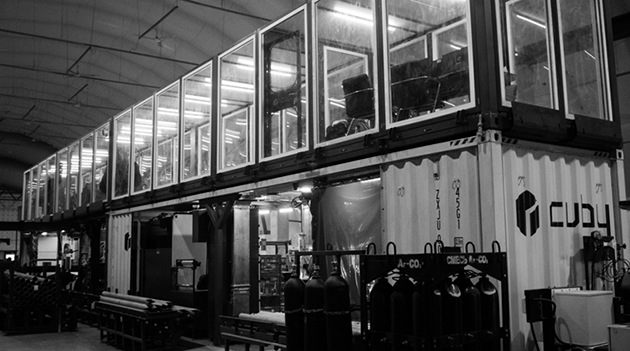
Every stud, pipe, wire, and floorboard needed for a specific house is flat-packed.
Cuby = affordable homes.
Cuby’s target cost is $100 to $110 per square foot. That’s far cheaper than traditional builders that spend $150 to $300+ per square foot depending on location.
Aleks stressed to me Cuby is relentlessly focused on costs: “Tesla launched with the expensive Roadster to fund the cheap Model 3. You can't do that in housing. If you are a Roadster on day 1, you die."
“If Jesus came back today the only job he’d recognize is a…”
Carpenter. That was Aleh’s humorous way to describe the lack of innovation in housing.
It’s not for lack of trying. As I mentioned, startups have been trying to disrupt housing for a century.
Cuby has “last-mover advantage.” It designed the MMF specifically to disarm the three booby traps that killed its predecessors.
Shipping air.
Katerra built big whole rooms and shipped them to the site. Cuby ships the factory to near where the house will be built.
Cash incinerator.
A Cuby factory costs 10% as much as a normal factory. It only needs to build 70 homes a year to make money.
Best of all, it’s mobile. If the housing market in Phoenix cools, you can pack the 122 containers and move them to Dallas, where demand is hot.
Cuby doesn’t build homes. It builds the factory that builds the home, which is another safety buffer. It enters into joint ventures with local developers that put up the $10 million to build the factory. Cuby doesn't deploy the machine until the demand is guaranteed.
Regulatory camouflage.
Cuby’s factories produce a kit of parts that follows International Building Code specifications. With small tweaks they are compliant with America’s 26,000 jurisdictions.
Aleh told me its first US test home in Michigan had zero permitting issues. The home was built under 60 working days at 30% to 40% below local contractor quotes!
To a building inspector, a Cuby home looks like a normal house, just built with unusually high precision:
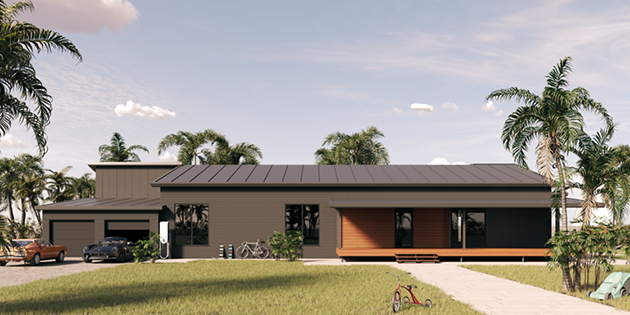
Cuby is basically…
A software company wrapped in steel
As an ROS member you know all about the physical innovation famine.
For 50 years progress was trapped in a narrow cone of software, apps and the web. That’s why your phone is a supercomputer, but your house is still built like it’s 1925.
Now that cone is widening into the physical world. Cuby manually mapped out the 10,000 steps required to build a house from scratch. It filmed every process, wrote code for every action, and built it into a system called "FactoryOS."
This is Cuby’s secret sauce. It’s LEGO instructions on steroids.
FactoryOS spits out 3D instructions for every single screw in the house. It’s built on Unreal Engine, the same video game engine used for Fortnite. These digital guides allow even an idiot like me who struggles to assemble an IKEA desk to build a house.
The software also acts as a relentless quality control manager. For example, it won't let a worker move to the next step until the AI visually confirms the last step is perfect.
There’s a reason I call Cuby “the Henry Ford for homes.”
Before Ford pioneered the assembly line, building cars relied heavily on highly skilled craftsmen. Ford's innovations simplified the process and drastically reduced build time. Cuby’s software does the same for homes.
Its digitally guided microtask system atomizes assembly. Four workers (in two shifts) can go from foundation through finishes in roughly 45–60 days. Cuby plans to drive this under 30 days.
We need to talk about toilet paper
Cuby clocked 1 million engineering hours designing its Mobile Micro-Factories, kit of parts, and software. That obsession shows up in strange places, like the bathroom.
When Cuby ships MMF extension units to a site (which are like self-contained command centers equipped with Starlink, workstations, lockers, hot showers, and every tool the crew needs), it packs the exact number of toilet paper rolls needed for four workers for the specific duration of the build.
That precision planning defines Cuby. If a worker finishes a task but a specific wrench isn't back in its slot, the AI recognizes it. The software won't let him finish his working day until he finds it. No delays due to missing tools:
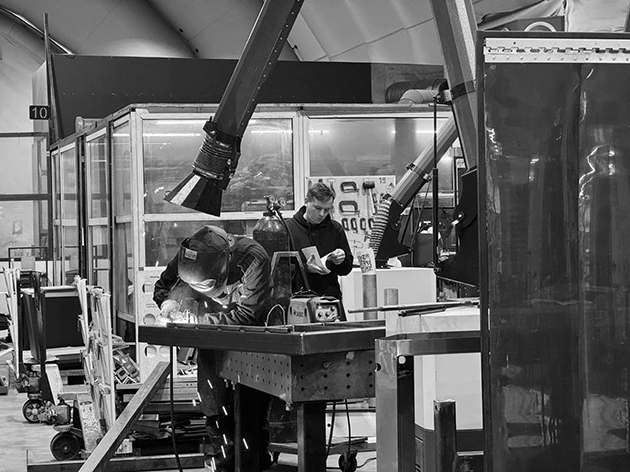
To avoid "shipping air," the software calculates the volume of empty space in a container down to the cubic inch. It will delay ordering small parts (like door hinges) until they can perfectly fill the gaps in a shipment of larger materials. Tetris for supply chains.
But my favorite feature is how the factories improve themselves.
We all know about Tesla's over-the-air updates. Back in 2017 when Hurricane Irma was hurtling toward Florida, Tesla remotely unlocked extra battery range for owners fleeing the storm. With the flick of a switch, the car got better.
Cuby does the same for factories. If a crew in Nevada finds a faster way to install a window, that process update is pushed to every Cuby factory worldwide instantly. Factories now update like your iPhone.
Ultimately the only thing that matters is: Can Cuby build homes faster and cheaper?
Yes. Labor accounts for roughly 70% of the cost of building a home, depending on location. Cuby’s FactoryOS aims to slash that by over 80%.
Today a traditional construction crew burns about 450 minutes of human sweat to finish a single square foot of a house. Cuby does the exact same work in 50 minutes.
A traditional builder needs over 15,000 hours of labor to go from foundation to move-in ready for a standard 2,000-square-foot family home. Cuby crosses the same finish line in just 1,659 hours. It’s building the same house with one-ninth the human effort.
This allows Cuby to pump out more affordable homes while not compromising on quality. Its houses come with steel framing and triple-pane windows, typically luxuries in the US.
On the desert outskirts of Las Vegas…
Cuby’s first US Mobile Micro-Factory is going up. It’s scheduled to pump out homes this fall for a local developer building 3,300 units. I can’t wait to visit.
But one factory won’t solve the housing crisis.
That’s why Cuby stood up a “papa factory” in China. This is the machine that builds the machines. Its job is to mass-produce the 122-container Mobile Micro-Factories.
Next year the papa factory will pump out four MMFs. The year after, 8 to 12. The exponential curve is starting now.
Talk to Aleh for five minutes and you realize he’s a serial inventor. He walked me through a dozen patented technologies, from the “magnetic skin” that lets you swap a home’s exterior like a phone case, to the pressurized factory dome that inflates like a tennis bubble.
And Cuby’s ultimate invention is, to quote Aleks, “a universal manufacturing engine that scales to whatever the world needs next. We’re already working on military barracks, data centers, and contractor garages.”
Housing is arguably the most broken industry in the world, with tough competition from healthcare and education. It’s a gigantic market that affects us all.
High housing costs mean fewer kids. It also warps politics as people feel locked out. Just look at NYC voting in a communist mayor!
If Cuby wins, the payoff is civilization-scale. I asked Aleks and Aleh for their vision:
“A 25-year-old schoolteacher in North Carolina no longer spends her weekends touring open houses she can't afford. She opens an app to design her house like she’s playing The Sims.
You can drag and drop rooms, see the exact cost update in real-time, push a button to see available plots and finally click order. The MMF gets to work, and she moves in one month later.”
Aleks ended with: “We want to build more homes than anyone else on earth.”
If Cuby succeeds it has a shot at rebuilding the American Dream.
What future would you build if you could have a cheap, custom house by next month? Let me know in the comments below.
—Stephen McBride


