
The world’s new fastest car is…
The great leapfrogging
There’s a new world’s fastest car.
It’s not a Ferrari, Lamborghini or Bugatti.
It’s Chinese brand BYD.
BYD’s new Yangwang U9 “hypercar” clocked 308 mph during testing in Germany, shattering the record formerly held by a Bugatti Chiron.
Yet there was no roaring piston engine, because the world’s new fastest car is… an electric vehicle (EV).
When a young Henry Ford reportedly asked JP Morgan to invest in his new automobile startup, Morgan said: “Cars are just toys for rich people.”
That’s how many folks still think of EVs today. Novelties. “Real men drive muscle cars.” Right? Well…
Our fellow optimist Marc Andreessen had some interesting thoughts on this during a recent podcast.
“I just met one of the most successful guys in Dubai… This guy is extremely wealthy. He could drive anything. He told us he’s replaced his entire personal fleet with Chinese [electric] cars. Not because they’re cheaper, but because they’re better.”
The Electric Leapfrog
As you may know, I recently moved my family to Abu Dhabi. I say Middle East, you say… oil. That’s what this region has been famous for our whole lives.
But drive 30 minutes from our place, and you hit a solar farm so huge it sticks out on Google Maps:

Al Dhafra solar plant houses roughly 3.7 million solar panels and powers over 160,000 households in the UAE.
A petrostate paving the sand with sun power…
The fastest car on earth is now electric…
These are separate developments to the untrained eye. But they’re the same story: the electric leapfrog.
For a century we burned stuff to make the world go round - petrol in engines, gas in stoves, oil in boilers. Now the burners are getting swapped for motors, batteries and electronics. And not just for environmental reasons. In most cases, electric stuff is just better now.
But electric tech has a PR problem. People hear “EV” and think:
Sacrifice
Not long ago, battery-powered cars were worse in almost every way: slower, pricier, shorter range.
It’s time to update our worldview. Because the fastest, safest, most desirable machines are now electric.
It’s not just cars. Your kitchen will soon be electrified too.
I visited Impulse Labs’ HQ and got a hands-on live demo of its battery-powered, outrageously fast stove. It’s radically better than anything in your kitchen today. I saw it boil a big pot of water in 40 seconds, versus 10 minutes for a conventional oven.
It reminded me of watching a Tesla CyberTruck, towing another CyberTruck, race past a Lamborghini. It’s the moment you realize the game has changed.
Impulse’s stove is powered by a lithium battery that delivers short bursts of massive power far beyond what a wall outlet alone can supply. The stove turns that energy into a perfectly controlled magnetic field that heats a pan directly, not the air around it. This keeps the glass-ceramic top cool to the touch so your kids don’t burn their hands.
And that, my friends, is all you need to build a stove that’s 10X better than anything else on the market.
Nowhere is the electric leapfrog more obvious than in drones.
Drones, not all that different than the ones you can buy off Amazon, now kill more soldiers than tanks, artillery and machine guns combined in Russia and Ukraine.
Read our Deep Dive on how drone tech is transforming warfare here.
How did quadcopters leap from “Christmas present” to reshaping battlefields, seemingly overnight?
Because “ideas had sex,” as Rational Optimist Society co-founder Matt Ridley would put it. It wasn’t one big breakthrough, but a mixture of smaller advances that finally clicked together.
Drones are electricity with wings. Think about the parts:
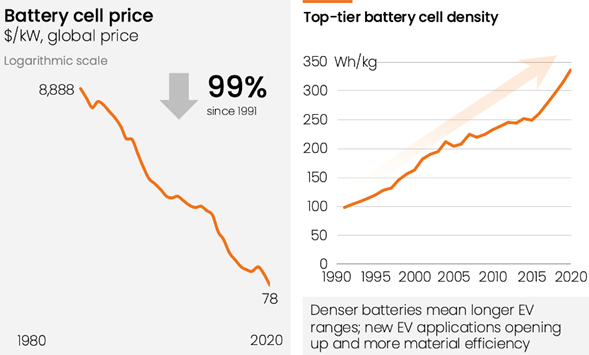
Lithium batteries became dense enough to store huge amounts of energy in a small box. What once powered a camcorder can now run a home. A lithium-ion battery costs 97% less than it did in 1991.
Electric motors became so efficient and finely tuned they can spin a drone propellor with the precision of a Swiss watch.
Power electronics, which control how electricity flows, shrank from bulky cabinets to chips the size of your fingernail.
Sensors got small and cheap enough to coordinate everything in real time.
Flight computers – the tiny brain that steers the drone hundreds of times per second – got cheap and mass producible.
Combined, these breakthroughs cut the cost of building a typical electric product, including drones, 99% since 1990.
I’m looking forward to visiting leading drone innovators, Neros and CX2 Industries, in El Segundo next month.
It’s important to understand how fast the electric leapfrog is happening. In warfare, it’s a matter of life and death. Armies that failed to embrace drones have been devastated.
For keyboard warriors like me, the stakes are lower. But ignore how fast the electric stack is improving, and you’ll misjudge the next decade of innovation, business and investing.
For example: flying cars.
I’ve been skeptical about electric vertical take-off and landing (EVTOLs), mostly because of regulation. But…
A “flying car” is just a big drone with people inside.
The same ingredients that allowed quadcopters to dominate the battlefield now make air taxis plausible.
One thing I know for sure: The first flying cars will debut here in the UAE. Archer Aviation is working with Abu Dhabi, and Joby is working with Dubai, both targeting a 2026 launch.
Meanwhile, something strange happened in California last month.
Big gas power plants usually roar to life and take over from solar when the sun goes down.
But this time, thousands of white battery boxes woke up and shouldered the evening rush. They pushed out enough electricity to power millions of homes.
This network of batteries working together is called a virtual power plant (VPP). It’s thousands of Tesla Powerwall boxes hanging in garages, linked together by code. A signal goes out like a neighborhood group text, and those home batteries function as one big power plant.
On one recent evening, Tesla’s VPP dispatched roughly a mid-size gas plant’s worth of power to the grid.
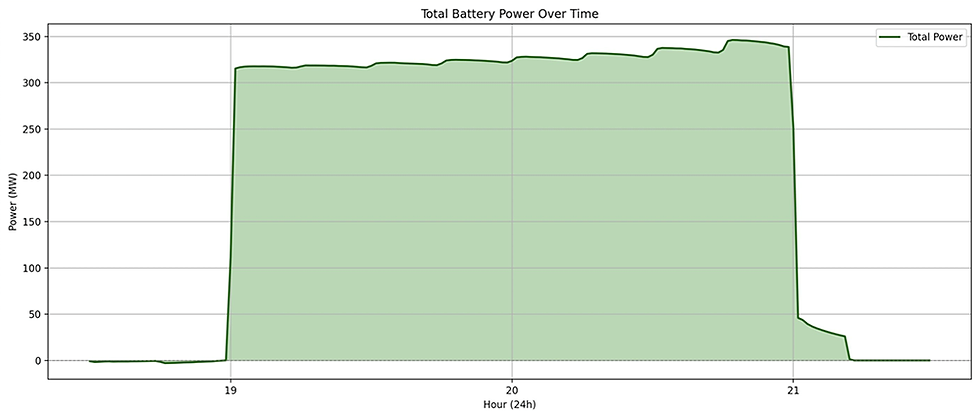
The best part? Powerwall owners got paid.
The company that masters VPPs will be the biggest power provider in America within our lifetimes.
My money is on Austin’s Base Power, which I’ll be visiting in November. It installs home batteries by the thousands and knits them together into one fleet.
It’s a no-brainer for homeowners: lower bills and immunity from all but the worst blackouts. For the grid, it’s even better: access to backup energy when they’re in a pickle.
The magic of batteries is they move energy through time. They bottle up cheap daytime sunshine and pour it back out at dinnertime when it’s needed most.
Batteries are the engine of the electric leapfrog. Unlike oil and gas, batteries are technologies, not fuels. And what do rational optimists know about technology? It gets better, faster, and cheaper.
That’s why battery prices collapsed 99% since 1980 while performance tripled.
I recently caught up with Ethan Loosbrock, founder of battery innovator Ouros Energy. He’s building a new cell that’s 10X denser and 100X cheaper than today’s lithium-ion batteries.
If Ouros can execute, it’ll be one of the biggest breakthroughs of our time. You can listen to our conversation here.
Electrification is the golden thread tying together many of today’s most important innovations.
In the electric leapfrog era, who wins and…
Who gets left behind?
If you’re an investor, you must face this question.
EV sales are up 15X since 2017. As battery-powered cars race ahead, it’s obvious Tesla will be much, much bigger in the future.
But every industry built on burning things for fuel is up for reinvention.
Have you ever heard of a diesel-powered humanoid robot? No, and you never will.
And AI data centers are just vast warehouses that turn electricity into intelligence.
Take what my friend Casey Handmer is building with Terraform Industries. It’s taking advantage of rapidly falling solar prices to make natural gas from sunshine, water, and air.
If you’re an entrepreneur, ask yourself: what problem could you electrify? Sam D'Amico of Impulse built battery-powered stoves because he wanted to cook pizza faster.
You don’t have to be an inventor to seize this opportunity. The electrification boom needs installers, electricians and technicians.
Electrician wages for contractors working on data centers have roughly doubled over the past year. In the southern US, companies are building AI factories the size of Manhattan. If you’re willing to move to West Texas, it’s the 2015 fracking boom all over again.
I love these two Wall Street Journal headlines because they’re the opposite of the usual “tech kills jobs” spiel.


And for America, it’s a wakeup call.
America was hooked on foreign oil for decades. We literally fought wars over it. Then came fracking, which turned the US from energy beggar into energy superpower.
Now the game has changed again. China is winning, hands down, in the electric leapfrog era. It’s the world’s first “electro-state” – the Saudi Arabia of electric tech.
China makes 80% of the world’s solar panels, 70% of EVs, and 75% of batteries… all at a lower cost than the West.
This is a more serious problem than it may seem. In the old industrial world, knowing how to make a car didn’t help you make a phone.
But in this new electric age, product know-how converges. EVs, drones, and flying cars are all versions of the same machine: a battery, a motor and a computer wrapped in a different shell.
BYD started as a humble battery maker, then realized a modern car is basically a battery, motor, and software platform on wheels. Master those three, and you can build anything that moves… even the world’s fastest car. Now BYD makes everything from buses and forklifts to ships and trains.
In the electrified economy, once you can build one thing well, you can build almost anything.
In a world built on electricity, he who controls the electrons controls the future… from AI data centers and robot fleets to desalination plants and air taxis.
The good news is American builders are putting us back in the game. Innovators like Neros, Base Power and Ouros are proving the US can still lead when we decide to build.
Which part of Electric Leapfrog should we go deeper into next: drones or solar?
You decide, comment below.
—Stephen McBride
Stephen McBride is a co-founder of the Rational Optimist Society.


