
How many lives will this AI model save?
Why doomers keep losing
I’m putting the finishing touches on a story 100 years in the making.
For a century dozens of entrepreneurs have tried to become the "Henry Ford of housing”… the hero who speeds up building, lowers cost, and relieves our dire “houses are way too expensive” problem.
They’ve all failed. It takes longer to build a home than it did in the 1970s!
Next week I’ll introduce you to the innovator I think finally cracked the code. It’s a contender for disruption of the decade. Do not miss it.
Today, a true story that’ll raise your eyebrows:
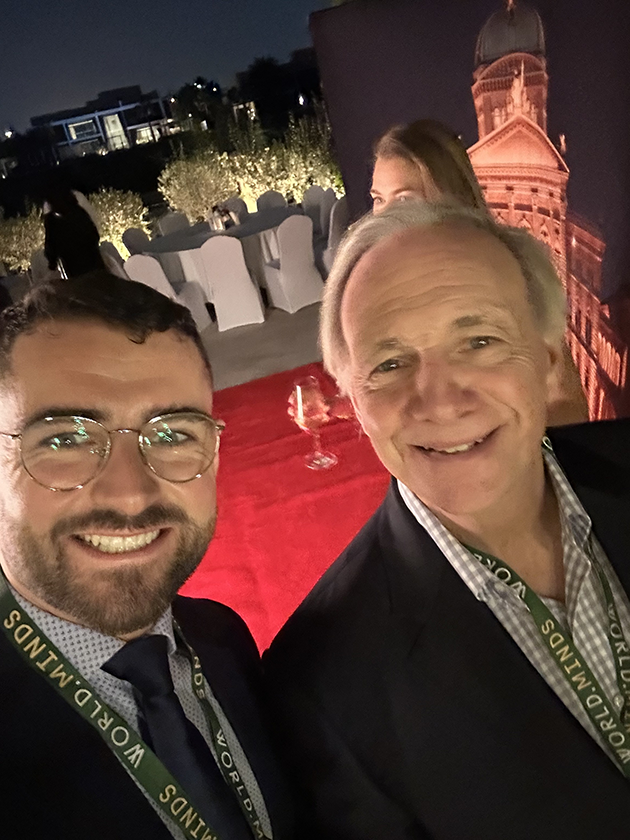
I had a group dinner with hedge fund pioneer Ray Dalio in Abu Dhabi.
For a billionaire, he’s a normal dude:
Ray, who built the world’s largest hedge fund by mastering economic cycles, dropped a surprising stat that he’s mentioned in his book and various podcasts: “Droughts, floods, and pandemics have killed more people than wars.”
True, but… the number of people dying from natural disasters is near record lows:
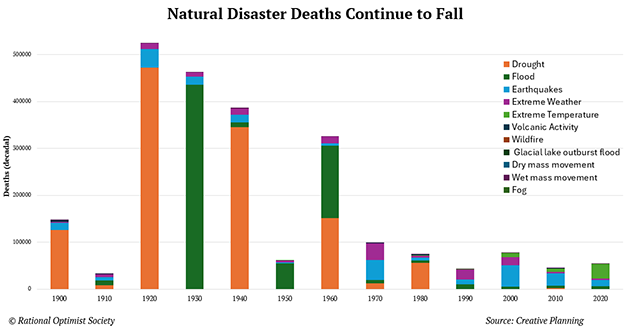
It’s not that weather got better. What changed is us. We built stronger structures and got incredibly good at warning people and getting them out of harm's way.
Now AI is giving us the ultimate early-warning system.
As Hurricane Beryl churned through the Caribbean two summers ago, a team of physics PhDs, using room-sized government supercomputers, predicted it would hit Mexico.
The same day Google DeepMind ran an experimental AI model called GraphCast. It disagreed and forecasted landfall in Texas.
Four days later Beryl slammed into Texas.
An AI model on a laptop beat PhDs with supercomputers!!
GraphCast requires just two sets of data: the state of the weather 6 hours ago, and the current state of the weather. “ChatGPT for weather” then spits out a more accurate 10-day forecast in seconds.
Imagine how many thousands of lives AI super-weathermen will save?
GraphCast is part of the “great handoff.”
For the last century, much technology has been held back by government monopoly. If you wanted to split the atom, break the sound barrier, or go to orbit, you needed state backing.
Now government bureaucracies are handing the baton to private innovators:
Nuclear: Dozens of startups are building microreactors in warehouses across America.
Space: SpaceX has already launched more cargo into orbit than NASA ever did.
Supersonic: The only supersonic liner in history (Concorde) was a joint venture between the UK and French governments. Now Boom, Astro Mechanica, and Hermeus are reviving it.
Innovation is escaping the committee room and entering the marketplace. I’m extremely optimistic about this.
Know what technology is criminally underrated?
Geothermal energy.
Deep underground, an endless furnace burns hotter than the surface of the sun. It's been running since Earth formed 4.6 billion years ago, generating enough heat to easily power all of humanity.
Almost every power plant today, be it nuclear, coal, or gas, is just an elaborate way to boil water into steam. That steam spins turbines and voila, electricity.
Geothermal is nature’s steam engine. Drill holes into hot underground rocks. Pump water down. Use the hot water or steam to spin turbines and generate power.
Iceland gets around 30% of its power from geothermal, thanks to its boiling mud pits and steam vents. Yet geothermal provides only 0.4% of America's power today. Why so little?
It’s hard to dig deep enough. The Soviets dug the deepest hole ever in 1970, the Kola Superdeep Borehole in Siberia. After 20 years of drilling, they reached 7.6 miles down.
At those depths temperatures hit 360°F. Their drills kept breaking. The 9-inch-wide hole was welded shut in 1995, a dead end.
Now, three small companies, each with a distinct approach, are reviving geothermal:
NOW: Fervo
Deep in the Utah desert Fervo Energy is performing precision surgery on the Earth’s crust, threading L-shaped wells straight down through hot granite.
Picture two parallel wells. The first plunges straight down 15,000 feet, then hooks sideways like a hockey stick. Cold water flows down it.
The second well carries up pressurized steam hot enough to power a small city.
Fervo recently demonstrated a 70% year-over-year reduction in drilling times. It’s innovating faster than the oil industry did during the shale revolution.
It also just signed the largest deal in geothermal’s 60-year history with Southern California Edison.
Fervo’s flagship "Cape Station" project is progressing ahead of schedule. When it comes online this year it’ll deliver enough stable power to light up 100,000 homes.
NEXT: Mazama
We all learned water has three phases: ice, liquid, and steam. But if you push water past 705°F under extreme pressure, it turns into a "supercritical fluid.”
In short, it becomes a ghost-like mist that can generate 5-10x more energy than a standard geothermal well. Supercritical water is the holy grail of geothermal.
That’s what Texas-based startup Mazama is hunting.
Last October it drilled two miles deep into the Newberry Volcano complex in Oregon and created the hottest geothermal well in history.
Drilling into a volcano usually destroys equipment. But Mazama drilled through hard rock at record speeds with zero equipment failures.
Mazama is targeting costs under 5 cents/kWh, which would put it toe-to-toe with natural gas.
FUTURE: Quaise.
Quaise Energy wants to drill deeper than we’ve ever gone before.
Born in MIT's nuclear fusion lab, Quaise aims to bore 12 miles down into Earth’s crust, where rocks bake at 930°F.
At extreme depths even heavy-duty drills crack and snap in half. So Quaise said…
Screw the drills; let’s use lasers.
It’s building a machine that melts rock with high-powered millimeter waves. These microwaves vaporize granite like a blowtorch through ice.
Last summer Quaise successfully tested its "energy drill" in Texas. They drilled 118 meters into solid granite, carving basketball-sized holes through solid rock. Quaise aims to drill a kilometer-deep well by next year.
It’s early days. But if Quaise succeeds, one small geothermal well as narrow as a trash can could power an entire town!
If I had to pick a horse to bet on, Quaise has my money.
Geothermal isn’t ready for prime time just yet. It still costs several times more than natural gas or nuclear to get a geothermal well up and running. And paybacks are long.
But what matters is geothermal is now evolving fast.
My kids will be happy to know the floor really is lava.
I bet we’ll smash the Soviet Kola Superdeep record before this decade is out.
People often ask why we founded ROS…
The Society was born out of a necessity to stay sane.
I imagine a future conversation with my 7-year-old daughter: “Dad, what did you do when everyone told us the world was doomed?”
I want to answer that I didn’t just watch. We stepped up and filled the narrative void with rational optimism.
If a news network gave me the reins for one night to report on what happened in 2025, here’s the broadcast you’d hear.
Welcome to “The best news in America” show!
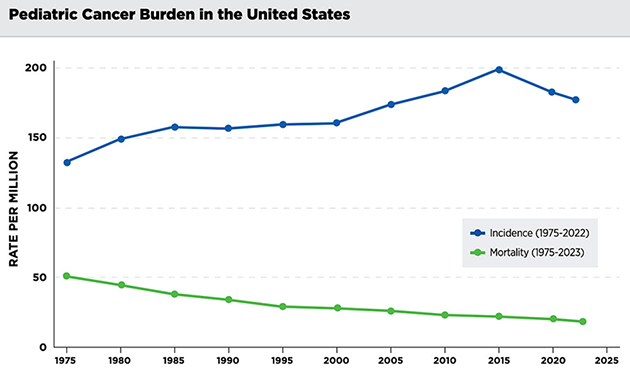
No. 1: Slowly but surely, we’re winning the war on cancer.
The American Association for Cancer Research reported a two-thirds decline in the pediatric cancer death rate since the 1970s:
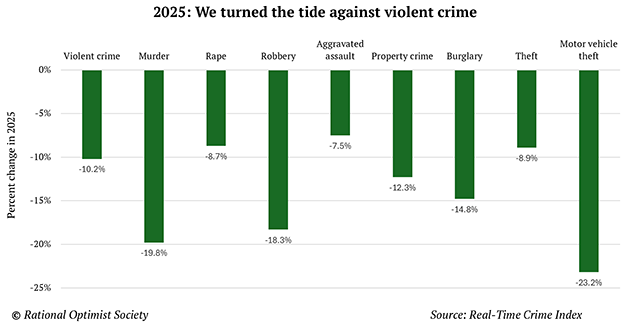
No. 2: 2025 saw the largest one-year drop in the murder rate ever.
Roughly 12,000 fewer people were murdered in the US over the past two years compared to the pandemic years.
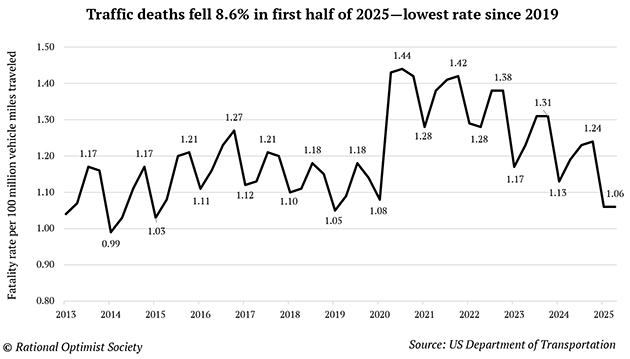
No. 3: Traffic deaths fell 8% in the first half of 2025.
We now have the lowest fatality rate since 2019:
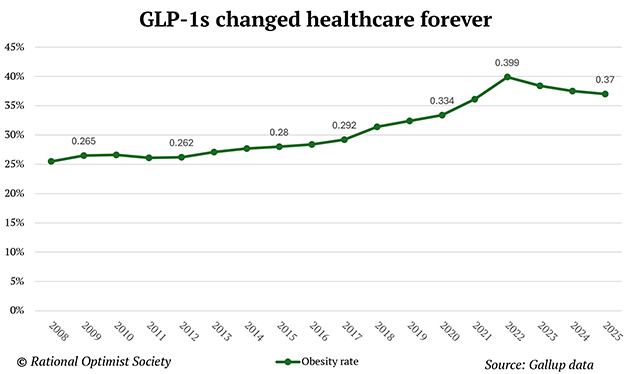
No. 4: A Gallup study found the US obesity rate fell for the second year running.
That small tick down represents roughly 7.6 million fewer overweight adults:
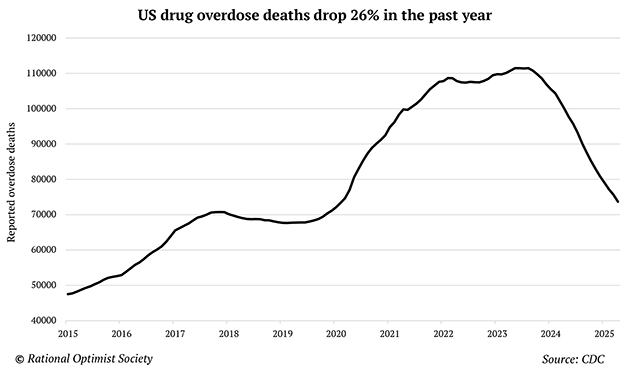
No. 5: Drug overdoses, the No. 1 cause of death for Americans under 50, dropped 26% over the past year to lowest level since 2020:
Don't let the negative news nellies steal your optimism. It’s your most valuable asset.
I’ll see you next Sunday.
—Stephen McBride


