
Rational Optimist Awards part 2!
Including hockey stick chart of the year
Happy New Year, my fellow rational optimist.
2026 will be an awesome year, and not just because it’s America’s 250th birthday.
Innovators will wake up every morning and make it awesome.
Imminent breakthroughs I’m most excited about:
Three nuclear microreactors will go critical by July 4, 2026. Alpha School will roll out in dozens of US cities. We’ll see at least one more supersonic jet take to the skies. And the largest cloud-seeding project in history is ramping up.
Last week was Part 1 of our inaugural Rational Optimist Awards ceremony. This week we’ll hand out the remaining 10 trophies… plus a bonus award.
If you think I’m wrong about any of these, tell me below in the comments section. Best comment wins an award of its own: “Most Persuasive Argument From a Rational Optimist.”
Let’s crown some winners.
Headline of the year…
Winner: 52-year ban on supersonic flight lifted
In 1964 the Federal Aviation Administration conducted 1,253 sonic booms over Oklahoma to test how disruptive they were. Three in four residents said they didn’t mind. But a tiny 3% minority raised hell.
That was enough for the FAA to outlaw supersonic flight in US airspace in 1973.
Instead of banning noisy aircraft, the US banned all supersonic aircraft. This destroyed any opportunity to solve the noise problem with technology.
After 52 years of “faster than sound” flight being outlawed, we’re righting that wrong. In June the president signed an executive order overturning America’s supersonic ban:

As someone who frequently flies overseas this was hands-down the best headline of the year.
Imagine boarding a plane in New York at 10 am and landing in Los Angeles at 9 am.
A literal time machine. That’s the promise of supersonic flight.
We met the entrepreneurs building the next generation of supersonic jets. Read our deep dive on Boom, Astro Mechanica and Hermeus here.
Story of the year…
Winner: Brad Smith (Neuralink)
Brad Smith is a dad of three suffering from ALS, AKA “Lou Gehrig’s disease.” It slowly steals your ability to move, speak and eventually breathe, but your mind remains sharp.
As a dad of three, the thought of being trapped inside my body, unable to hug my kids or provide for them, is literally my worst nightmare.
Thanks to this quarter-sized chip from Neuralink, which slides under his skull and nestles against his brain, Brad can now talk with his family for the first time in years.
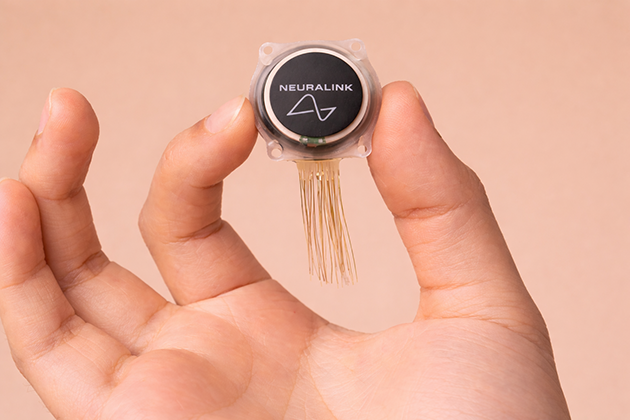
Neuralink’s surgical robot precisely implants 1,024 microscopic electrodes on 64 threads—each thinner than a human hair—into the part of the brain that controls movement.
These threads listen to the electrical signals your neurons fire when you intend to move.
The chip reads Brad’s mind and translates thoughts into action.
Now he can go to his kids’ soccer games. He can play video games with them. In Brad’s own words: “Going outside has been a huge blessing for me. And I can control the computer with telepathy. Life is good.”
God bless innovation.
Brad is Neuralink Patient 3. Watch our interview with Patient 1, Noland Arbaugh, here.
“The future has arrived” moment of the year…
Winner: Waymo
This year I rode in over a dozen Waymos in Austin, LA and San Francisco. If you’re a nonbeliever, go take a Waymo ride.
A white Jaguar Waymo pulls up with a spinning sensor on its roof that looks like a high-tech crown.
You sit down and the screen welcomes you by name: “Good afternoon, Stephen. Heading to the bar now… This experience may feel futuristic… We’ll do all the driving.” One press of the “start ride” button, and we were off.
Riding in a normal Uber afterward felt like going back to a flip phone.
My friend Tyler Hayes, founder of Atom Bodies (AI-powered prosthetic arms 100X better than what patients can get today), made a point in San Francisco that rings true:
“Waymo changed how regular people feel about technology. In the 2010s, tech meant software apps, tiny upgrades on a glowing rectangle. Waymo is the first time normal people can feel the future. A robot pulls up. You get in. It drives you across town. No explanation needed.”
Waymo started as Google’s self-driving car project in 2009. A dinky little one-person rickshaw. Now it’s clocking 1 million rides per month in California alone:
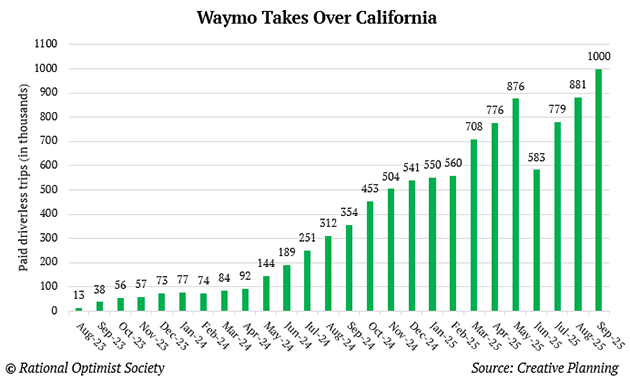
And Waymos are ultra-safe. A peer-reviewed study of nearly 100 million driverless miles in four American cities showed Waymos have 90%+ fewer serious crashes than human drivers.
The more robotaxis we drive, the more lives we save.
Turnaround of the year…
Winner: Climate change
My whole adult life I’ve been blasted with the message that climate change will end humanity. Every government, corporation and Hollywood star told us we’d soon be toast, unless we did as they said.
I always struggled to square that apocalypse script with the fact climate-related deaths have been falling for a century:
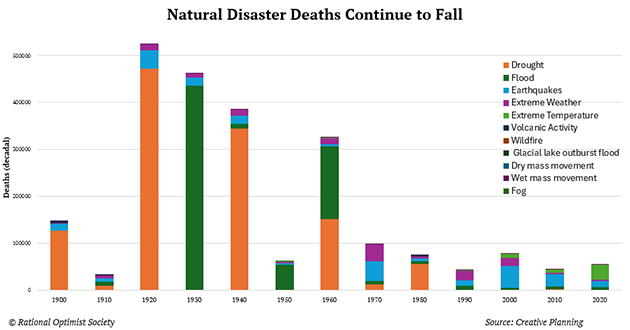
2025 was the year climate hysteria died. Matt Ridley, the original rational optimist, laid out the proof in a recent essay, which you can read here.
My favorite stat on this: Bloomberg found mentions of climate on earnings calls dropped 75% from their peak.
Why the sudden shift? AI.
The old climate narrative was all about cutting back. Less energy. Less growth. Less everything. But the giant data centers needed to power ChatGPT have insatiable energy demands.
OpenAI’s flagship project, Stargate, will consume 5 gigawatts of power. We’re building computer warehouses that consume as much power as Philadelphia!
If there’s one thing governments and corporations care about more than climate virtue signaling, it’s not losing the AI race.
AI is the perfect cover story for the changing climate narrative.
To quote Matt Ridley:
“Throughout the tech world of the American west coast, emoting about climate suddenly seems like a luxury belief compared with the need to sign contracts with power suppliers mostly burning natural gas – or get left behind in the AI race.”
Hockey stick chart of the year…
Winner: SpaceX
Elon’s SpaceX is the cleanest hockey stick chart in the world. It’s now launched more mass into orbit since its first flight in 2006 than every other US aerospace firm combined!
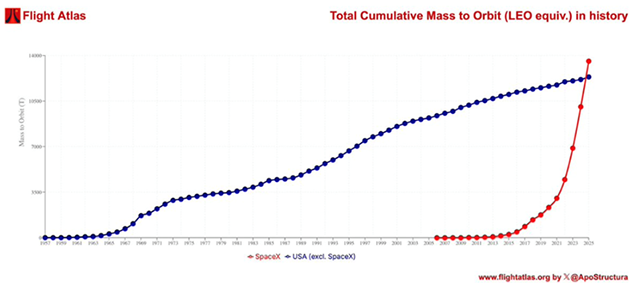
Rocket launches used to be rare. Not anymore.
In 2025 SpaceX set a new annual record with 170+ launches, meaning a SpaceX rocket went up roughly every other day. This included five launches of its skyscraper-sized rocket, Starship. It’s also passed 10,000 Starlink internet satellites in orbit.
SpaceX’s valuation in the private markets surged to $800 billion. That makes it larger than Raytheon, Boeing, Lockheed Martin, General Dynamics, Northrop Grumman and L3Harris… combined!
There were several great hockey stick charts in frontier tech this year, so this award deserves a runner-up.
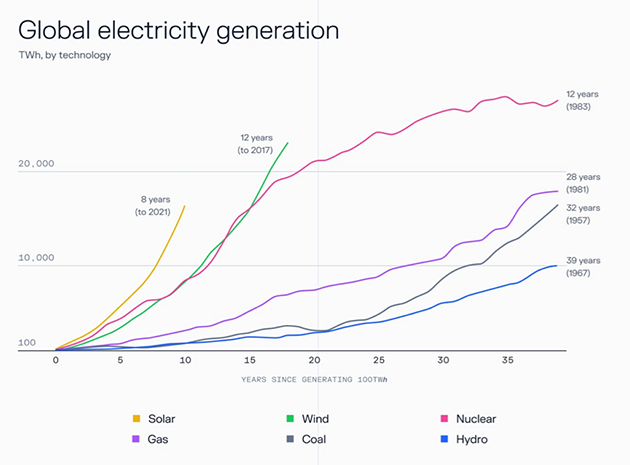
Second place goes to solar power. It’s now the fastest-growing energy technology in history:
Unsung hero of the year…
Winner: Fracking
Remember when America’s biggest problem was relying on Middle Eastern oil?
In 2005 the US imported 3.7 billion barrels of oil. Wars were fought over black gold.
What if I told you no country in the history of our planet has pulled oil out of the ground at the pace the US did in 2025?
America now produces 50% more oil than Saudi Arabia. Sounds fake, but it’s a fact:
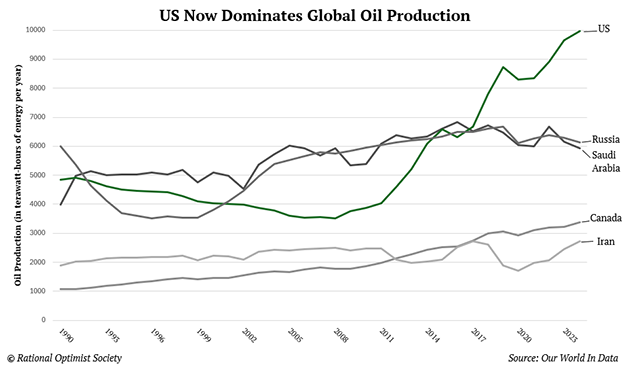
From the world's largest energy importer to its largest producer in 20 years.
This is all thanks to fracking, the technique used to access oil and gas trapped in rocks thousands of feet underground.
Rational optimists know cheap, reliable energy is the bedrock of all innovation.
If it weren’t for fracking America would be miles behind in the AI race. Today the vast majority of data centers are powered by gas turbines. Next-generation supersonic jets will also run on “liquefied” natural gas.
And yes… fracking has been great for the environment too. America’s total carbon emissions dropped 20% since peaking in 2006. Fracking made natural gas so cheap it replaced coal as America's No. 1 power source.
Comeback of the year…
Winner: Nuclear (the Second Atomic Age)
Nuclear is the cleanest, safest, densest and most reliable energy source ever discovered. Yet instead of embracing it we all but banned it in the West in the 1970s.
Thankfully we’ve snapped out of that delusion, prompted by the need for a lot more clean, reliable energy to feed AI progress. Governments aren’t just allowing nuclear development again… they’re clearing regulatory roadblocks and widening loopholes for nuclear entrepreneurs to sprint through.
Meanwhile Big Tech giants Google, Amazon, Microsoft and Meta all inked deals to restart shuttered nuclear plants and build new ones.
And 10 small modular reactor startups are racing to turn on America’s first microreactor by July 4, 2026.
These startups, including Valar Atomics, Aalo Atomics, Radiant, Last Energy, Antares and Deep Fission, collectively raised roughly $1 billion in 2025.
If there’s one image to sum up nuclear’s comeback, it’s this:
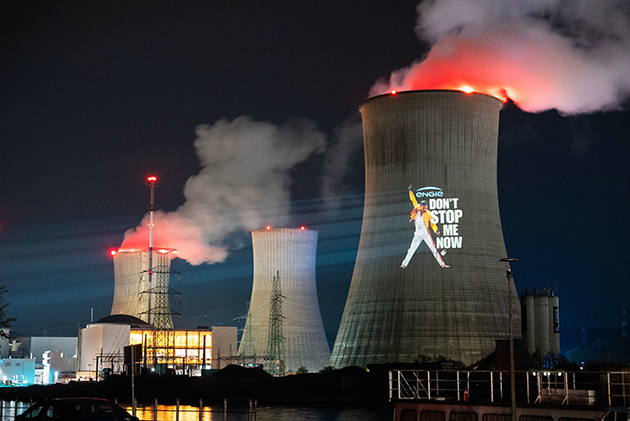
A 50-year-old Belgian reactor was scheduled to shut down, and suddenly a giant projection of Queen’s “Don’t Stop Me Now” appeared on its cooling tower.
The stunt was led by environmental activists… the same people who spent decades trying to kill nuclear.
It’s the most exciting time for nuclear energy in at least 50 years. The second atomic age is here.
Miracle of the year…
Winner: Baby KJ’s CRISPR treatment
In Philadelphia a baby named KJ Muldoon was born with a one-in-a-million genetic disorder that’s typically a death sentence. His liver couldn’t clear ammonia (the toxin your body makes when it breaks down protein) meaning eating could damage his brain.
Doctors offered his parents "comfort care," a way of suggesting they prepare to let him go. Instead he became the first human to receive a personalized gene-editing treatment to fix the typo in his DNA.
Your genome is three billion letters long. KJ’s problem came down to one wrong letter.
Doctors built a tool to “edit” that letter. After spending 307 days in the hospital, KJ was released and is now home and thriving.
He “graduated” from the hospital wearing a little cap and gown. This image will stay with me for a long time.

We’ve been hearing about gene editing, aka the CRISPR revolution, for years. In 2025 it finally arrived.
Robot of the year…
Winner: Matic Robotics
My least favorite chore is vacuuming. It’s the kind of time-sucking task a robot should have taken over by now. And technically, it has... if you’re okay with a Roomba that bumps into walls, gets stuck on rugs and needs constant rescuing.
That’s why I’m awarding robot of the year to Matic Robotics.
Just like the iPhone wasn’t the first smartphone, Matic isn’t the first robot vacuum. But it’s the first that works the way you want it to.
Matic is a fully autonomous robot that sees and cleans your home like a human. It uses five cameras and onboard AI to create a 3D Google Street View-style map of your home, complete with furniture, floor types and elevations.
Matic knows the breakfast table gets dirtier than the guest bedroom. It learns your home like a butler would and prioritizes where to clean.
Unlike most smart devices (which are dumb), Matic also recognizes the difference between spilled juice and dry crumbs, and seamlessly switches between vacuuming and mopping on different surfaces.
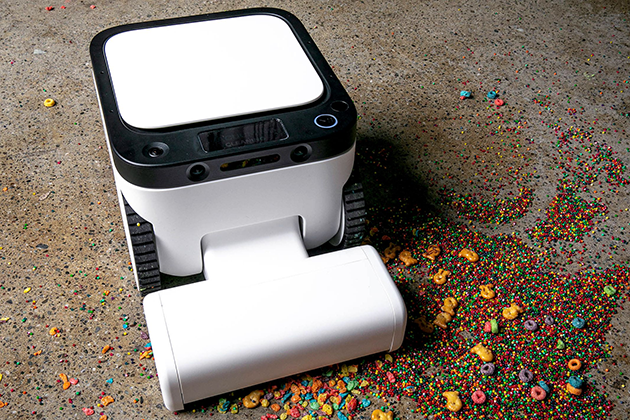
Matic’s founder and CEO Mehul Nariyawala is motivated by pure rational optimism. His mission is to give American families their time back. “Every minute Matic gives back is a minute I get to spend with my kids instead of cleaning spaghetti off the floor,” he told me.
I asked Mehul for his vision: “A future where Matic is your personal butler, like Alfred from Batman. You don’t have to worry about housework. It says I got this. I’ll ping you if I need help. It can make calls for you, like phoning the plumber if it notices a pipe loose.”
Blight of the year (anti-award) …
Winner: Britain’s nuclear “fish disco”
America has its fair share of progress-halting bureaucrats.
We’ve got regulators in Boston telling robotaxis they need a human “safety driver” sitting there… while the robot does the driving. A single public toilet in San Francisco took three years and cost $1.7 million to build. And in LA, almost a year after wildfires burned 600 Malibu houses to the ground, the city only issued two rebuilding permits!
But if we’re giving out the trophy for the most comically self-defeating bureaucracy of the year… the UK wins.
The company building one of the UK’s newest nuclear power plants had to produce a 31,000-page environmental report before it poured an inch of concrete.
Then regulators forced it to install 288 underwater speakers as an “acoustic fish deterrent” to keep fish from swimming too close to the cooling pumps.
The fight over the “fish disco” started in 2019 and is still ongoing.
If you ever wonder why the UK and Europe are falling behind, remember this story.
Let’s not end on a sour note and let the bureaucrats get the last word. Here’s one last trophy.
The “Building in Spite of The Blight” award.
And the winner is… Elon Musk and the xAI crew.
xAI took a muddy 114-acre patch of grass and swamp on the Tennessee–Mississippi border and turned it into the world’s largest AI data center… in 122 days.
That’s roughly half the time it takes to build a typical 1,800‑square‑foot American home!

The tricks Elon and co. had to pull off to get this data center up and running are remarkable.
When told they’d have to wait a year to pull energy from the grid, they installed 14 natural-gas turbines as a temporary power plant.
To keep the 200,000 AI chips inside the data center from cooking, they rented a quarter of America’s mobile cooling capacity.
And when Tennessee permitting got in the way, xAI simply stepped over the state line, leaning on a decommissioned power plant in Mississippi to help power the site.
This is what “building in spite of The Blight” looks like.
And that concludes the inaugural Rational Optimist Awards!
If you disagree with any of my picks, nominate your own winners in the comments.
Happy New Year, and remember… don’t bet against the innovators!
—Stephen McBride


