
Everything’s AI
“Everything’s computer.”
President Trump famously said this when he first sat inside a Tesla Model S last year.
He should have said, “Everything’s AI.”
AI is the most important force on the planet now. Its gravitational field is affecting everything.
Look around. AI has vanquished the “innovation famine.” This is Matt Ridley’s observation that although we got amazing advances in digital technology in the last 50 years, there’s been practically zero improvement in the physical world.
That era is over. Exhibit A: nuclear energy.
I've been investing in nuclear since 2018. For years I felt like a total outcast. Nuclear was the ugly duckling of energy.
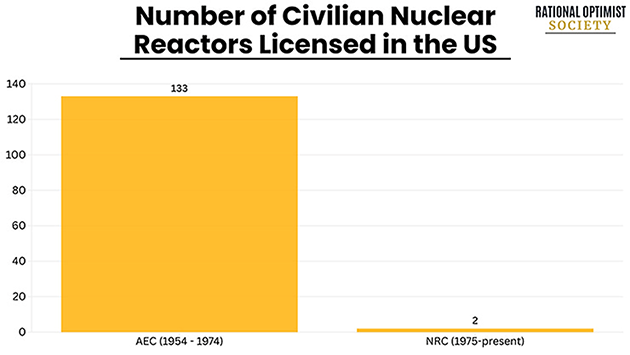
Do you know how many new reactor designs the Nuclear Regulatory Commission (NRC) greenlit since it was founded in 1974?
Zero! And only two reactors started commercial operation on the NRC’s watch, compared to 133 before.
Nuclear has re-entered the chat because AI needs it. Every time you ask ChatGPT a question, you’re using an industrial-scale machine.
Behind the scenes your words travel to cavernous data centers filled with rows of NVIDIA graphics chips (GPUs). A single rack of NVIDIA H100s pulls more electricity than 50 American homes. And the latest AI data centers have over 100,000 AI chips inside!
In Santa Clara, California, at least two data centers sit empty because they can’t connect to the grid.
Nuclear is the only energy source that can deliver enough clean, safe, round-the-clock electricity to feed AI.
Microsoft inked a deal to help restart the Three Mile Island plant in Pennsylvania. Amazon entered a 17-year contract with Talen Energy to power its data centers with nuclear. Meta inked a 20-year deal to buy power from Constellation Energy’s Clinton nuclear plant in Illinois… strictly to feed its AI data centers.
We’re also building America’s first small modular reactors (SMRs)… to power AI.
A good rule of thumb is “whatever AI wants, AI gets.”
I had dinner recently with a senior energy policymaker in Washington who put it bluntly: "We needed a cover story to give us permission to build again. AI is it.”
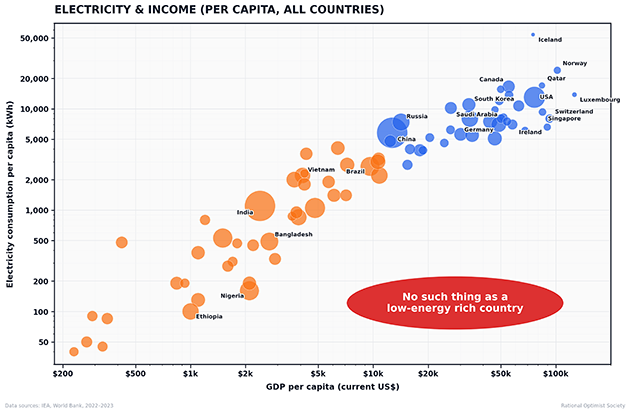
Rational optimists know energy is the bedrock of all innovation. There is no such thing as a rich, low-energy country, and there never will be.
At first I laughed at the idea of data centers in space…
What could possibly warrant putting chip clusters into orbit?
AI.
America's grid can't keep up with AI’s insatiable energy appetite. The average wait time to connect to the grid is now 7 years.
Instead of hunting for power on Earth some very smart people are looking up to the stars.
Space has two things AI data centers crave: unlimited solar energy with no clouds or night cycles. And no permitting battles. There’s no Blight in outer space!
Last November Washington-based startup Starcloud launched a satellite carrying an NVIDIA chip and is running an AI model as we speak…
SpaceX (which just acquired xAI) is seeking FCC approval to launch 1 million satellites that will harness solar power for AI data centers…
Google is working on Project Suncatcher to put its AI chips on orbital satellites…
Space data centers are possible, and I think they will be one of the most important trends to watch in the next 3-4 years.
Does the math work? Not yet. The best analysis suggests space-based data centers are still roughly 3X more expensive than Earth ones.
Satellite costs are the biggest bottleneck. In space you have to build and launch your own power plant in the form of massive solar arrays. But if there’s one thing we know about technology it’s the more we do something, the cheaper it gets. It’s called learning curves, my fellow nerds.
Remember, the only reason we’re even talking about data centers in space is because SpaceX demolished the cost of reaching orbit:
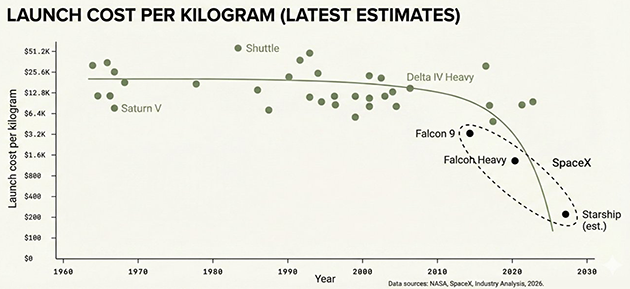
We’re approaching a world where you can fill a skyscraper-sized rocket with AI servers and launch it into orbit for a fraction of what a single satellite cost a generation ago.
What will be possible when reaching space is 10X cheaper than today?
This is what living through a historic buildout feels like.
As a share of the US economy the AI buildout is on track to exceed every major infrastructure project since the railroads.
I think the biggest misconception about AI is that it's “just software.” It’s not. We need so much physical stuff to power AI that we're building nuclear plants, putting data centers in space, and undertaking one of the largest construction campaigns in American history.
Across 2025 and 2026 Big Tech giants will spend over $1 trillion building AI data centers. That’s 6X more than America spent putting a man on the moon, inflation-adjusted!
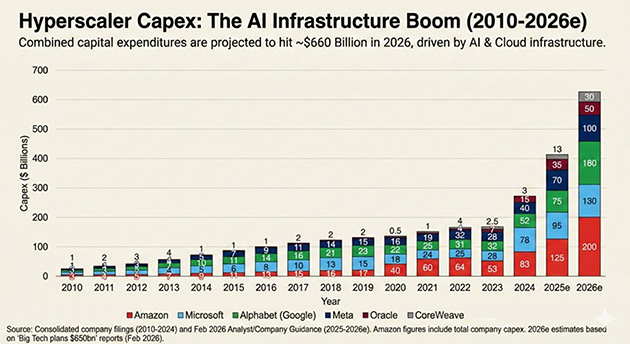
The AI buildout is teaching America how to build big, physical, ambitious projects again.
xAI’s “Colossus” cluster in Memphis went from a gutted factory to a fully operational, 100,000-GPU data center in just 122 days. It takes 234 days to build the average American house.
The “knock-on” effects here are monumental.
Think about SpaceX. Thousands of engineers cycled through that company and went to the school of Elon Musk. Many left and started their own companies.
The SpaceX Mafia includes Radiant (nuclear reactors), Hermeus (hypersonic jets) and Varda (making drugs in space). That was the talent diaspora from one company.
Now multiply that across an entire trillion-dollar buildout. Tens of thousands of engineers are learning how to stand up megaprojects at a pace America hasn't seen in half a century.
It’s hard not to be optimistic.
A cure for one of America’s biggest killers already exists.
Roughly 40,000 Americans die on the roads annually. Tens of thousands of moms, dads and kids leave the house in the morning and never come home. We've accepted this as the cost of doing business.
Enter the robotaxi.
Over 100 million driverless miles, Waymo reduced bodily injury claims by 90%. Researchers found almost all Waymo accidents were caused by the human driver in the other car.
Robotaxis are like vaccines for our roads. Every month we delay full deployment, people die who didn't have to.
Waymo started life in 2009 as Google’s self-driving car project. The car was a dinky little one-person pod that looked like a marshmallow on wheels. Now it completes over a million rides per month in California alone:
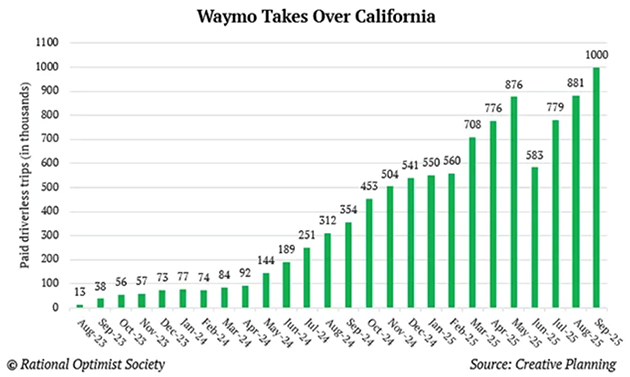
Why the sudden takeoff?
Because everything’s AI.
Self-driving tech used to work like a student cramming a massive rulebook. Then Waymo and Tesla replaced all that hand-written code with AI that learns from driving. Instead of following rules the car now makes decisions based on what it sees.
The switch to end-to-end AI squeezed a decade’s worth of progress into twelve months.
Autonomous driving has graduated from “testing” to “scaling.” It’s no longer about if it works, but how fast they can manufacture the cars.
People who are still “anti-robotaxi” need their heads examined. Opposing self-driving cars is like opposing seatbelts 50 years ago.
Last year I rode in over a dozen Waymos in Austin, LA and San Francisco. It’s magic. I’ve yet to meet a nonbeliever who’s actually ridden in one.
They’re rolling out fast here in Abu Dhabi. I took my kids on their first robotaxi ride last week. You should’ve seen the pure delight.
The best way to teach kids (by far) is with a dedicated, one-on-one tutor
We’ve known this since Professor Bloom proved it in 1984. Just seven weeks of personalized tutoring could transform C students into straight-A students.
Problem is very few parents can afford personal tutors. Alexander the Great had Aristotle. The rest of us got a classroom with 30 kids and one exhausted teacher. Conveyor-belt schools were the best we could do.
What if the cost of a personal Aristotle could drop to nearly zero? We’re about to find out.
ROS co-founder Dan Steinhart recently Deep Dove into AI schooling here.
Alpha School in Austin is doing truly astounding things with AI learning. Its K-8 students test in the top 1% in the US. The average fifth grader at Alpha scores higher in math than the national average for an eleventh grader. A ten-year-old outperforming a sixteen-year-old!
Alpha kids follow a personalized, AI-crafted learning plan. They go at their own pace and can’t progress to the next step until they pass a mastery test. This is possible because an AI tutor assesses their knowledge in real time, identifying gaps and helping students through them.
AI learning works so well it compresses all the core academics into two intense hours. Students spend the rest of the day learning how to live. They launch podcasts, learn to manage Airbnbs and run real businesses.
Alpha kids are learning 2X faster while loving school. That’s a civilizational-level upgrade.
A lot of parents worry AI will make us dumb and lazy. Alpha proves the opposite. When AI handles the drudgery of rote memorization and repetitive drills it frees us to do the things that make us distinctly human.
AI is ushering in a golden age of learning. I (almost) wish I was back in school again.
Thanks, AI
Without it, nuclear stays dead. Cars keep killing 40,000 Americans a year. And a billion kids stay stuck hating school.
Here's what I'd encourage every Rational Optimist to do:
Use AI daily. I wrote a guide to using AI agents here.
Rethink how your kids learn. If you have kids or grandkids, this is the most important action to take. Play around with AI tutoring tools. Explore schools like Alpha that are pioneering this model. Even if your kids are in a traditional school, supplement with AI-powered learning at home.
Invest accordingly. I see a decade of rapid growth ahead for companies at the epicenter of this multi-trillion-dollar investment cycle. Nuclear is entering its first expansion in 50 years. Space is getting its first real use cases beyond communications. Self-driving cars will reshape transportation.
The digital revolution created a generation of internet millionaires. AI drags the center of gravity back to the physical world. People who build real things will mint fortunes.
Spread rational optimism. Rational Optimist Society has hit 25,000 members. We’re just getting started!
Rational optimism is self-fulfilling. People who believe the future can be better are the ones who go out and make it better.
You're witnessing the end of a 50-year innovation famine and the start of something extraordinary. Invest in the builders. Teach your kids.
— Stephen McBride


