Agents: AI for normies
Big news! After a long wait on the printer, our first kids book is finally almost ready to debut.
It’s about 2 brothers who became gritty founders before it was cool – Wilbur and Orville Wright. They scraped together $1,000 of their own money and failed over 700 times on their way to inventing the airplane.
The book is 100% human (no AI used). I wrote it and a Vermont artist illustrated it in beautiful watercolor.
One important thing – we had to buy the books upfront, so we’ll only have 1,500 copies. Considering we have over 33,000 ROS members, it could sell out very fast.
If you want copies in time for the holidays for the kids or grandkids in your life, you’ll want to order right when it comes out. We will send you an email when the book is available, within the next 1-2 weeks.
Here’s the cover:

Thanks for your support in helping make the world more rationally optimistic for our kids.
—@Dan Steinhart
This summer I (Stephen) flew my family of five from Abu Dhabi to Ireland and forgot to enter our frequent-flyer numbers.
To recover our valuable miles, I would have to register for five separate accounts and fill out the airline’s “missing miles” form five times. Too much work, so I didn’t bother.
A few weeks later I got early access to a newly launched AI “agent” called Instinct. I tested it by sending it a simple voice note on WhatsApp: “sort out the miles from our summer flights.”
My Instinct agent dug the bookings out of my email, opened miles accounts for my wife and kids, set up a family account to link them all, filed the claims, chatted with a human customer rep… and got our miles credited!
We’ve entered the age of AI agents that do real, useful work for you.
This is the third “big bang” of the AI era:
In November 2022 AI learned to talk in human language when ChatGPT launched.
In September 2024 AI learned to think when reasoning models were first released.
Now, in November 2026, AI has learned to work.
I’m what my friend Tyler Cowen calls an “AI maniac.”
I’m an early adopter of every new feature, and have woven AI deep into my work and life to supercharge my productivity. I’ve been trying to get AI agents to work for me since last year. But they’d hit so many snags it was usually easier to do a task myself.
So when Instinct claimed my family’s miles without me lifting a finger, I knew the technology had finally turned the corner, and we had to write the next Deep Dive on agents.
In this Deep Dive we’ll look at what AI agents can do, the companies involved, and how they’ll change the internet, the world, and your life.
We’ll also share how we used agents to fully plan the two-week research trip we just took across the US. And we’ll address the practical concerns you’ll face as you wade into the world of agents: should you give an AI agent access to your credit card? Your email? Your computer?
To start… what exactly is an AI agent?
It’s simply an AI with its own computer. An agent can do almost anything you can on a computer, and a lot of stuff you can’t.
For example, ChatGPT can write emails. But to actually send them, you have to paste the emails into Gmail and click send. An agent can write and send the email, then read the reply and continue the conversation.
Unlike simple chatbots, the best agents have long memories. Your agent will get to know you, your preferences, and what you do for a living, so it can better help and anticipate your needs.
Agents are AI for normies
ChatGPT and Claude are great. But most people use them merely as glorified search engines.
To really get the most out of them you must know what to ask, how to phrase it and what to do with the answer. Using them is a skill in itself, one that takes hundreds of hours to master.
Agents are designed for normal, non-AI-maniacal people. You talk to them the way you’d talk to a friend. You can text or send them a voice note in apps you already use, like iMessage or WhatsApp.
What do you notice about Meta’s agent, Muse?

Quite different branding from OpenAI and Anthropic, right? While those labs are constantly warning that their AI could grow too powerful and destroy humanity, Muse looks like a harmless little buddy with a computer who does stuff for you.
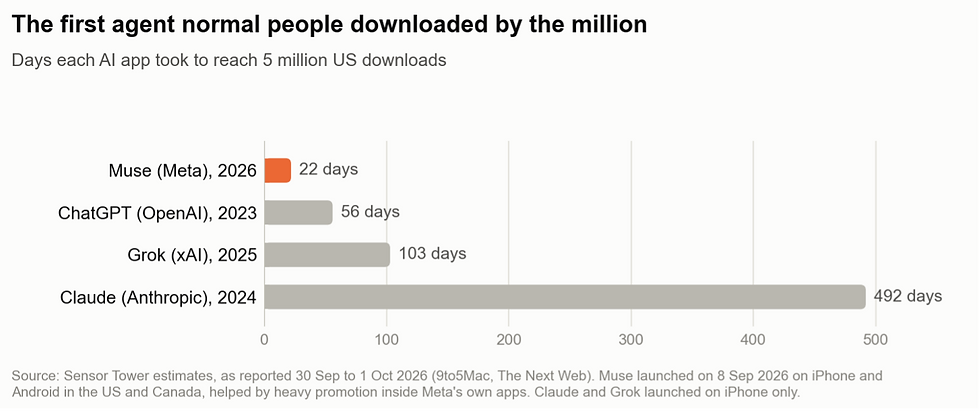
This makeover has worked wonders. Muse was downloaded 5 million times in an astonishing 22 days after its launch, beating even ChatGPT:
Why agents, why now?
Humans have always had to learn computers’ lingo. First punch cards, then typed commands. We adapted to using the mouse, keyboard and touchscreen.
The dream was always for computers to adapt to us. To just talk to the machine. Agents finally make the dream real. They will transform how we use computers.
There have been attempts to create agent-like technology since at least 1994, when General Magic promised software “agents” would run your online errands. It flopped, but its creators went on to build the iPhone and Android.
In 2023 a free program called AutoGPT went viral. The premise: give it a job and it’ll carry it out for you. It usually failed because a job is a chain of steps, and a chain is only as strong as its weakest link.
Let’s assume claiming our miles took 20 steps: search the inbox, find the booking, open the airline’s website, make an account, log in, talk to customer support if necessary, and so on. An AI that gets each step right 90% of the time sounds pretty good. But it would still fail at some point in the chain 7 out of 8 times.
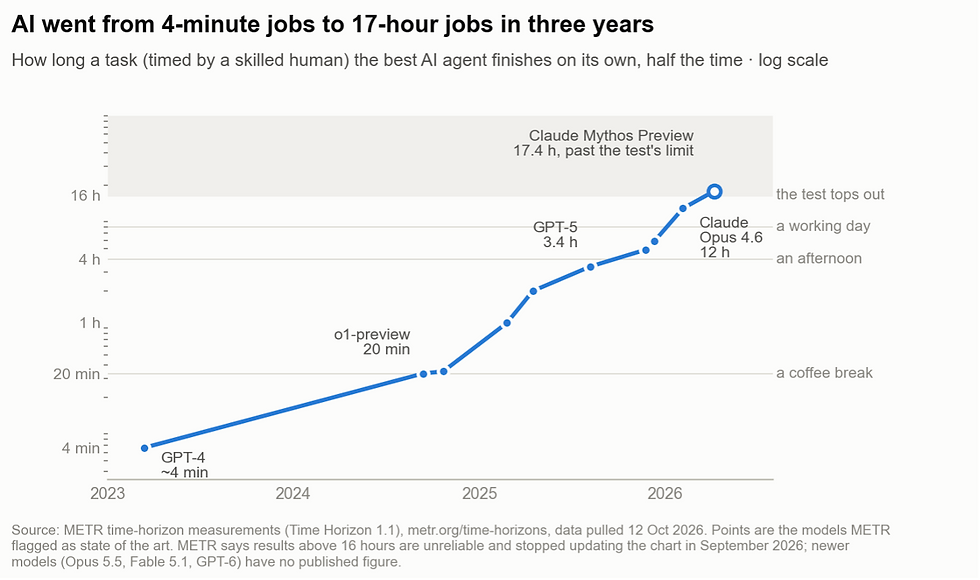
Finally, in the fall of 2026, AI models have grown powerful and accurate enough to reliably chain together many tasks. We can best see this in the rapid advance in AI’s ability to persist in doing focused work for longer.
In 2023 GPT-4 could sustain a task that takes a person about four minutes. In September 2024: 20 minutes. In February this year, Claude Opus 4.6 reached 12 hours. Two months later an early version of Anthropic’s Claude Mythos passed 17 hours.
At this pace, the best agents will reach a working month by mid-2027.
If you’ve never watched an agent use a computer, it’s surreal. You can watch it log into websites, type emails and send calendar invites. It’s like seeing a ghost do your admin work.
There are five agents worth knowing about today. For reasons you’ll see, we recommend picking one agent for work and a different agent for life tasks.
Claude Code (Anthropic)
Most capable, best for work and ambitious projects.
Unlike most of the other agents in this guide, Claude Code doesn’t just have its own computer. It can work inside your computer. It can open your files and read and edit them.
Contrast this with a simple chatbot like ChatGPT, which lives in a window and sees only what you hand it. If you want 200 PDF bank statements turned into one spreadsheet, you’ll have to upload them to ChatGPT a handful at a time.
Claude Code can retrieve the bank statements from a folder on your computer without you doing a thing. Or it can log into your online bank and grab the statements itself, if you give it your credentials.
Security tip: Never type a password directly into an AI chat. Instead, have the AI give you control of its browser when it reaches the login page. You then type the credentials in, so the AI never has them.
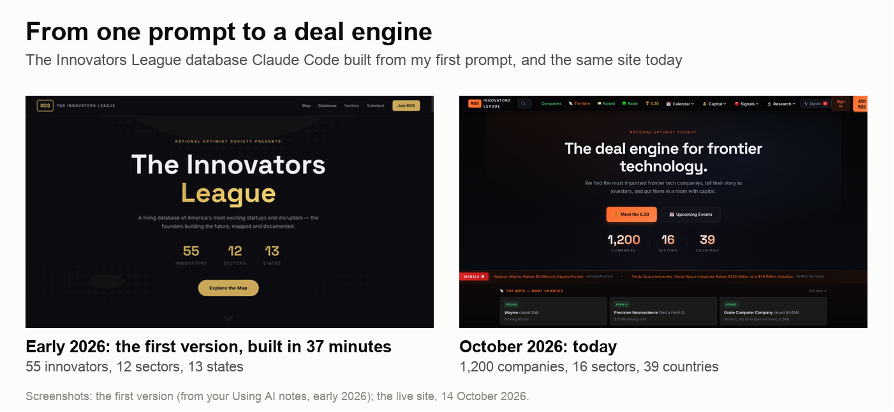
Using Claude Code, we’ve built valuable tools that we could never have made ourselves. For years we wanted to build a living, breathing database of the most exciting frontier companies in America. But we never had the team to build it.
Having never coded a line in my life, I typed a long, rambling note describing what I wanted. Less than 45 minutes later I had a working website with 55 companies on it.
Today the Rational Optimist Society startup database tracks 1,200 companies in 40 countries. Every day Claude Code agents pull in new funding rounds and news. Every Monday a watcher agent reads the portfolio pages of 27 venture funds and flags new companies. Another feed tracks more than 17,000 open jobs at our companies.
We just took a two-week trip meeting 50+ founders in Austin, Los Angeles, San Francisco and New York. These trips used to take days to plan. We’d send hundreds of emails, keep a constantly evolving agenda, and spend hours on Google Maps trying to line up meetings close together.
This time, Claude Code did the grunt work. It combed through our prior trip notes and our startup database to find every founder worth meeting in the cities we’re visiting. It sent more than 400 emails and about 150 direct messages on X.
Claude Code then read every reply, followed up when needed, and built the calendar, being sure to group meetings by neighborhood. It saved us countless hours and made connections we’d never have found on our own.
We did not, however, use it to book the flights and hotels. That’s a job for Instinct or Muse.
To get the most out of Claude Code, you have to give it access to your email.
Security debate: Your co-authors disagree on granting email access to Claude.
I (Stephen) give it my email so it can monitor my replies and calendar on my behalf, escalating to me only the messages that need a human touch. This frees up my time for more valuable tasks, allowing me to be much more productive.
I understand the reluctance to give AI access to your email, but I think most people will do it eventually. It’ll be like entering your credit card number to buy things on the internet in 1998. Most people swore they’d never divulge their payment details on the internet. Now it’s second nature.
I (Dan) am not giving any AI access to my primary email. Most people’s emails are connected to all their other logins, so a compromised email means your entire online life is compromised.
Instead, I granted Claude access to a secondary email that’s not tied to my logins. I did the same for Claude Code’s control of my computer. Instead of granting it access to my primary laptop, I gave it access to an inexpensive second laptop that’s isolated from my main one.
Maybe I am overly cautious. And I’ll probably cave eventually. But at least for now, I’m not comfortable enough with the tech or companies involved to surrender control.
We’ll all be grappling with these questions soon enough.
Strength: Best for hard, ambitious work. If you’re using AI to help build software or supercharge a business, Claude Code is the best, hands down.
Weakness: Clunky when interacting with the outside world. Expensive, but worth it. We each pay $200/month for the “Max” plan. It’s easily worth $20,000 to us.
Instinct
Best errand runner, best for admin and personal tasks
Instinct is an AI assistant you text or talk to. It has its own phone number and its own computer, and it deals with the outside world for you. This is the agent that heroically retrieved my airline miles.
Instinct is the only agent of our five that lives entirely in your messages. You don’t have to download an app or even open a browser window to use it. You simply text it on iMessage or WhatsApp, like a human. Instinct can fill in forms, send emails, chat with (human) customer service agents, and even make phone calls.
Having used Instinct for a few weeks, we can confirm it is incredible.
Instinct soft-launched in August to about 200 friends and family, with five invites each. It used a viral “invite-only” marketing strategy that was highly successful. I got an invite in September, and gave one of my five invites to a friend who runs a hedge fund in Cape
Town. The next day he messaged me:
“I gave it a complicated medical insurance claim to sort out. I'd been trying to untangle a problem between my doctor and my insurer. I uploaded all the documents, gave it access to my medical insurer's account, and asked it to reconcile the claim. It came back with a summary and a solution.
Then I started arguing with it. I told it it was wrong. It kept explaining the details and pointing out what I'd missed. It turned out to be right!
I phoned the gap-cover insurance company. They checked their records, admitted they'd made a mistake, and agreed to pay the extra amount as an exception. Wow.”
Instinct isn’t as powerful as Claude Code.
What makes it magic is how you interact with it, and its ability to seamlessly carry out tasks for you on the internet.
I (Dan) used Instinct to book the flights, hotels, and rental cars for our trip. I was at first reluctant to give it my credit card, but that didn’t last long. When paying for something, a screen pops up controlled by payment processor Stripe. Stripe plays middleman, taking your credit card info and encrypting it, so the agent never sees it.
Both Instinct and Muse use Stripe as an intermediary. It’s too bad Stripe is a private company and tightly controls its stock from being sold on secondary markets. It will be a HUGE winner as the payments layer for agentic AI.
Highlights of using Instinct to book our trip:
It seamlessly booked flights and rental cars. It even completed the pre-check-in to skip the line at the car rental counter. I never had to go to a website.
It reminded me to pick my seat a day before the flight. I told it to book an aisle seat as far forward in the plane as possible, and it did so flawlessly.
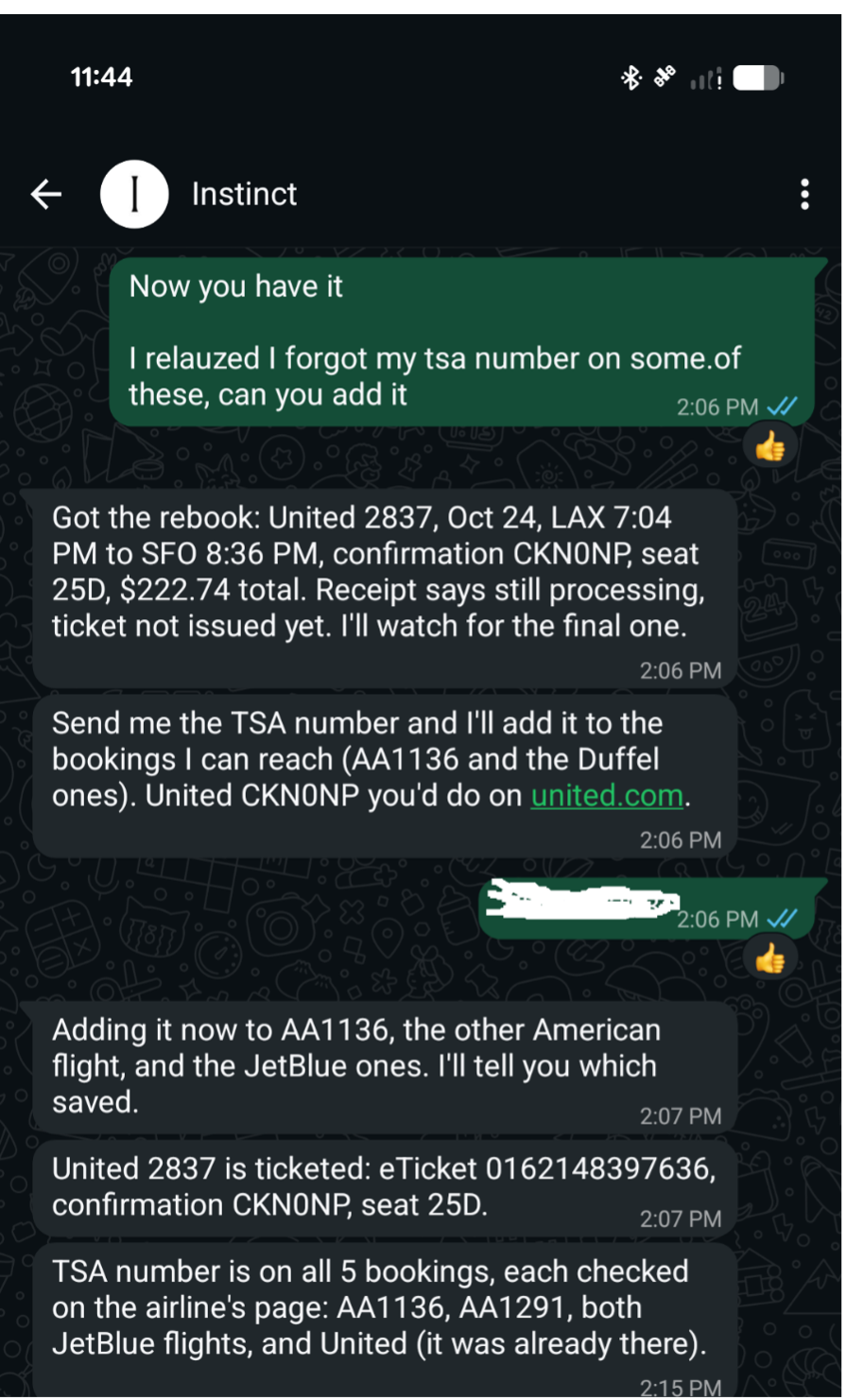
I forgot my TSA PreCheck number on several of my reservations. Instinct handled it for me with one message:
At a parking garage in Austin, I would have normally had to download an app and click through a series of annoying screens to pay. Instead I snapped a photo of the license plate of our rental car and the QR code on the parking spot, sent them to my Instinct agent, and said “pay for parking.” A minute later I saw the charge for parking come through on my credit card.
It’s not perfect, though. The lowlights:
Stephen arrived in Austin the night before me, and I let Instinct book his room. Instinct only put my name on the reservation, resulting in a frustrating wait for him after he’d been travelling for 24 straight hours from Abu Dhabi. Sorry, Stephen.
At our San Francisco hotel, Instinct quoted me over $4,000 for two rooms for four nights. I went to the website and found I could get a “members rate” by simply entering my email, which cut the price to about $2,500.
Like with Claude Code, you’ll need to give Instinct access to your email to unleash its true powers. However, every Instinct agent also comes with its own email address – so you can manually forward messages to it, like you would a human personal assistant.
Strength: Best at doing life’s administrative tasks like booking travel. Free. Works everywhere.
Weakness: Not as powerful as Claude Code.
Muse (Meta)
The gateway drug, easiest way to get started, most mass appeal
Every Muse user gets their own computer in Meta’s cloud, with a browser you can watch, plus a second AI that checks each action before it goes out. It’s free to start, with $20 and $100 tiers for heavier use.
Muse is the first agent built for the mass market: free, capable, and simple.
I actually started planning our trip with Muse before switching to Instinct. Muse seamlessly booked on one airline, but had trouble with another that blocked it as a bot. It also couldn’t seem to figure out how to enter my member’s number into Marriott.
Anecdotally, Instinct seems more capable.
Strengths: Good at doing life’s administrative tasks, though not quite as reliable as Instinct. Great branding. Cheap or free.
Weakness: Only works in the US and Canada for now.
Grok Bot (SpaceX)
A team of specialist agents
Instead of one assistant, Grok Bot gives you a roster of “AI teammates.” Each has its own job and schedule, sharing one always-on computer in the cloud. It’s built with Cursor, the AI coding company SpaceX bought for about $60 billion in August.
We created a “chartbot” that’s an expert in making beautiful charts, and a “quantbot” that automatically runs weekly calculations that feed an investing system.
At first it was novel, but as we got more familiar with Grok Bot, the “team” concept seemed unnecessary. Grok Bot also gives you a “chief of staff” agent that delegates to the specialist agents. We started going to the chief of staff for everything, defeating the purpose of the specialists.
We found both Instinct and Muse were better for executing real world tasks like booking travel. Grok Bot however is superb for recurring online tasks. We set it up to schedule and post automatically on social media for the Rational Optimist Society, and report stats and findings back weekly.
While Grok Bot trails both Claude and ChatGPT in raw power, it has a major long-term advantage: being part of the SpaceX ecosystem.
The AI wars will likely come down to who can access the most computing power. SpaceX, with its total domination of the launch market, is the only company that can economically build and operate orbital compute, which we believe is the future.
SpaceX isn’t bad at building data centers on the ground either. It completed Colossus II in Memphis in record time. It’s now the world’s biggest cluster at nearly a gigawatt, and is still growing.
Grok Bot will surely be integrated into Teslas, allowing you to work while your Tesla drives itself.
Strength: Well-rounded. Best long-term access to compute, which could determine the winner.
Weakness: Not the best at anything. Claude is more powerful. Instinct is more seamless.
Dots (OpenAI)
Pepsi to Claude’s Coke
OpenAI unveiled Dots at the end of September, seemingly in response to all the other agents bursting onto the scene.
Each agent, called a “Dot,” gets its own computer in OpenAI’s cloud and keeps working when you’re away. You can reach it inside ChatGPT by text or by phone. Like with Claude, you can give it access to your computer.
This is a Coke-or-Pepsi situation with Claude Code. Both can do pretty much what the other can. It comes down to taste.
But lock-in is very real. Our Claudes know us. Most weekdays I (Stephen) talk to Claude Code more than I talk to my wife. I wouldn’t switch unless OpenAI’s agents became radically better, which we don’t see happening.
Dots is not available in the UK or EU.
Strength: Powerful.
Weakness: Little differentiation from Claude Code. If you already pay for ChatGPT Pro, try Dots. If you’re in the Claude ecosystem, there’s no reason to switch.
Gemini Spark (Google)
Conspicuously absent
Google should be winning this race. It already has your Gmail, your calendar, your maps, and maybe even your phone. If you use Google Chrome, it probably already stores your passwords and payment info.
The biggest hurdle in AI agent adoption is fostering enough trust for users to hand over their most sensitive information. Google has already solved this.
So why is it fumbling?
Google stumbled into the greatest business in the history of capitalism: selling ads through its still-dominant search engine. But Google has never been great at competition. Many of its biggest wins were acquired, not built: YouTube, Android, Maps, DoubleClick.
Google’s own researchers invented the transformer in 2017. That’s the “T” in ChatGPT. OpenAI turned it into the product.
Who’s in charge also matters. Every other company in this guide is run by its founder. Founders can steer the company with vision. Google is run by a “manager.”
We have barely tried Gemini Spark, Google’s agent, so take this with a pinch of salt. But early reviews aren’t great. That jibes with our experience of Google’s Gemini models.
China
Slightly behind in capability, pulling ahead in usage
All the agents in this guide run on American models. The smartest AI models come from two American companies, Anthropic and OpenAI.
Right behind America is China. China’s best model lagged America’s by about 16 months in early 2024. It’s closed the gap to four months.
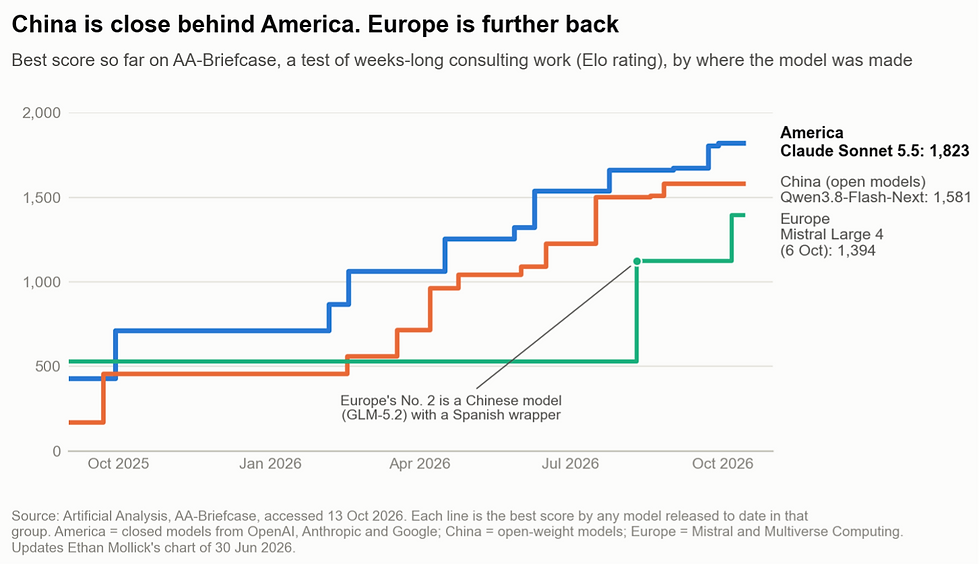
China’s best labs are going all-in on “open source” AI. Anyone can download their models, run them on their own computers and modify them. That makes them cheap. This is key, because agents burn mind-boggling amounts of tokens compared to simple chatbots.
A chatbot answers an average question in under 2,000 tokens. (A token is the unit AI work is measured in: about three-quarters of a word.) A reasoning model working through one hard science question uses about 7,600.
A coding agent fixing one real software bug uses about 4.2 million (!) tokens. On OpenRouter, a marketplace developers use to access various AI models, agents now burn 15X more tokens than human users.
Chinese models now handle more tokens than American models:
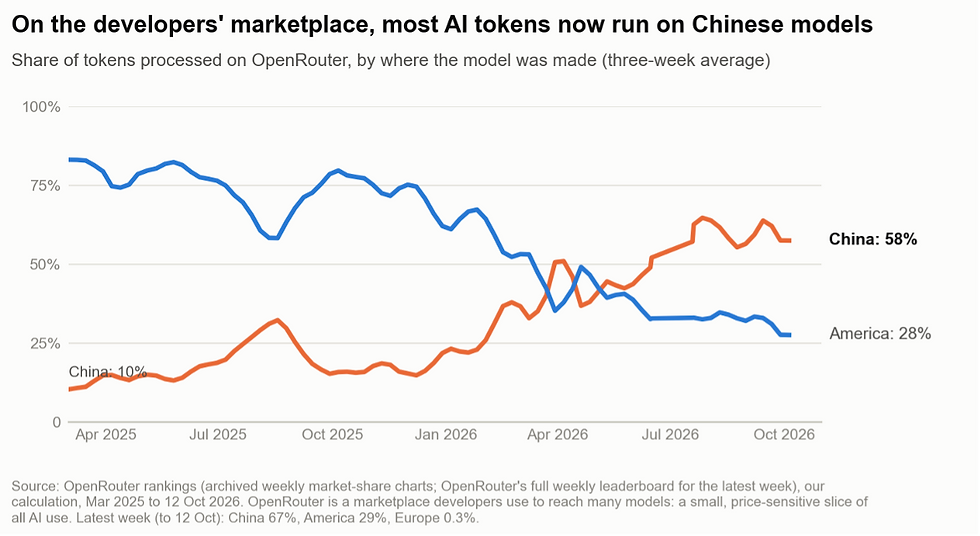
And OpenRouter’s COO says Chinese models are disproportionately used in agent workflows run by US companies.
History says the prize goes to whoever spreads a technology fastest. Not necessarily who invents it.
Britain invented the steam engine, railway and factory. Yet by the early 1900s Americans were richer than the British. America overtook Britain not by inventing more, but by putting new technology to work, faster.
That’s the warning for America. It won’t win the AI age by inventing the best model and keeping it in Silicon Valley. It wins by getting its AI into every company, hospital, school and home. China understands this.
If the US slows down now, with rules that make American AI harder to build or use, it will hand China the win. Which would be tragic, considering AI is the most transformational technology since the internet, and the most powerful technology ever.
Europe
Sigh…
Mistral, France’s AI champion and the top European lab, released its latest and best model on October 6. It ranks far behind American and Chinese models:
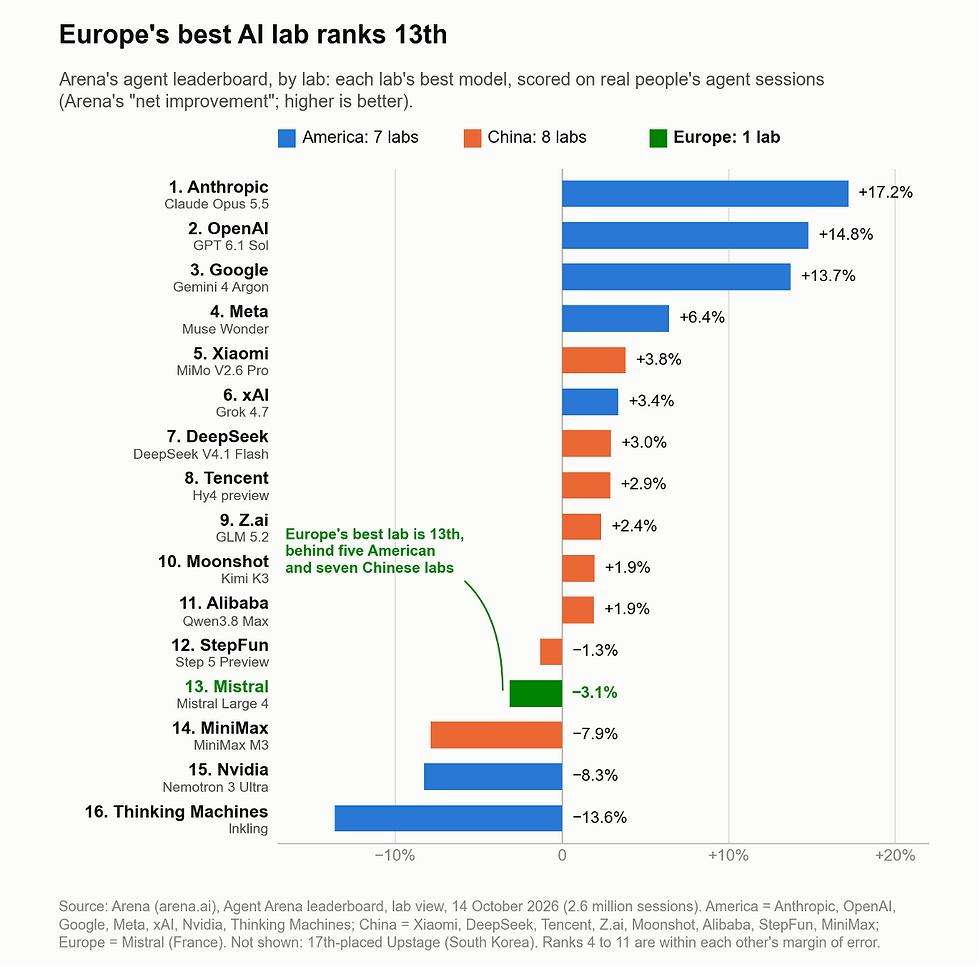
This understates how far behind Europe is. Benchmarks are abstract. A better test: who’s actually using it?
We don’t know a single person who uses Mistral or any other European model. On OpenRouter, European models handle less than 0.3% of tokens.
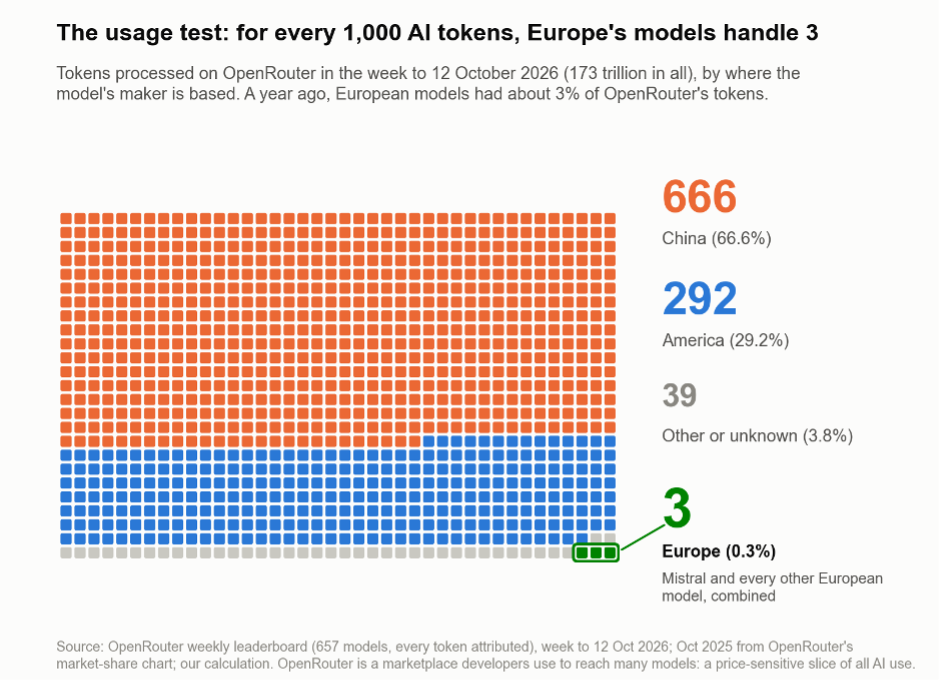
The gap between Europe and the US/China will only grow. AI runs on chips and power. Europe lacks both. America has about 75% of the world’s AI computing power; Europe has about 5%.
A team of analysts recently interviewed European data-center operators. They all said they couldn’t build at scale without subsidies, because power costs too much. Maybe Germany demolishing its nuclear plants wasn’t a great idea?
Several of the agents in this guide don’t work in Europe at all due to regulations. Europeans are becoming second-class digital citizens. Which leaves Europe without control of its own AI destiny. In a recent interview, VC legend Marc Andreesen observed that Europe seems “enthusiastic about being left behind in AI.” We see no evidence to the contrary.
As in so many industries before it, Europe’s best AI talent goes to America. A few years ago Thomas Odenwald, a German who’d spent nearly three decades in Silicon Valley, came home to join Aleph Alpha, Germany’s answer to OpenAI. After two months Odenwald quit and went back to California.
DeepMind, Europe’s greatest AI lab, sold itself to Google in 2014.
5 ways agents will change your life
1. Everyone gets staff
ROS cofounder Matt Ridley often tells the story of Louis XIV, the Sun King. He ate dinner alone, choosing from 40 dishes. It took 498 people to prepare each meal.
Thanks to trade and specialization, the average person now has access to the same variety and quality of meals as the Sun King.
But until now, only wealthy people could afford personal assistants. The agent era gives everyone a personal assistant. Remember, Instinct is free. What a time to be alive!
What this means for you: write down the jobs you’d hand to a full-time assistant. Now you have one. Unleash the agents.
2. The friction tax disappears
A surprising amount of the modern economy runs on friction.
Unneeded subscriptions on auto-renew, unclaimed miles, gift cards stuffed in drawers. Starbucks alone booked $222 million last year from money customers loaded onto its prepaid cards and never spent.
And that’s pocket change compared to the interest income people are missing out on. JPMorgan, Bank of America and Wells Fargo hold about $1.6 trillion of deposits that pay no interest at all. Why do people not move their money into a 3.5% interest-bearing bank account?
Friction. Humans avoid chores. But agents will happily spend 40 minutes on a $12 refund. They’ll print the label for the box in the hallway and remind you to send it back.
Companies that profit from friction should be nervous.
What this means for you: pick the three biggest friction taxes in your life and hand them to an agent.
3. The web gets rebuilt for robots
The notes app on the first iPhone looked like a yellow legal pad. Designers call it skeuomorphism: dressing the new thing up as the old thing. Familiarity breeds acceptance. The first cars were called “horseless carriages.”
Agents are in their skeuomorphic phase. Today they click through websites built for humans, fill in forms designed for humans and wait on hold on phone lines made for humans.
This will not last. The web will be rebuilt for agents.
Keep in mind, chatbots have a natural speed limit. A human has to read and respond to what they write.
But when agents talk to each other, most AI words need never be read by a human.
Right now, companies are just figuring out how to deal with agents. Some have chosen to treat agents like spam. Amazon blocked Meta’s Muse, for example. We think this is a losing strategy that will be reversed.
Shopify went the other way, making all stores open to Muse by default.
Cloudflare, which guards many of the world’s websites, now lets an agent prove who it is with a digital signature.
Agents will also transform shopping and advertising. They’ll ignore ads meant for humans. Brands will learn to sell to machines.
What this means for you: if you run a business, make it easy for an agent to buy from you. They might just be your fastest-growing customers.
4. Software for one
My son is learning Arabic at school in Abu Dhabi, so I asked Claude to build him a game. I gave it two rules. First, follow the curriculum: it built the game around the same words and letters he learns in school.
Second, steal Alpha School’s secret. Joe Liemandt, a founder of Alpha, says 90% of learning is motivation. So my Arabic app plays like a video game with rewards at the end.
The first version flopped. Everything on the screen was Arabic and my son didn’t know where to click. I told Claude what went wrong and it rebuilt the whole thing the same day.
What this means for you: make a list of the tools you’ve always wished existed. Then get your agent to build them.
5. The entrepreneurship boom
In the past year Americans filed 6.3 million applications to start a business: the most since the Census Bureau started counting:
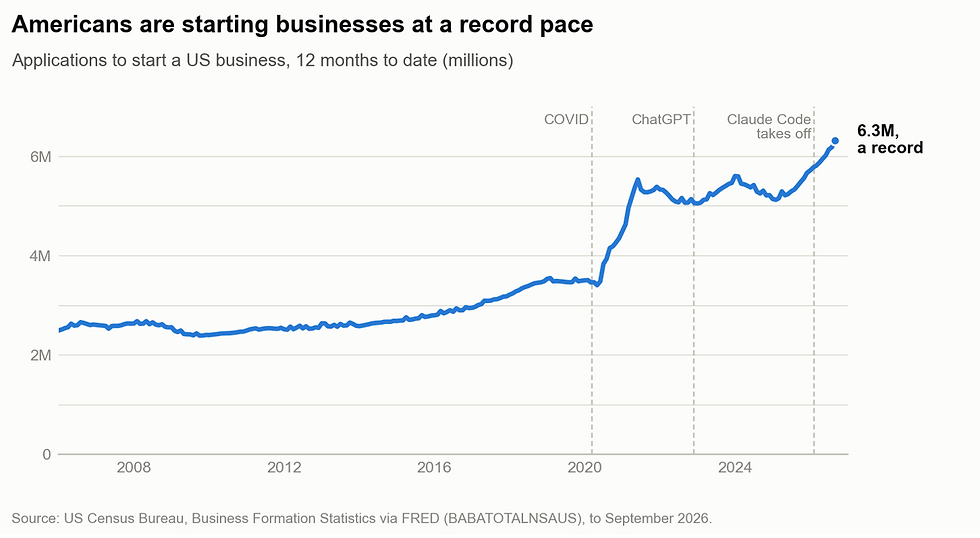
Stripe says the number of single-person companies earning $10 million or more has nearly tripled in two years.
Entrepreneurs who once needed a bookkeeper, a designer, a developer and an assistant to get started now need only a laptop and a few agents.
This is the best time in history to be an entrepreneur. The cost of trying something just fell to almost zero. We’re entering the golden age of business creation.
What this means for you: if there’s a business you’ve been meaning to start, the excuses just vanished.
How to thrive in the agent era
Technology has always created more (and better) jobs than it destroyed. We don’t believe AI will be any different. Human desires are infinite.
But that’s no excuse to be complacent. A lot of well-paying jobs aren’t worth much anymore, even if it’s not apparent yet. We’re going to have to reinvent how we work.
I (Dan) started my career at a Big Four accounting firm in NYC. I worked 80-hour weeks and made $55,000 a year. The partners golfed and earned millions.
Seems unfair. But you learn quickly that any schmoe can do the numbers. It’s the relationships that matter, as rational optimists know well.
Agents accelerate this split and bring it to every industry. “Doing the numbers” – or the basic graphic design, the legal clerk work, the low-level coding, the mediocre writing, the trip booking… is now free.
So what becomes valuable in the age of AI agents? When agents do the grunt work, our job is to do what’s uniquely human. There are three things agents will never do for you: A-R-T.
1. Agency
George Mack, who wrote the best essay on agency, has a test. If you were stuck in a third-world prison cell and could call one person to get you out, who would you call? Not the person with the most degrees. The one who gets things done.
You know agency when you see it. Blake Scholl was working on internet coupons at Groupon before starting Boom Supersonic to bring back supersonic travel. In January 2025 Boom’s test jet broke the sound barrier.
Palmer Luckey was a teenager tinkering with VR headsets in a garage. Today Luckey’s Anduril is a defense company worth tens of billions. This is agency.
The simplest definition of agency is “you can just do things.” Now with agents at your fingertips, you can do things, like code and deploy an entire website in one afternoon, that you never could before.
The people with the most agency will get the most out of agents.
2. Relationships
Agents can read every article, transcript and press release about a company on the internet. But they can’t stand in a factory, touch what’s being built and shake a founder’s hand. This is why we now spend so much of our time travelling and visiting factory floors.
Invest in your presence and your ability to connect. Relationships run the world. That was always true. AI amplifies it.
Get AI to handle the grunt work so you have more time to meet people.
3. Taste
AI produces a flood of “slop.” Taste is the antidote: knowing what to keep, what to toss, and what to feed your agents.
Before AI, making things was the hard part. Now making is nearly free and the scarce thing is choosing well. An agent can send 300 emails before breakfast. It can’t tell us which founders are worth a flight to LA. That’s taste.
Picture a day in 2030…
While you slept, your agent noticed your car insurance was about to renew 30% higher. It got three quotes, switched and saved $600. It spotted that your bank quietly cut your interest rate, so it moved your money to a better account.
Your prescription came through because your agent appealed the insurer’s denial. At breakfast, your daughter asked how volcanoes work. By lunch there was a learning game waiting on the iPad, built just for her.
None of this is futuristic. It all happened to someone this year! It just isn’t widespread yet. To quote William Gibson: “The future is already here — it’s just not very evenly distributed.”
If you’re new to agents and wondering where to start, start with a job you know well. That way you can describe what you want in detail, and you can judge its answers and actions from experience. Treat it like a smart young apprentice. Start with a simple task. As it earns your trust, give it more complex work.
Above all else, get started. You learn agents by using agents, not from a manual. You don’t have to become an AI maniac to get great benefit from agents. Although if your kids and grandkids want to “future-proof” their career prospects, there’s no better way than to master AI agents.
We can’t say this strongly enough. Within five years there will be two kinds of knowledge workers: ones who manage agents and ones who are hopelessly outgunned. Help your loved ones be in the first group.
And keep in mind, every agent in this guide runs on a model that got dramatically better in the past 18 months. The real question is: what will even better models do?
Nobody knows exactly. But the direction is clear. They’ll take on longer jobs, make fewer mistakes, and be trusted with more valuable work. We’re only at the start.
We’re a community, so let’s help each other. This week, teach one person one thing you learned about agents. Then send them this Deep Dive so they can get started too. Every like and restack helps bring new rational optimists into the fold.
All aboard the AI agent train!
—Stephen McBride and Dan Steinhart