
The Rational Optimist’s guide to the galaxy
Updated: Aug 7
The new space race, mapped
Just south of LA International Airport in a former Beyond Meat warehouse, we visited a company making drugs in space.
Its drug factory fits in a cone-shaped capsule no bigger than a trash can. Inside it, drug crystals grow more perfectly in orbit than they ever could on Earth.
We got to see and touch the second capsule ever to complete a mission. Two weeks earlier it had been 300 miles away in low Earth orbit. Its heat shield was scorched black from enduring re-entry into Earth’s atmosphere at 25X the speed of sound.
This company is Varda Space. Its factory floor tells the story of the blossoming new space age. Pharma clean rooms on one side. Spacecraft assembly on the other. Mission control in the middle.
Three miles away in the neighboring town of Hawthorne is the rocket company that brings Varda’s capsules to space. You may have heard of it. For 60 years, the hard part of space was getting there. Now that SpaceX has solved that, innovators are racing to wrap their heads around the extraordinary possibilities now open to us.
In this Deep Dive, we look at the companies building businesses in space.
They range from “ordinary”—photography of every plot of land on earth taken daily.
To extraordinary—launching data centers into space, which is, in our opinion, inevitable.
To almost unbelievable—launching giant mirrors into orbit to reflect sunlight on demand to anywhere on Earth.
There’s so much happening in space we had to be ruthless in our selection.
We know over 100 space companies but cut the list to those that matter most. We’ll start on the launchpad and work our way up to the stars.
PART I: ON THE LAUNCHPAD
Everything in space begins here, with the brute force problem of getting off the planet at a reasonable cost.
SpaceX solved it so completely that the only real question left is who comes in second.
SpaceX
Unlocked space, now the toll booth for the entire space economy
SpaceX’s importance is best described in 4 words: cheap launch changed everything.
For 60 years we threw a rocket away after a single flight. Imagine scrapping a Boeing 747 after one trip from New York to London and building a new one for the flight home? That’s how we did space. It’s why putting a kilogram of anything into orbit cost a fortune.
Then SpaceX learned to land its rockets and fly them again. The result is the single most important chart in space:

The cost to put one kilogram into orbit fell from roughly $54,500 on the Space Shuttle to about $2,700 on the reusable Falcon 9. SpaceX’s giant new Starship is aiming to push it under $100.
Cutting the price of reaching orbit by 95% makes a lot of things make sense that didn’t before. Every company in this Deep Dive is downstream of this one chart.
Rocket reusability achieved the biggest cost reductions, but the driving force behind it was SpaceX’s relentless application of Elon Musk’s “Idiot Index.”
The Idiot Index compares the total cost of a finished part to the raw materials that go into that part. If the ratio is high, there’s probably money to be saved.
The Idiot Index of old-school rockets was off the charts. Raw materials were only about 2% of its price. The other 98% was labor and supplier markup. SpaceX attacked that 98%.
Example: early on SpaceX needed a mechanical actuator for Falcon 1. Their suppliers said, “Sure, that’ll be $120,000.”
Elon laughed at the quote and set an engineer on designing one. His part cost $3,900 and got Falcon 1 to space.
Last year SpaceX launched 165 rockets, accounting for more than 80% of the mass humanity sent to space. Nearly every other company in this Deep Dive is its customer in one way or another.
Not bad for a company that almost went bankrupt. By September 2008 SpaceX’s first three Falcon 1 rockets had each failed. The company had enough cash for just one more launch.
Flight four reached orbit. The entire modern space economy hangs on that one flight not blowing up. That’s how close all of this came to not existing.
SpaceX’s IPO filing gave us the first real look inside the financials of the business. The rockets barely make money. Starlink, its satellite-internet service, is handsomely profitable, but not nearly profitable enough to justify SpaceX’s eye-watering $2+ trillion valuation.
That rests on two bets: its skyscraper-sized rocket Starship and the future of AI running through space. More on that below.
Rocket Lab
Most credible competitor to SpaceX’s launch business
Rocket Lab builds small and medium rockets. Founder Peter Beck is a self-taught engineer from New Zealand who learned to build rockets in his spare time while working in an appliance factory.
Not only did he start a rocket company in a country with no space industry. Rocket Lab became the first private firm to reach orbit from the Southern Hemisphere!
Today Rocket Lab’s Electron is the second-most-active rocket in the US. Neutron—its bigger, reusable rocket—is in development. Rocket Lab’s future rides on whether Neutron flies… and if it does, how quickly Rocket Lab can ramp up its launch cadence.
Blue Origin
Mistake-prone SpaceX competitor with its own giant reusable rocket
Jeff Bezos founded Blue Origin two years before SpaceX. New Glenn is its giant reusable rocket, which it landed for the first time in late 2025.
But Blue Origin suffered major setbacks recently. One flight stranded a customer’s satellite in the wrong orbit. Then a New Glenn exploded during a static fire test, destroying Blue Origin’s only launchpad.
Blue Origin has more money and arguably better hardware than anyone but SpaceX. Yet after 25 years it still can't launch reliably.
Relativity Space
3D-prints rockets
Relativity’s idea is to “print” rocket parts out of metal instead of welding thousands of parts together.
The company had financial trouble and nearly died last year, until former Google CEO Eric Schmidt acquired it and became CEO. It has signed $3 billion in launch contracts for its large Terran R rocket. And just this month, NASA picked Relativity to build the craft carrying its scientific instruments on a mission to orbit Mars scheduled for 2028.
Although that’s an important vote of confidence, Relativity has yet to reach orbit. The next two years will make or break it.
Where's Europe?
I (Stephen) am Irish. When I’m hard on Europe, know it comes from a good place.
In the 1990s Europe’s Ariane rockets owned more than half of the world’s commercial launch market. Last year the continent that invented commercial launch put up a measly seven rockets. SpaceX matched that in the first two weeks of January.
Why the stagnation? While Europe spent 30 years building rockets by committee, California innovators rewrote the rules of spaceflight, leaving everyone else in the dust.
Look at this chart. Note it counts satellites, not rockets, crediting each to whoever ordered it rather than whose rocket carried it. That’s the most flattering way you can score Europe—and yet it still barely registers:
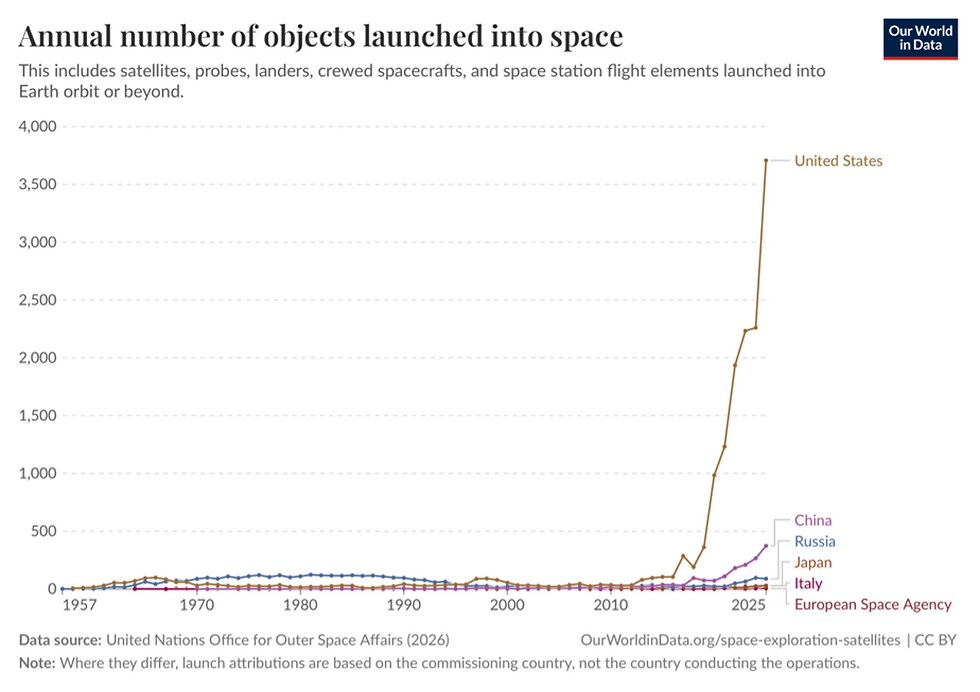
For about nine months Europe couldn’t reach orbit on its own at all. Part of it was Russia stopped letting Europe use its rockets after invading Ukraine.
The other part was retiring their Ariane 5 rocket before Ariane 6 was ready.
With no rocket of its own, Europe had to launch its Galileo satellites on American SpaceX rockets. These satellites run the navigation system Europe built so it wouldn’t have to… rely on America’s GPS.
Although Europe lost the launch race, it’s competitive in other areas of the space stack, as you’ll read below.
PART II: INFRASTRUCTURE
This is the part of the space economy that’s already benefiting humans. When you tap your card, hail a ride or track a package, a satellite is helping make it happen.
Starlink
SpaceX subsidiary delivering fast internet anywhere on Earth
Starlink has 10,000+ satellites orbiting the planet. That’s about two-thirds of all satellites in orbit. Serving over 10 million subscribers, Starlink is wiring up places that cell towers never reached. Its business generates $11 billion in revenue, accounting for 61% of SpaceX’s revenue. It is the only profitable segment of SpaceX.
Last year SpaceX paid $17 billion to buy EchoStar’s wireless spectrum. This will allow it to deliver real broadband straight to an ordinary phone, no special dish required.
Starlink isn’t the only one trying to beam the internet from space, but it will win. SpaceX is the only player that owns its own rockets. Everyone else must buy launches, often from SpaceX, so they’ll never be faster or cheaper. Even the US government is using Starshield, the military version of Starlink, instead of building its own satellite network.
Astranis
Beaming internet from 36,000 km away
Each Starlink satellite is screaming around the planet at 17,000 MPH in low Earth orbit (LEO), about 550 km above our heads. At those short ranges it can give a strong signal with almost no lag. But it takes thousands of them to blanket the Earth.
Astranis beams internet from much further away, parking its satellites in geostationary orbit (GEO) about 36,000 km from Earth. From there one satellite can cover an entire country. The trade-off is the signal travels 65 times farther, adding lag.
Astranis builds small (350 kg), relatively cheap satellites. Its customers are countries and companies that get their own dedicated “bird.” It’s already inked deals with Taiwan and Oman.
Astranis has found a frontier of space internet Starlink doesn’t already dominate and is pulling ahead.
SES
The plumbing behind global TV
Out of tiny Luxembourg, SES is one of the two or three biggest satellite operators on Earth. It owns a huge portion of the world’s TV, in-flight Wi-Fi and military comms market.
In 2025 it swallowed its old rival Intelsat, giving it a fleet of roughly 120 satellites and around €3.7 billion in annual revenue. It’s also leading IRIS2, Europe’s €10 billion answer to Starlink. SES shows not every winner in space must be a bleeding-edge startup.
ICEYE
Operates the world’s largest fleet of radar satellites
ICEYE and the two companies that follow compete in Earth observation. This is the most crowded and competitive area of space and, as insiders kept telling us, the most overrated. We’re including the only three we believe have a defendable niche.
ICEYE, a Finnish company, is the best Earth radar-imaging company on the planet. Most satellites watch the Earth with a camera, which means clouds and nightfall blind them. ICEYE uses radar instead. It bounces radio waves off the ground and reads the echo, allowing it to see through clouds and total darkness.
ICEYE produces a fresh satellite roughly once a week and raked in over €250 million in revenue in 2025.
Planet Labs
Photographs the entire Earth every day
Planet Labs flies a swarm of 200 shoebox-sized satellites that photograph every patch of land on Earth every single day. It produces a daily “before and after” of the whole planet.
It’s now pivoting from taking photos to selling data. Having a 10-year daily “timelapse” of Earth is extremely valuable and something no rival can copy.
We’re only scratching the surface in figuring out how to use this data. For example, giant oil tanks have a lid that floats directly on top of the oil, sinking lower as the tank drains. From space, you can measure almost exactly how full it is. Do that for every major oil tank on Earth, and you can track the world’s oil supply in near-real time.
You can imagine how useful that is to the military, not to mention commodity traders.
Muon Space
Detecting wildfires from orbit
Muon builds and operates custom satellites. Its FireSat constellation spots wildfires as small as a classroom using heat-vision sensors and AI. It compares every patch of ground to thousands of past images to flag anything suspect. The first operational trio of FireSat satellites are due to launch in the coming months.
Muon is an easy first answer to the question “Why should the average Joe care about space?” FireSat will save lives and homes on Earth.
Xona Space Systems
Hard-to-jam replacement for GPS
Last month I was in downtown Dubai trying to get an Uber. The driver was minutes away, then his dot leapt across the city, and my dot had me floating in the ocean. Our GPS signals were being spoofed.
With drones and missiles crisscrossing the Gulf, militaries flood the airwaves with radio noise to blind them. Our phones are just collateral damage. Jamming now scrambles the GPS on well over 1,000 flights a day.
Xona is building its own navigation network. Its 250+ satellite constellation (Pulsar) flies low, roughly 330 miles up, versus 12,500 for the old GPS birds. That makes its signal roughly 100X stronger, and it’s encrypted. The result is centimeter-level location that’s hard to jam or fake.
The US Space Force recently scrapped its own billion-dollar plan to build a GPS backup and started looking at buying commercial instead. Self-driving cars, drones, ships, and the military all need positioning far tougher and more precise than a 50-year-old system can give them. Xona is the front-runner here.
Apex Space
Mass-producing satellite buses
The shipping container is just a humble steel box. But it turned global trade from a slow, bespoke craft into a roaring industry.
Space is having that exact moment right now. Its version of the steel box is the satellite bus.
Every satellite has two parts. There’s the payload: the thing that does the job, like a camera or a radar. And there’s the bus, which you can think of as the satellite’s chassis and engine. It contains everything else that keeps the satellite working: the body, solar panels and batteries, thrusters to steer, a computer for brains, and radios to phone home.
For decades every satellite bus was hand-built from scratch, which made them eye-wateringly expensive. Now a wave of startups is standardizing the bus. The idea is to build one common mass-produced body that anyone can bolt a payload onto.
This is one of the most valuable layers of space. He who builds the “shipping container” of space sits at the center of the entire industry.
Apex is in the lead. We met Apex’s founder, Ian Cinnamon, at the company's sprawling 50,000-square-foot factory in LA. When Ian set out to build his first satellite, the experts said it’d take “three years and $50 million.” Apex did it in 12 months for under $10 million.
Apex allows a company to order a satellite bus the way you’d book an Uber. Go to its website, choose a size, and see the price and delivery date on the spot.
Apex’s smallest satellite, Aries, sells for $3.5 million, roughly 3X to 10X times cheaper than what the legacy defense “primes” charge for bespoke buses. Its customer list reads like a who’s who of new space.
Apex has cracked the most unglamorous problem in space. We bet it’s worth $10 billion within a few years. Apex is perhaps the company we are most bullish on in this entire guide.
K2 Space
Building big, high-power satellites
For two decades the trend in satellites was to go small. When launch costs a fortune every kilogram is precious. K2 is betting that cheap launch will revive big satellites.
Its core insight is that power is the real limit on what a satellite can do, and bigger satellites can carry more power. A typical small satellite runs on roughly a hair dryer’s worth of electricity. K2’s “Mega” bus carries 20X that.
K2 has signed major deals with the US Space Force. Its flagship satellite, Gravitas, became the biggest satellite of its kind flown into orbit when it hitched a ride on a SpaceX Falcon 9 rocket back in March.
Now comes the real test: deploying the satellite in orbit, generating power, running payloads, and firing its thrusters. If Gravitas clears these hurdles, K2 will leap into the ranks of the most important space companies.
EnduroSat
Europe's satellite factory
Hailing from Bulgaria, EnduroSat builds a line of standardized satellite bodies, from shoebox-sized up to the half-ton class. It’s already delivered 120+ buses to customers like IBM. Its goal is to crank out two satellites a day from its factory in Sofia.
Europe is about to pour money into satellites to wean itself off American dependence. EnduroSat will likely be drinking from that firehose of government cash and could be one of the biggest winners in all of Europe.
Northwood Space
Ground stations that talk to satellites
A satellite you can’t talk to is a very expensive rock. Every satellite must send its data down to Earth and get commands back up. The antennas and lasers that link satellites with Earth are now important bottlenecks.
Picture a giant antenna that must physically swivel to track a satellite racing overhead. It costs millions, takes years to build, and can talk to only one satellite at a time. That’s the sorry state of ground dishes today.
Northwood's fix is “Portal,” an antenna with no moving parts that can talk to many satellites at once. Portals can be mass-produced, dropped off the back of a truck, and switched on. It’s already landed a $50 million US Space Force contract, aiming to help modernize the military's satellite control network.
Northwood is already a leading player in space’s infrastructure layer.
Observable Space
Lasers that connect to satellites
Observable is betting the future of space comms runs on light. Its main business is telescope manufacturing and ground-based optical sensing to track objects in orbit. Recently it started expanding into laser communication, moving data to and from satellites on beams of light instead of radio.
This allows for more bandwidth and a link that’s nearly impossible to jam or eavesdrop on. Think of it as fiber-optic cable, except the “cable” is a laser.
Observable already runs a 40+ site global network for tracking objects in orbit. It helped carry the laser link for NASA’s Artemis II Moon mission. It’s still early days for this company, but if light is the future of space comms, Observable could be on every satellite.
PART III: THE OFF-WORLD INDUSTRIAL REVOLUTION
Now let’s meet the companies doing things in space that were previously impossible.
Varda
Making drugs in orbit and flying them back to Earth
On Earth, gravity causes flaws when growing drug crystals. In space there’s hardly any gravity. This “microgravity” allows purer, more stable crystals to grow, which allows Varda to make more stable and effective drugs.
Making drugs in space sounds questionable until you do the math. During our visit, Varda’s CTO Nick Cialdella explained that all the mRNA in every COVID vaccine dose ever administered would fit inside a couple of milk jugs. When a product is that valuable per gram, flying a 200 lb. drug factory into orbit pencils out.
In May, United Therapeutics, a $25 billion pharma giant, signed a deal with Varda to make drugs in space.
SpaceX made getting up to space routine and cheap. Varda is doing the same for coming back down. Surviving a Mach-25 plunge through the atmosphere is one of the hardest problems in all of engineering.
Varda has solved it. It is 6-for-6 in launching capsules and getting them back to Earth safely. It’s only the third company in history (after Boeing and SpaceX) to bring a spacecraft home from orbit.
Most space startups live on government grants. Varda landed a real $25 billion customer and is funding itself through hypersonic testing contracts with the Pentagon. The clearest proof yet that “making things in space” can be a real business.
Space Forge
Growing semiconductors in space
Hailing from Britain, Space Forge intends to use the same microgravity trick. But instead of drugs, it will grow semiconductor crystals. Those crystals should come out far purer than anything you can make on the ground. That means better, more efficient chips.
ForgeStar-1 reached orbit in mid-2025 and successfully fired its furnace. But unlike Varda, Space Forge hasn’t brought a factory back yet. Its next mission, ForgeStar-2, must survive the fall.
Stick the landing, and Space Forge becomes one of Europe’s most important startups.
Impulse Space
Moving satellites to where they need to be
A rocket is like a train that only stops in one place. SpaceX’s Falcon 9 drops objects off in LEO (550 km away) or on a path toward GEO (36,000 km away). But many satellites need help making that last stretch to GEO.
Today there are two bad options. Firing a gentle electric thruster is cheap, but takes months to reach higher orbits. Strapping on an extra rocket stage is fast but costly.
The fix is a “space tug,” a dedicated vehicle that picks up a satellite at the drop-off point and drives it the rest of the way. Several aerospace founders we met in LA told us, “Maneuverability is the most underrated trend in space.”
Impulse founder Tom Mueller is arguably the best rocket-propulsion engineer alive. He was SpaceX employee #1 and designed the Merlin engine that still powers every Falcon 9.
Impulse’s “Mira” is a small tug that's been flying paying missions since 2023. Its big brother “Helios” is still in development and promises to haul a satellite from LEO up to GEO in just 8 hours, a trip that currently takes months. Impulse also says Helios can deliver ~3 tons of cargo to the Moon, several times what current lunar landers carry.
Impulse is the clear leader in the long-range space-tug race, and it isn’t close.
D-Orbit
Europe's space tug
Italy’s D-Orbit builds tugs that ferry satellites. In contrast to Impulse, it is focused on the space equivalent of “last-mile delivery.” Its ION vehicle nudges satellites to where they need to go, typically within 150km of the drop-off point.
D-Orbit has the longest operating track record in this category with over a dozen successful missions since 2020.
In a sector where almost everyone is burning cash, D-Orbit is flying missions and making revenue doing it. A standout in Europe.
Inversion Space
Stores cargo in orbit, then drops it anywhere on Earth within an hour
For space to become a real economy, reentry must become as cheap and routine as launch. With so much going up, getting back down is set to become a huge market.
Inversion is building warehouses in space. The idea is to launch its capsule (Arc) packed with cargo and park it in orbit, where it can wait for months or even years. Then at the press of a button, Arc fires its thrusters and steers itself down to a precise spot on the ground.
Imagine dropping equipment to troops halfway around the world in under an hour. Talk about a killer military use case.
That potential is years away, but Inversion has found a clever way to earn money for now. A capsule screaming back to Earth at Mach 20+ behaves a lot like a hypersonic weapon, which the Pentagon will pay good money to observe. That same reentry expertise has Inversion working with Anduril to build space-based interceptors for America’s Golden Dome.
We’re meeting Inversion's CEO Justin Fiaschetti on an upcoming trip to learn more.
Data centers in space
Not nearly as crazy as it sounds
Last November a SpaceX rocket lifted off from California carrying a satellite about the size of a kitchen fridge. Bolted inside was a single Nvidia H100, the same line of Nvidia GPU behind today’s frontier AI models.
Built by a two-year-old startup called Starcloud, the satellite reached orbit. While screaming around Earth at 17,000 mph, the chip aboard trained an AI model on the complete works of Shakespeare.
Since then Google announced its own AI chips are bound for orbit by 2027. Nvidia is building a version of its newest chip for orbit too. And SpaceX’s sky-high valuation hinges on whether data centers in space succeed.
When the biggest companies in the world start sprinting for the same goal, pay attention.
The first thing to know about data centers in space is they won’t look like data centers on Earth. There won’t be giant floating warehouses up there. Instead, orbital data centers will be sleek and minimal. Picture a Starlink satellite with a GPU, solar panel, and radiator attached, moving in unison with other satellites to form a constellation.
Orbital data centers have real problems like cooling, radiation, and repair. But these are engineering challenges with known solutions.
Two reasons data centers in space will succeed:
#1: We're running out of power. US utilities are now telling AI companies to come back in 2028 if they want to connect to the grid. Some data centers sit finished and idle for years waiting for a hookup. In orbit data center satellites can harvest free energy from the sun through solar panels.
#2: NIMBYs. Seven in ten Americans don’t want a data center “in my backyard.” AI is unlike any prior tech wave in that it must live somewhere physical, and that somewhere gets a vote. In space there’s no town council or neighbors to file a complaint. It’s easier to put a data center over New York than in it.
Orbital data centers are going to happen, and SpaceX will win. An orbital data center is just mass you must lift. No one else can launch rockets anywhere near as cheaply as SpaceX.
But SpaceX’s real moat is owning the whole chain. If you buy the rocket from one company, the satellite from another, and the chips from a third, everyone’s markup eats you alive. Only SpaceX and affiliated companies own the whole stack.
The rocket: Starship.
The satellite: Starlink
The power: solar cells from Tesla and SpaceX.
The chips: Musk’s “Terafab” plan to fabricate the chips.
The brain: xAI's Grok is now owned by SpaceX.
There’s an underrated way SpaceX was able to drive down launch costs. Its Falcon 9 rockets were carrying Starlink satellites up there. The launches weren’t just iteration; they had a business purpose and ultimately made the company money.
Orbital data centers are the cargo that will allow SpaceX to fly Starship often enough to make it cheap.
SpaceX IPO’d at $2 trillion. The Starlink and launch businesses are worth $1 trillion if you really stretch. The other trillion is a wager on xAI and data centers in orbit.
The data center space race starts now. But it won’t reach meaningful scale until the early 2030s.
PART IV: THE FRONTIER
Now we reach the true frontier: the Moon, asteroids, and the race to replace the space station. This is the most romance-prone area, so it’s important to separate the real operators from the storytellers.
Intuitive Machines
Delivers cargo to the Moon for NASA
Intuitive Machines tried to land on the Moon twice. Both times the lander reached the surface and then tipped over. For a public company that’s a bad look.
But if Intuitive Machines can stick the landing it could be a huge business. It’s the sole winner of NASA's lunar data-relay contract to build a cell-tower network around the Moon. The next mission later this year is make-or-break.
Firefly Aerospace
Achieved the first successful commercial Moon landing
In March 2025 Firefly’s “Blue Ghost” lander touched down on the Moon perfectly upright on its very first try. NASA paid about $100 million for the mission.
Nailing the hardest maneuver in space on attempt one is the kind of credibility money can't buy. Firefly also builds rockets, but its small “Alpha” launcher has a patchy record.
Promising early signs with a long road ahead to a sustainable business.
Interlune
Mining Helium-3 on the Moon
Interlune wants to mine Helium-3, a rare gas worth about $20 million a kg. Almost none of it exists on Earth, but an estimated million tons sit baked into the lunar soil.
The near-term uses for Helium-3 are powering fusion reactors or cooling quantum computers, which must be chilled to a hair above absolute zero.
Interlune already signed contracts with the US Department of Energy and Bluefors, the dominant maker of quantum fridges.
Interlune is a literal moonshot. Either it cracks Moon mining and is worth billions or it goes to zero.
Vast Space
Building the first commercial space station
For 25 years the ISS has been humanity’s outpost in space. But it’s old, and in 2031, it will be deliberately steered down to burn up in the atmosphere. SpaceX is building the vehicle that will drag it to its fiery end.
Instead of building a replacement, NASA wants to rent space on privately owned stations. A handful of companies are racing to build a private ISS.
Vast is the leader in our opinion.
Founded and primarily funded out of the pocket by crypto billionaire Jed McCaleb, Vast’s first station, Haven-1 already passed full structural and pressure testing, with a few more rounds of testing to go. It’s due to launch in 2027.
Reflect Orbital
Putting mirrors in orbit to beam sunlight down to Earth
A block away from SpaceX’s original headquarters, Reflect Orbital is crafting giant space mirrors to give you sunlight on demand.
Reflect wants to park a fleet of giant mirrors in orbit, catch sunlight, and bounce it back down to Earth. It can light up a solar farm after sunset so it keeps generating power, or illuminate a search-and-rescue site in the dark.
The mirrors are made of a shiny film NASA wraps spacecraft in called Mylar. It’s so thin a palm-sized sample floats in the air like a plastic bag. A finished mirror is bigger than a tennis court yet weighs about 220 lbs and origami-folds into a box the size of a microwave.
As you might imagine, aiming a mirror that’s orbiting Earth at 17,000 mph so it paints a useful patch of light is fiendishly hard. But the hardware won us over, and founder Ben Nowack is one of the sharpest guys I've met.
AstroForge
Mining asteroids for platinum-group metals
AstroForge’s CEO Matt Gialich is the most entertaining character in the space economy. He runs 50-km trail races, swears like a sailor, and is refreshingly honest about the long odds.
The goal of his next mission, in his words: “F*cking land on an asteroid.”
Platinum-group metals are among the most valuable substances on Earth. Out in space some rocks are practically made of the stuff. Gialich says the ore on his target asteroid is 5,000-10,000 times purer than the best platinum mine on Earth. The plan is to bring home 1-2 tons of refined platinum, worth over $80 million at today’s prices.
We spent an afternoon at AstroForge’s HQ. Flying 30 million miles to an asteroid? “It’s only 10% of the way to Mars,” Gialich shrugged. “No big deal.” The hard parts come next.
In the back of the warehouse he demoed a high-powered laser that melts asteroid rock so the metal can be separated and refined in space. He cranked it up until it scorched a chunk of rock into white-hot vapor.
AstroForge is taking a leaf out of SpaceX’s book and building a near-term business to fund its big mission. It has bought several US gold mines and is using the same laser-refining tech it plans to use in space to unlock Earth deposits nobody can profitably dig today.
AstroForge’s first probe, Odin (built in 10 months for $3.5 million), was lost after a ground station power failure caused contact to be lost. Its next try, DeepSpace-2, is built and will launch this fall. The goal is to land on an asteroid. Mining one comes later.
PART V: THE HIGH GROUND
Space’s peace era is ending. China already showed it can sneak a satellite up to another one and tow it away. Russia has developed weapons to blind and kill satellites. Space is fast becoming a war-fighting domain.
Hundreds of billions of dollars will be spent on space offense and defense over the coming decade, including America’s in-development Golden Dome missile shield.
As one founder put it, the race to control the high ground decides whether the rules for space get written in English or Mandarin.
SpaceX and Anduril have already locked up billions in Golden Dome contracts. Here are three smaller companies tackling a hard and important problem.
Fortastra
Building “bodyguards” for space
About 12,000 active satellites orbit the Earth today. That’s expected to grow tenfold in the coming years. Yet they're sitting ducks with almost no ability to defend themselves.
Fortastra is building “bodyguard” satellites that maneuver right up alongside a valuable satellite and guard it. They can inspect a suspicious object that's approaching or shadow a threat.
Founder Mike Smayda’s key insight is the breakthrough is in the brain, not the body. A human can’t steer these effectively from the ground. The bodyguard must think for itself, with an AI brain making split-second decisions in orbit.
Fortastra is barely a year old and one of the earliest-stage companies here. But it’s solving a serious problem, and having met Mike several times, we think he can pull it off. He’s a SpaceX veteran who helped crack rocket reentry and co-founded hypersonic-jet unicorn Hermeus.
Elon Musk wants to launch up to a million satellites for his orbital data centers. They’ll need protection. Whoever owns the “defender” layer in orbit becomes a multibillion-dollar company.
True Anomaly
Spacecraft that chase, inspect, and shadow other satellites
True Anomaly’s spacecraft “Jackal” is designed to chase down target satellites, inspect them, and if ordered, interfere with them. It’s the closest thing we have to a fighter jet for orbit.
True Anomaly was founded in 2022 and was one of the dozen companies picked for the Golden Dome’s space-based interceptors. It’s already flown Jackal spacecraft, though the early flights hit some snags. From here it’s all about execution.
Turion Space
Watches other satellites and is building “rendezvous” satellites
There are more than a million pieces of debris whipping around the Earth, plus thousands of active satellites. The US military wants to keep an eye on foreign craft. Turion puts cameras in orbit to watch them up close.
We chatted with founder Ryan Westerdahl, who spent eight years as a propulsion engineer at SpaceX. His summary of what Turion is building was beautiful: “a camera on a bullet, photographing another bullet, as they pass each other at twenty times the speed of sound.”
Its DROID satellites snap close-up images of other spacecraft and feed them straight into the Space Force’s intelligence database. Turion has been flying them since 2023. It’s now building a bigger “GEO” class spy satellite.
Turion is also developing its own engines to grab things in space. It’s inventing a way to gently grip “hostile” satellites and haul them out of the way. In 2024 it landed a $32 million Space Force contract for three of these “rendezvous” satellites.
It plans to scale from hand-built spacecraft to 40 a year by 2027.
What else will we create on our way to the stars?
Many of the above companies will fail. Space is hard.
But don’t underestimate the impact of a society merely trying to reach the stars.
During the Apollo era the number of science and engineering PhDs in America doubled.
And by 1963, the Apollo program was using 60% of America’s entire supply of computer chips. This provided guaranteed demand for fledgling chip companies like Fairchild Semiconductor, allowing it to get better and faster at making chips, ultimately laying the foundation for what’s now Silicon Valley.
You can never predict what a society will invent on its way to the stars.
We’ll leave you with what AstroForge CEO Matt Gialich told us when we asked him why he’s trying to mine asteroids against such long odds:
“We were all kids once and had dreams, and then we let money get in the way. Don’t lose that. Shoot your shot. Have a go. Dream big.”
Make sure to share this so more rational optimists can dream bigger,
together.
—Stephen McBride and Dan Steinhart


