
The Rockefeller of solar
Updated: Aug 18
No drilling required
In today’s Diary:
The castle lab for impossible machines
A desert full of lungs and kettles
The 39th drop of solder
“I can do whatever I want”
Casey’s final boss battle
You’re one of the first 30,000 rational optimists. Thanks for helping reach this milestone. Next stop: 100,000. You can help us get there by forwarding this to everyone you know and sharing like your kids’ future depends on it!
Dear rational optimist,
NASA has reprimanded Casey Handmer more than once. His crime? Solving problems too quickly.
So he quit to work on something much harder.
Today Casey makes natural gas out of sunlight and air, identical to the stuff that heats your house and cooks your dinner.
I’ve visited more than 70 frontier-tech startups this year. Terraform Industries may turn out to be the most important.
Terraform works out of a castle across the road from the site of Lockheed’s original Skunk Works, where Kelly Johnson built the finest aircraft in history, including the U-2 and the SR-71 Blackbird.
I walked through the entrance and read three words painted on the floor…

The second thing I noticed was all the flags, one for every nationality on the team. Here they are behind me and Casey:

The castle is a labyrinth. You walk through one room, find a door, and there’s another room behind it. And in that room, someone is inevitably building something cool. There’s a ramp running through the middle that Casey’s kids ride scooters down.
Casey talks fast, like someone pressed fast forward on his voice box. I noticed he answers the questions he finds interesting, not necessarily the ones you ask. The man is constantly scanning for the next puzzle worth his time.
Propped against his keyboard is a business card. It reads: “I can do whatever I want.” Also on his desk: a solar-powered fan hat:

It’s a desk-toy version of what Terraform builds at scale:
Machines that use solar power to produce unlimited quantities of cheap synthetic natural gas
Casey got this idea while working on a Mars base at NASA. Getting to Mars is “easy.” The problem is getting home. A rocket can’t carry enough fuel. So we’ll have to make it from the carbon dioxide in the Martian atmosphere and water frozen in the dirt.
Casey realized this far-off Mars idea works better on Earth, which crucially has paying customers.
He spent a year experimenting in his garage and came to “the horrifying realization that synthetic fuel was not going to happen if I didn't do it.”
Making synthetic fuel isn’t a new idea. During WWII, Germany, cut off from oil, produced 124,000 barrels of fuel a day from coal, which is mostly carbon.
Petrol, diesel and natural gas are all hydrocarbons. Carbon is floating in the air around you. Hydrogen is in every drop of water. Turning these abundant natural elements into fuel is simply a matter of rearranging their atoms.
So why is there a graveyard of startups that tried to make hydrocarbons instead of drilling for them? Cost. Until recently the electricity needed to stick carbon and hydrogen together cost about 10X the price of the resulting natural gas. So they built exquisite machines to try to make it up on volume. They ended up with the worst of both worlds: expensive electricity powering expensive machines!
Casey believes making cheap synthetic fuel is now possible because the cost of solar power has plunged and continues to plunge.
If you think this idea is crazy, consider this. My ROS co-founder Dan Steinhart presented Terraform as one of seven bleeding-edge innovators to watch at a conference in Zurich. This conference was well-attended by Nobel-prize-winning scientists. After Dan’s talk, scientists keep seeking him out to talk about Terraform. They were glad someone is finally doing this. One said he’d had the idea to turn electricity into natural gas years ago—but the electricity costs made it impossible.
Casey is the most bullish person on solar I’ve ever met. He’s also totally uninterested in powering the world with panels.
It’s why I call Terraform…
The anti-solar solar company.
Casey taught nuclear physics at Caltech and will tell you: “I'm not anti-nuclear. I'm somewhat reluctantly pro-solar.”
“Think about the ideal energy system. A flat rock you point at the sky. Nothing spins. Nothing gets hot. Photons in, electrons out. No moving parts, no specialized labor, no exclusion zone, no armed guard, no twenty-year license... that’s a solar panel.”
Where solar doubters go wrong is not updating their priors. Yes, solar was once just an overly subsidized hippie dream.
In 1956 one of the Bell Labs scientists who invented the solar cell worked out it would cost $1.5 million to run an average American home on panels. In 1975 a watt of solar cost $128. Today it's about 11 cents, a 99.9% decline.
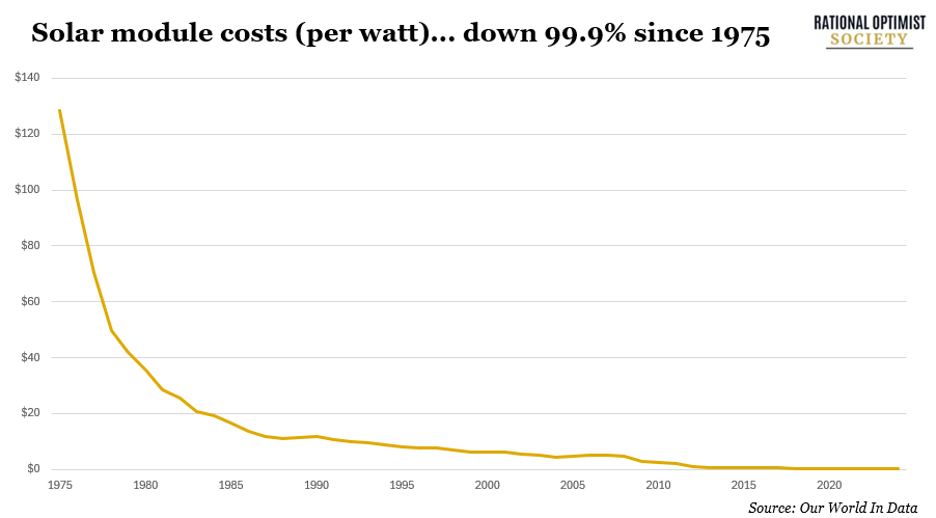
Solar was 54% of all new US energy capacity in 2025, the top new source for the fifth year running. This May it passed coal in the US electricity mix for the first full month ever.
Casey says: “Not only are solar adoption, production, and price decreases continuing, they're accelerating. And the rate at which they're accelerating is still accelerating.”
The obvious objection to powering the world on panels is nighttime. Making solar reliable enough to run a grid means batteries. And batteries are expensive.
Casey agrees. He also knows you can’t fly a 747 on sunshine. Planes don’t run on panels. Neither do container ships, steel mills or the fertilizer that grows half the world’s food.
Electricity is only about 20% of the energy we use. The other 80% moves as hydrocarbons. Diesel in ships. Kerosene in airplanes. Gas in your boiler.
Casey told me: “The revealed preference of humanity is they like using oil… Oil's amazing. And you can't just turn it off, unless you want everyone to starve to death very quickly."
Solar produces absurdly cheap electricity during daytime. The world will keep running on hydrocarbons. Casey took these two seeming contradictions and built the “Terraformer.” It’s the size of two shipping containers.
You drop it in a desert, unroll five acres of solar panels… and walk away.
At sunrise it wakes up, starts breathing in air and drinking a little water. By noon it’s producing pipeline-grade natural gas. It turns an empty field, in Casey’s words, into an “instant oil well.”
Inside each Terraformer are three machines that work together to make fuel out of air.
#1: The lungs
Carbon dioxide makes up 0.04% of the air we breathe. To collect enough, you must move a huge amount of ordinary air through the machine.
The Terraformer’s “lungs” move about a million cubic meters of air a day, roughly what 100,000 people breathe. It looks like a steel box with big fans bolted to the side.
Inside, the air blows across trays of white flakes. This crushed lime absorbs carbon dioxide and costs about $100 a ton. The exotic sorbents other carbon capture startups use run to more than $10,000 a gram at research scale.
Casey showed me a bucket of crushed lime, which looks like gym chalk. Handling it takes the skin off your hands. That was one of only two things Casey told me not to touch. The other was a bottle of the first methanol Terraform made:
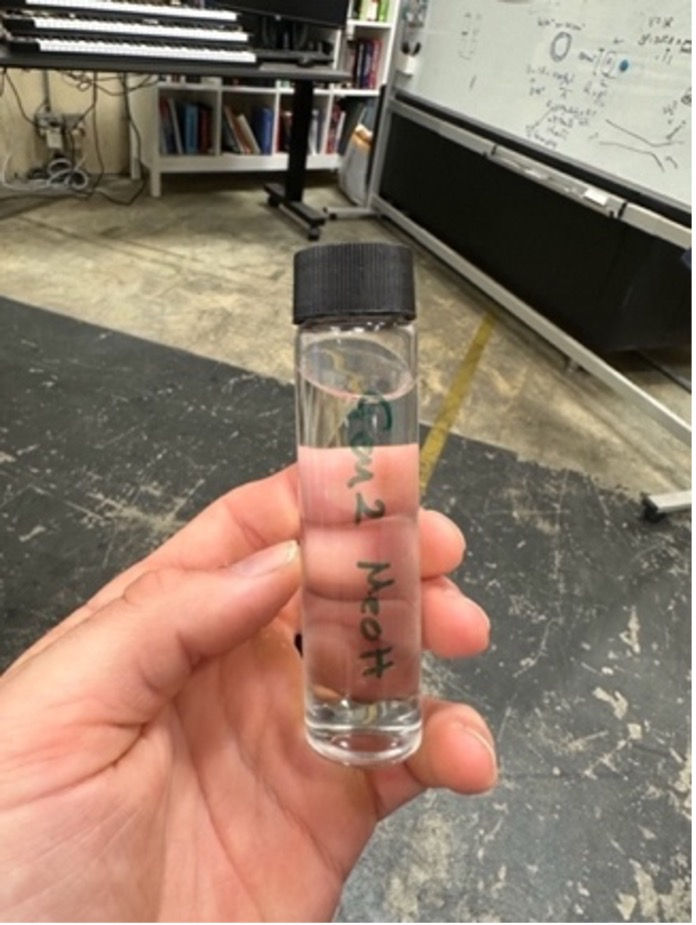
The flakes ride a conveyor belt for about two days while air passes over them. They go in soft and damp. They come out, in one Terraform engineer's words, “like crispy frosted flakes.”
Now the flakes have turned to limestone. They’re dropped through a chamber running at around 1,000°C. The heat cracks the rock apart, and pure carbon dioxide hisses off as gas.
The leftover lime goes back into what Casey calls “the glorified pasta roller,” where it’s pressed into fresh flakes, and the process starts over.
#2: The kettle
Next we need hydrogen, which comes from water.
Run electricity through water, and it splits into hydrogen and oxygen. The tool that does it is called an electrolyzer, and a commercial one costs about $1,500 per kilowatt.
Terraform’s costs under $100 a kilowatt.
Casey cut costs by refusing to make anything out of metal. The electrolyzer is injection-molded plastic, the same material as LEGO. His engineering rule is “If you can get it from Home Depot, use it.” An early carbon capture rig ran on a KitchenAid cake mixer.
#3: The pressure cooker
Now you have carbon dioxide and hydrogen. Put them in a hot, pressurized tube packed with cheap nickel pellets and they “have sex.” Out comes natural gas, plus water carrying away the leftover oxygen.
Traditional refineries are built to run 24/7. So how do you run a chemical plant like the Terraformer on a power source that turns off every evening?
Answer: the injection system, which Casey calls the most important thing Terraform built.
It feeds hydrogen and carbon into the reactor in exactly the right ratio, constantly. It throttles up and down second by second while holding its recipe to 0.1% accuracy.
A system like that typically costs up to $800,000. Terraform’s costs under $10,000.
Casey isn’t building the finest synthetic fuel machine. He’s building the cheapest one. It’s the “Southwest” of synthetic fuels—just as Southwest founder Herb Kelleher was singularly focused on building the world’s lowest-cost airline.
One Terraformer produces about 2.4 million cubic feet of natural gas a year… enough to heat and cook for 34 American homes. It’s chemically indistinguishable from what comes out of the ground in West Texas and plugs straight into the existing gas network.
Casey is:
The Rockefeller of solar.
John D. Rockefeller made his money in oil without ever drilling an oil well.
In the 1860s Rockefeller snapped up crude for pennies a barrel and refined it into kerosene, which brought light after dark to the masses.
Rockefeller refined crude into light. Casey is refining light into crude. At midday in California the grid now produces so much solar that it throws energy away. Casey buys panels and refines that “free” light into natural gas.
Both men bought something the world had a glut of and turned it into something it needed. And both men obsessed over relentlessly driving down costs.
Standard Oil sealed each kerosene tin with 40 drops of solder. Rockefeller tried 38 and the cans leaked. But 39 drops held, and across millions of tins that single drop was worth a fortune.
By 1880 he controlled 90% of America’s refining market.
Terraform is just as scrappy. Walk around Terraform’s castle, and you'll see sheets of DELETE stickers which engineers slap onto parts marked for elimination.
Other synthetic fuel plants need grid connections, substations, transformers, inverters, hydrogen storage and a refinery. Terraform deleted all those steps. The electricity goes straight out of the panel and into the Terraformer.
The Terraformer’s electrolyzer stacks are clamped shut by long metal bolts running through them. After an explosion in December they went looking for the weak point and found it was the bolts.
They ditched the bolts and welded the stacks instead. From 33 bolts to zero.
The first Terraformer was built for around $200,000. Casey reckons the same machine assembled from standard commercial parts would run to about $5 million.
Making expensive things is easy. Making cheap things is hard. Nobody at Terraform invented a new material or discovered a new reaction. What they did, meticulously, was find the cheapest part for each job, and brute-force it to work.
What really strikes me is the sheer number of hard problems this team had to beat.
An electrolyzer at a fraction of the commercial price… a direct air capture system that runs on a bucket of chalk… a chemical reactor for roughly the cost of a used car.
Any one of those is a company on its own. Terraform did all three, got them working together and taught the whole machine to wake up and fall asleep with the sun.
Casey describes Terraform’s first four years as…
“Eating glass.”
“Now the R&D phase is mostly over. The Terraformer is ready to go. Our first test site is up and running and making money.”
An hour north of Burbank, Terraform bought five acres of scrubland next to a junkyard. They named it Muroc, after the dry lakebed where Chuck Yeager broke the sound barrier in 1947.
Everyone told him permitting a site in California takes four years. Terraform went from buying the dirt to breaking ground in 53 days.
The whole site—land, 2,900 solar panels, everything—cost about $2 million. An oil well for less than the price of a nice house in Los Angeles.
When I visited in early July Terraform had just cleared two milestones. The team hauled the furnace that bakes carbon dioxide out to the desert. They ran it on nothing but solar panels, pushing about thirty kilowatts into the rig, in 110-degree heat.
Pure carbon dioxide, pulled from desert air, on the first try.
Days later came the test the entire company rests on.
Terraform plugged the water splitter straight into the solar array. When the sun came up the stack started splitting water into hydrogen and oxygen. It kept going all day and stopped only when the sun dipped behind the hills.
The hydrogen came out at under $2 per kilogram. As far as I know nobody achieved that before.
And Casey’s own accounting still carries what he calls a 2X “we're idiots, it’s the first time” premium. Which means it only gets cheaper from here.
Two of the Terraformer’s three “organs” are now alive in the desert. The reactor, which marries carbon and hydrogen into methane, goes in within weeks.
Terraform’s first customers are labs and engine test stands, which need ultra-pure gas that cannot be pulled from the ground. The first buyer is Astro Mechanica, the supersonic jet engine company ROS members know well. Founder Ian Brooke is switching his engines to run on LNG because, he told me, it costs a tenth as much as jet fuel.
Casey estimates his full-scale system will make natural gas for about $20 per thousand cubic feet. That’s roughly what gas sells for in Europe and Japan today. I asked Casey how he plans to take on America’s frackers, the cheapest gas producers on Earth. That, he said, is…
The final boss battle
I asked Casey what the world looks like if Terraform wins.
“Within a generation, energy poverty will seem as remote to humanity as famine or sabretooth attacks. Our grandchildren will be swimming in copious cheap energy and wondering what all that drilling was for.”
Five years ago Casey was a physicist saying fuel could be made from sunlight and air. Everyone nodded their head and then went back to scrolling TikTok.
Then Casey went and actually built the machine to do it… in a castle in Burbank… with parts you could buy at Home Depot.
Casey says: “If you are obsessed with something and determined to see something exist in the world that doesn't currently exist… and no one else is doing it, well, you’re it. It’s like your unborn children. They're depending on you to make them real.”
It doesn’t get more rationally optimistic than that. And we at ROS are depending on you to help us accelerate the incredible organic growth we’ve experienced so far.
Please share this article like our kids’ future depends on it! Then tell me in the comments what you want to build.
—Stephen McBride
For full disclosure, the founders of Rational Optimist Society have established a small fund that invests in companies we believe in. Our fund just invested in Terraform.


