
Companies that dwarf big tech
In today’s Diary:
- Big tech is small
- The US military’s 1 point of failure
- Getting to space is easy, but bringing stuff back down…
- Fake meat vs. lifesaving drugs
- Wall Street has no clue
Hey Rational Optimist,
I just got back from two weeks in America meeting with ambitious and audacious founders. What I saw changed the way I think about investing.
For my entire career, the hottest companies were always digital. Amazon and online shopping. Facebook and digital ads. Uber and Airbnb.
These digital winners created enormous wealth. Look at the world's most valuable companies. In 2010 just two of the top ten were “tech” companies. Now tech is 9/10!
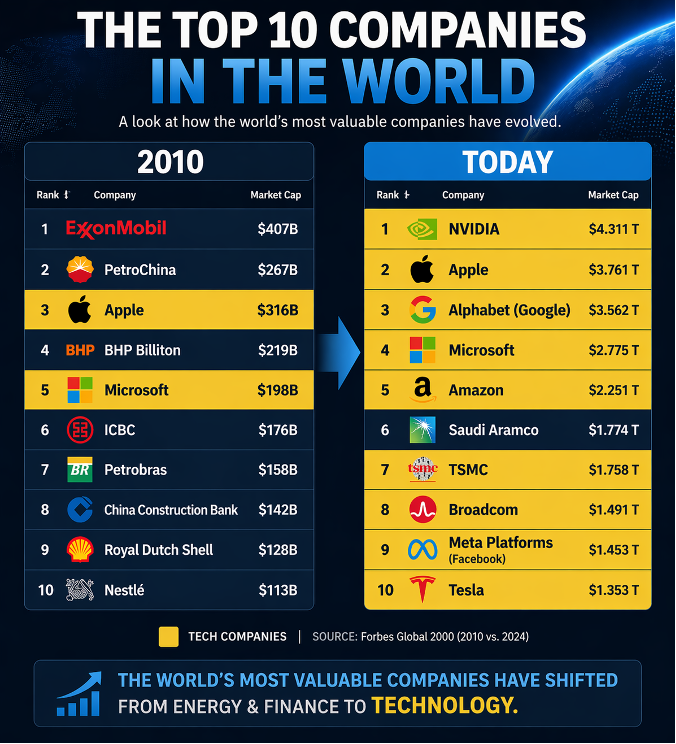
These nine companies are worth a combined $22 trillion. Remarkably eight of them were founded in San Francisco or Seattle.
It’s easy to look at that and think, “How can tech get any bigger?” NVIDIA alone is worth more than the entire stock market of France or Germany.
But then you look around at what’s happening and realize… tech is destined to get A LOT bigger. Within a decade $4 trillion for the world's largest company will look quaint. I'd stake my career on it.
Over dinner in NYC last week, deep tech investor Pablos Holman walked me through some numbers. If you add up all the revenue generated by tech companies—software + hardware + IT + cloud + everything else—you get $5 trillion.
Guess what global manufacturing output is?
$47 trillion.
And tech has barely touched it. That’s now changing, as our recent visit to Rangeview confirmed. Founder Cameron Schiller walked us through their historic warehouse where space shuttle engines were built in the 70s… and where Minutemen nuclear missiles were built before that.
Rangeview is repurposing this space to disrupt and redefine a 1,000+ year-old manufacturing process: metal casting.
To make a single custom part, a traditional foundry makes a custom metal die that costs $300,000, waits 6-8 months for tooling, then pours molten metal into the mold. 40+ hours of manual labor are required per part.
Rangeview is skipping all that. Behind sheets of orange glass in its El Segundo factory, it 3D-prints the ceramic mold directly from a digital file. It takes just 12 days to go from design to pour-ready mold.
Rangeview is already casting critical parts for fighter jets and nuclear microreactors, pouring nickel superalloys at 1,500°C.
Cameron thinks America made a devastating mistake by outsourcing our ability to make real things to China. He plans to build a hundred more of these factories in the US.
Varda is only the third company ever to…
Bring something back from space in one piece.
Thanks to SpaceX, we now have no problem launching stuff to space. Bringing stuff back without it burning up is arguably harder.
CTO Nick Cialdella gave us the tour of Varda’s El Segundo facility. Nick is ex-SpaceX and now leads one of this generation’s most boundary-pushing companies. Varda makes capsules that can safely bring stuff back to earth. I saw heat shields charred from reentry, sitting next to pristine ones about to launch.
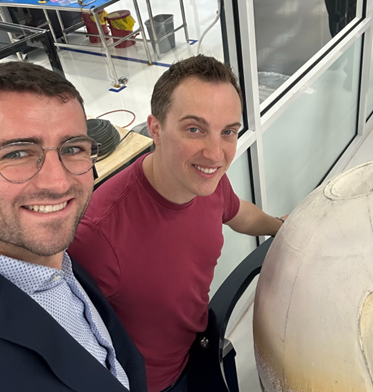
What do we need to bring back from space? Pharmaceuticals for starters. Inside Varda’s capsules, robotic systems make pharmaceutical compounds in microgravity that cannot be made on Earth.
Pharma is a $1.2 trillion market. Drugs are absurdly valuable per gram. Nick pointed out the entire global supply of mRNA Covid vaccines could fit inside a few milk jugs. When your product is that concentrated, the economics of launching to space and back pencil out.
Varda tests drugs and assembles spacecraft under one roof in El Segundo. It took over a warehouse Beyond Meat had pumped $50 million into. Fake meat to lifesaving space drugs—what an upgrade!
Varda is 5 for 5 on reentry missions. The first double launches are coming later this year—two capsules going up on one rocket.
What did you achieve in the last two years?
I kept asking myself that after visiting Valar Atomics founder Isaiah Taylor.
Isaiah is in his mid-twenties with four kids. He started Valar a little over two years ago and is on track to turn on the first nuclear microreactor in US history:
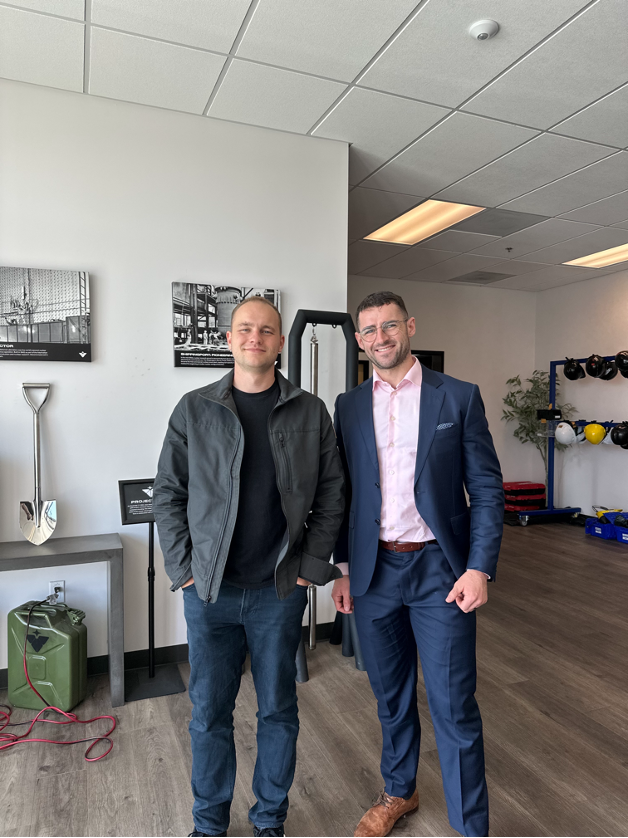
Valar is one of our favorite nuclear companies, and we've written about it many times. Isaiah calls it the “anti-SMR SMR company.”
Most small modular reactor startups imagine hundreds of reactors dotted around the world. Isaiah's vision is the opposite: cluster a thousand-plus microreactors on a single “gigasite,” pumping out clean, safe, abundant power.
Isaiah gave us a great nuclear history lesson. Early reactors were simple: uranium fuel inside graphite blocks.
Then the Navy needed reactors small enough to fit on a submarine. So they added water as a coolant. The commercial industry copied that design and scaled it up.
Problem is water-cooled reactors are inherently dangerous. When water gets too hot it turns to steam and can cause explosions. The nuclear industry spent the next 60 years trying to make a fundamentally dangerous design safe.
Valar is using a design that’s fundamentally safe—graphite-moderated, no water.
Last time Dan and I visited we got to see Valar’s test reactor up close. This time the factory floor was empty because the reactor had been shipped to its test site in Utah.
The reactor has been ramped to full temperature and running at full power for four weeks. DOE inspectors are on-site. Isaiah says it will fully turn on before July 4th.
Affordable housing is upstream of everything.
In New York I saw many couples carrying dogs like babies. Some push their dogs in strollers.
I wonder how many more kids we’d have if people could afford housing?
That's why Cuby is one of the most underrated innovators.
I was in New York for less than 24 hours but made time to see my friend Aleks Gampel, Cuby’s co-founder:

Cuby doesn’t build houses. It builds the factories that build houses.
Take an entire automotive-grade production line—robotics, CNC machines, welding stations—and pack it into 150 shipping containers. Cuby’s Mobile Micro-Factories (MMF) will pump out 200 homes per year. They’re targeting to build at roughly half the cost of traditional builders.
Its first US factory is shipping to New Mexico right now. Sixty of 150 containers are already on-site. It starts producing homes in Q1 2027.
I can’t wait to visit its first factory later this year.
So we’ve got Rangeview, Varda, Valar, and Cuby attacking manufacturing, pharma, energy, and construction.
What do these industries have in common?
They’re gigantic!
Tech is finally coming to reshape them.
If Rational Optimist Society has an investing thesis, it’s that the biggest prize pools are finally being disrupted by technology.
Most of the founders I met are dedicating the best years of their lives to transforming industries that are much, much larger than the software markets that made the last generation of billionaires.
Armed with the SpaceX mindset of “iterate fast, no excuses,” I think they’re going to win.
At the end of my trip, I met several investors and analysts in New York. Smart dudes. But none of them had a clue about the hard tech renaissance blossoming on the West Coast.
I saw the future over the past few weeks. It’s going to be better than you can possibly imagine.
—Stephen McBride


